52
-1
0
30
Briefs: Software
A new system that brings together real-world sensing and virtual reality would make it easier for building maintenance personnel to identify and fix issues in commercial buildings that are in operation. The system was developed by computer scientists at the University of California San Diego and Carnegie Mellon University. Read on to learn more.

Briefs: RF & Microwave Electronics
Researchers from Sandia National Laboratories and Ohio State University are taking experimental navigation technology to the skies, pioneering a backup system to keep an airplane on course when it cannot rely on global positioning system satellites. Read on to learn more.

Briefs: Communications
Cornell researchers have developed a low-power microchip they call a “microwave brain,” the first processor to compute on both ultrafast data signals and wireless communication signals by harnessing the physics of microwaves. Read on to learn more about it.

Briefs: RF & Microwave Electronics
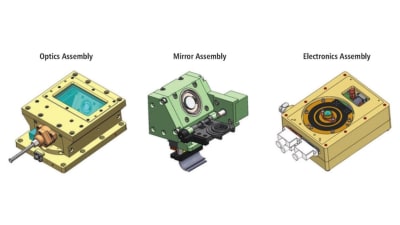
NASA Goddard Space Flight Center has developed a Space Qualified Rover LiDAR (SQRLi) system that will improve rover sensing capabilities in a small, lightweight package. The new SQRLi package is developed to survive the hazardous space environment and provide valuable image data during planetary and lunar rover exploration. Read on to learn more about it.
Briefs: Sensors/Data Acquisition
Mechanical engineering researchers in the Harvard John A. Paulson School of Engineering and Applied Sciences think there’s another way to design robots: Programming intended functions directly into a robot’s physical structure, allowing the robot to react to its surroundings without the need for extensive on-board electronics. Read on to learn more.

Briefs: Aerospace
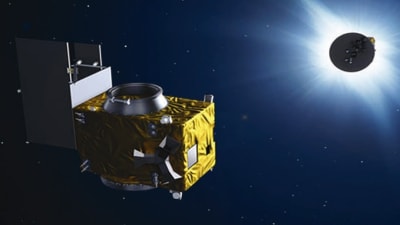
NASA has developed an innovative combination of a Magnetometer, low-powered ElectroMagnets, and Resonant Inductive Coupling (MEMRIC) to create and control relative positioning of nano satellites within a cluster. This is a game-changing approach to enable distributed nanosatellite (nanosat) clusters. Read on to learn more.
Briefs: AR/AI
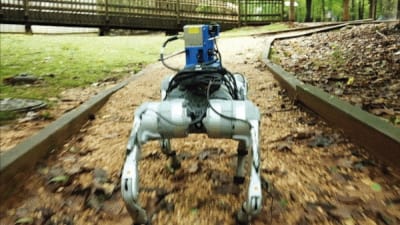
Researchers from Duke University have developed a novel framework named WildFusion that fuses vision, vibration, and touch to enable robots to “sense” complex outdoor environments much like humans do. Read on to learn more.
Briefs: RF & Microwave Electronics
Despite all the technological evolution in navigation, waters just off coastal shores around the globe have remained a black box. That is, until researchers from The University of Texas at Austin and Oregon State University developed a new technology that uses satellites in space to map out these tricky areas. Read on to learn more about it.

Briefs: Imaging
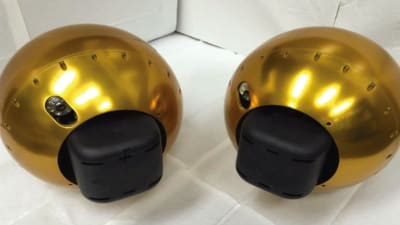
Innovators at NASA Johnson Space Center have developed a robotic system whose primary structural platform, or “orb,” can be injected into a pipe network and perform reconnaissance of piping infrastructure and other interior volumes. When deployed, this technology uses throttled fluid flow from a companion device for passive propulsion. Read on to learn more.
Briefs: Sensors/Data Acquisition
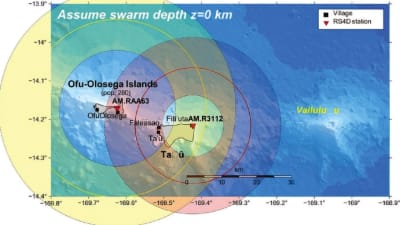
Residents of the Manu’a Islands in American Samoa were feeling the earth shake, raising concerns of an imminent volcanic eruption or tsunami. Scientists from the U.S. Geological Survey used machine learning and a technique called template matching on shaking data recorded from a single seismic sensor located 250 kilometers away to locate the source of the shaking. Read on to learn more.
Briefs: AR/AI
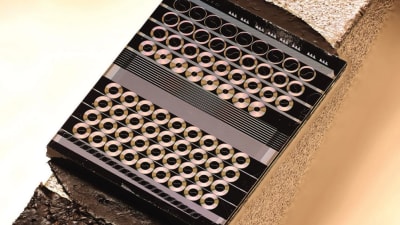
Artificial intelligence systems promise transformative advancements, yet their growth has been limited by energy inefficiencies and bottlenecks in data transfer. Researchers at Columbia Engineering have unveiled a groundbreaking solution: a 3D photonic-electronic platform that achieves unprecedented energy efficiency and bandwidth density, paving the way for next-generation AI hardware. Read on to learn more.
Briefs: AR/AI
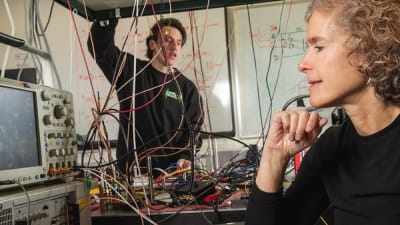
Augmented reality has become a hot topic in the entertainment, fashion, and makeup industries. Though a few different technologies exist in these fields, dynamic facial projection mapping is among the most sophisticated and visually stunning ones. Read on to learn more about it.

Briefs: Photonics/Optics
Researchers have developed a photonic chip-based traveling wave parametric amplifier that achieves ultra-broadband signal amplification in an unprecedentedly compact form. Read on to learn more about it.
Briefs: Sensors/Data Acquisition
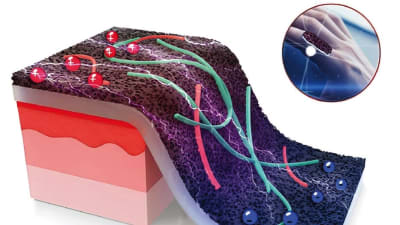
A major challenge in self-powered wearable sensors for health care monitoring is distinguishing different signals when they occur at the same time. Researchers addressed this issue by uncovering a new property of a sensor material, enabling the team to develop a new type of flexible sensor that can accurately measure both temperature and physical strain simultaneously but separately to more precisely pinpoint various signals. Read on to learn more.
Briefs: RF & Microwave Electronics
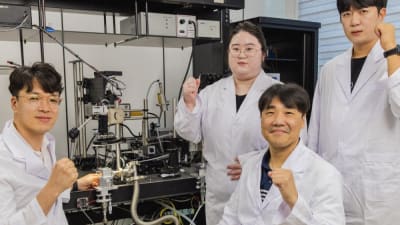
A research team led by Dr. Daeho Kim and Dr. Jong Hwan Park at the Nano Hybrid Technology Research Center of the Korea Electrotechnology Research Institute has developed a groundbreaking process technology that enables ultrafast, 30-second preparation of hard carbon anodes for sodium-ion batteries, using microwave induction heating. Read on to learn more.
Briefs: Imaging
Scientists have developed multi-modal 3D object detection methods that combine 3D LiDAR data with 2D RGB images taken by standard cameras. While the fusion of 2D images and 3D LiDAR data leads to more accurate 3D detection results, it still faces its own set of challenges, with accurate detection of small objects remaining difficult. Read on to learn more about it.

Briefs: RF & Microwave Electronics
The Brown University research team created a novel approach for a wireless communication network that can efficiently transmit, receive, and decode data from thousands of microelectronic chips that are each no larger than a grain of salt. Read on to learn more about it.

Briefs: RF & Microwave Electronics
Innovators at NASA Johnson Space Center have developed an adaptable RFID system that optimizes transmission for priority data as targets move in and out of passive coverage areas. The method extends the range, and reduces data latency, of ultra-low power battery-assisted passive RFID sensor tags. Read on to learn more.
Briefs: RF & Microwave Electronics
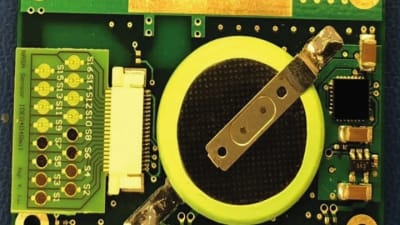
A future quantum network may become less of a stretch thanks to researchers at the Argonne National Laboratory, the University of Chicago, and Cambridge University. By “stretching” thin films of diamond, they created quantum bits that can operate with significantly reduced equipment and expense. Read on to learn more.

Briefs: RF & Microwave Electronics
Researchers at Texas A&M University are working on a new method of infrastructure monitoring using Synthetic Aperture Radar (SAR) remote sensing systems. SAR allows researchers to inspect and characterize pavements, retaining walls, and embankments from space and can help determine if there are flaws that should be further inspected for repair, saving valuable time. Read on to learn more.

Briefs: RF & Microwave Electronics
In a paper published in the journal Nature Nanotechnology, a team of Caltech engineers reports building a metasurface patterned with miniscule tunable antennas capable of reflecting an incoming beam of optical light to create many sidebands, or channels, of different optical frequencies. Read on to learn more.

Briefs: RF & Microwave Electronics
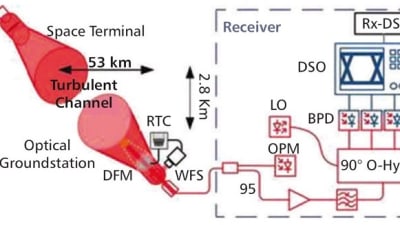
Researchers have achieved data rates as high as 424Gbit/s across a 53-km turbulent free-space optical link using plasmonic modulators — devices that uses special light waves called surface plasmon polaritons to control and change optical signals. The new research lays the groundwork for high-speed optical communication links that transmit data over open air or space. Read on to learn more.
Briefs: RF & Microwave Electronics
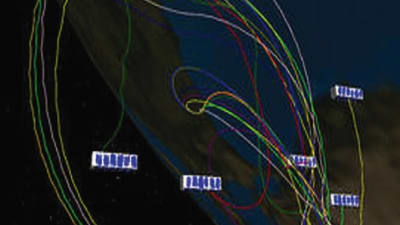
To address scalable control of orbital dynamics, NASA Ames Research Center has patented Swarm Orbital Dynamics Advisor (SODA) — a solution that accepts high-level configuration commands and provides the orbital maneuvers needed to achieve the desired type of swarm relative motion. Read on to learn more.
Briefs: Power
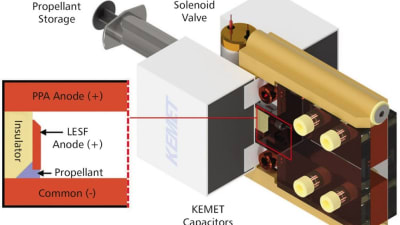
A novel micropropulsion system was developed for nanosatellite applications using a liquid-fed pulsed-plasma thruster. It uses a liquid propellant for a Lorentz-force pulsed-plasma accelerator and an extended lifetime ignition system driven by nanosecond-long pulses. Read on to learn more.
Briefs: Software
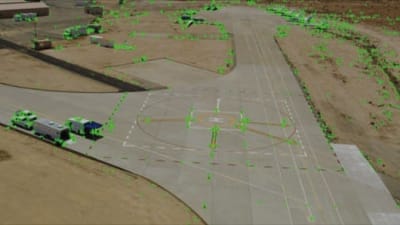
Incorporating a vision-based navigation method, NASA Ames has developed a novel Alternative Position, Navigation, and Timing (APNT) solution for AAM aircraft in environments where GPS is not available. Read on to learn more about it.
Briefs: Aerospace
A research team from the University of Waterloo’s Laboratory for Emerging Energy Research is looking into processing lunar regolith, the Moon’s top layer of soil and dust, into usable materials for life support, energy generation, and construction. This includes investigating the use of defunct satellite material as a fuel source when mixed with lunar regolith. Read on to learn more.
Briefs: Power
All-in-One, High-Power Microwave System
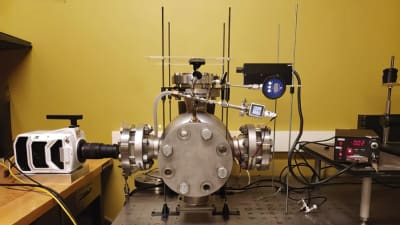
A device was developed that uses composite-based nonlinear transmission lines (NLTLs) for a complete high-power microwave system, eliminating the need for multiple auxiliary systems. Read on to learn more.
Briefs: Semiconductors & ICs
Researchers at the University of California, Davis, have developed a proof-of-concept sensor that may usher in a new era for millimeter wave radars. They call its design a “mission impossible” made possible. Read on to learn more.

Briefs: Imaging
Southwest Research Institute has developed off-road autonomous driving tools with a focus on stealth for the military and agility for space and agriculture clients. The vision-based system pairs stereo cameras with novel algorithms, eliminating the need for LiDAR and active sensors. Read on to learn more.

Top Stories
 Blog: Lighting

A Stretchable OLED that Can Maintain Most of Its Luminescence
 INSIDER: Design

Advancing All-Solid-State Batteries
 Blog: Energy

Batteries that Can Withstand the Cold
 Blog: AR/AI

My Opinion: We Need More Power Soon — Is Nuclear the Answer?
 News: Power

 Blog: Aerospace

Webcasts
 Upcoming Webinars: AR/AI

From Spreadsheets to Insights: Fast Data Analysis Without Complex...
 Upcoming Webinars: Electronics & Computers

Cooling a New Generation of Aerospace and Defense Embedded...
 Upcoming Webinars: Test & Measurement

Beyond AI-Copy-Paste Engineering: Advanced AI-Integration Success...
 Upcoming Webinars: Power

Battery Abuse Testing: Pushing to Failure
 Upcoming Webinars: AR/AI

A FREE Two-Day Event Dedicated to Connected Mobility
 Upcoming Webinars: RF & Microwave Electronics

Choosing the Right N-Port Strategy: Multiport VNAs vs. Switch...