54
-1
30
30
Briefs: Semiconductors & ICs
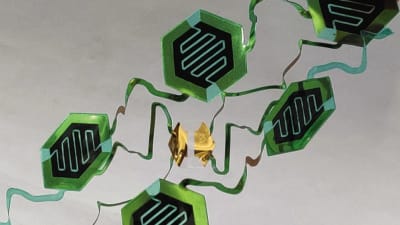
Engineers have developed a new technique for making wearable sensors that enables medical researchers to prototype and test new designs much faster and at a far lower cost than existing methods. Read on to learn more.
Briefs: AR/AI
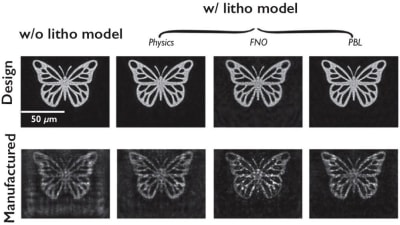
A new method enables optical devices that more closely match their design specifications, boosting accuracy and efficiency. Read on to learn more.
Briefs: Communications
Scientists have pioneered a method for using semiconductor technology to manufacture processors that significantly enhance the efficiency of transmitting vast amounts of data across the globe. The innovation is poised to transform the landscape of wireless communication. Read on to learn more.

Briefs: Electronics & Computers
After announcing a ferroelectric semiconductor at the nanoscale thinness required for modern computing components, a University of Michigan team has demonstrated a reconfigurable transistor using that material. Read on to learn more.

Briefs: Semiconductors & ICs
Penn Engineers have developed a new chip that uses light waves, rather than electricity, to perform the complex math essential to training AI. The chip has the potential to radically accelerate the processing speed of computers while also reducing their energy consumption. Read on to learn more.

Briefs: RF & Microwave Electronics
Researchers at Chalmers University of Technology have developed an optical amplifier that they expect will revolutionize both space and fiber communication.

Briefs: Semiconductors & ICs
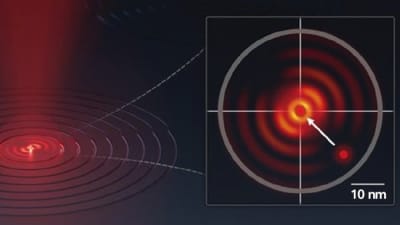
Researchers have developed standards and calibrations for optical microscopes that allow quantum dots to be aligned with the center of a photonic component to within an error of 10 to 20 nanometers (about one-thousandth the thickness of a sheet of paper). Such alignment is critical for chip-scale devices that employ the radiation emitted by quantum dots to store and transmit quantum information. Read on to learn more.
Briefs: Sensors/Data Acquisition
A research team from Kyushu University, in collaboration with Japanese company Nitto Denko, has developed a tape that can be used to stick 2D materials to many different surfaces, in an easy and user-friendly way.

Briefs: Materials
Microelectronics face a key challenge because of their small size. To avoid overheating, microelectronics need to consume only a fraction of the electricity of conventional electronics while still operating at peak performance. Researchers have achieved a breakthrough that could allow for a new kind of microelectronic material to do just that.
Briefs: Sensors/Data Acquisition
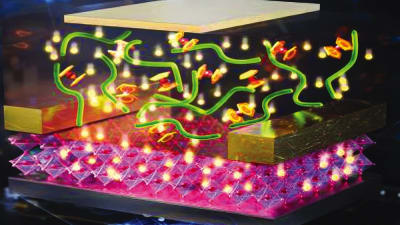
Researchers from Tokyo University of Science (TUS) led by Associate Professor Takashi Ikuno have developed a flexible paper-based sensor that operates like the human brain. The researchers fabricated a photo-electronic artificial synapse device composed of gold electrodes on top of a 10 μm transparent film consisting of zinc oxide (ZnO) nanoparticles and cellulose nanofibers (CNFs).

Briefs: Medical
Detector can identify radioactive isotopes with high resolution.

Briefs: Manufacturing & Prototyping
A multi-institutional project led by a Penn State researcher is focused on developing an all-in-one semiconductor device that can both store data and perform computations. The project recently received $2 million in funding over three years as part of the new National Science Foundation Future of Semiconductors (FuSe) program.
Briefs: Photonics/Optics
RMIT University’s Arnan Mitchell and University of Adelaide’s Dr. Andy Boes led an international team to review lithium niobate’s capabilities and potential applications in the journal Science. The team is working to make navigation systems that help rovers drive on the Moon — where GPS is unable to work — later this decade.
Briefs: Lighting
This advancement, one of the first of its kind, enables a useful new capability for a variety of applications, including improved prostheses, haptics for new modalities in augmented reality (AR), and thermally modulated therapeutics for applications such as pain management. The technology also has a variety of potential industrial and research applications.
Briefs: Semiconductors & ICs
The miniscule wires — the size of transistors on silicon chips or one thousandth of the breadth of the finest human hair — are made completely of natural amino acids and heme molecules, found in proteins such as hemoglobin, which transports oxygen in red blood cells.

Briefs: Materials
Researchers have unveiled a remarkable new material with potential to impact the world of material science: amorphous silicon carbide (a-SiC). Beyond its exceptional strength, this material demonstrates mechanical properties crucial for vibration isolation on a microchip. It is therefore particularly suitable for making ultra-sensitive microchip sensors.
Briefs: Photonics/Optics
Researchers have created a device that enables them to electronically steer and focus a beam of terahertz electromagnetic energy with extreme precision. This opens the door to high-resolution, real-time imaging devices that are hundredths the size of other radar systems and more robust than other optical systems.
Briefs: Manned Systems
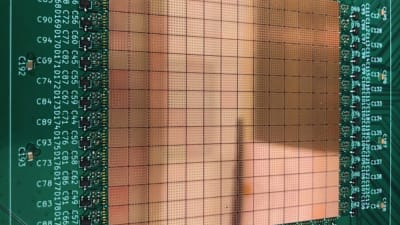
Wireless power transfer was recently demonstrated by MAPLE — Microwave Array for Power-transfer Low-orbit Experiment — one of three key technologies being tested by the Space Solar Power Demonstrator (SSPD-1), the first space-borne prototype from Caltech’s Space Solar Power Project (SSPP), which aims to harvest solar power in space and transmit it to the Earth’s surface.

Briefs: Photonics/Optics
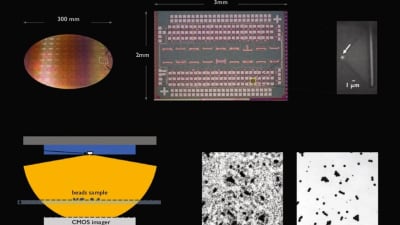
Researchers have developed the world’s smallest LED. It enables the conversion of existing mobile phone cameras into high-resolution microscopes. Smaller than the wavelength of light, the new LED was used to build the world’s smallest holographic microscope.
Briefs: Semiconductors & ICs
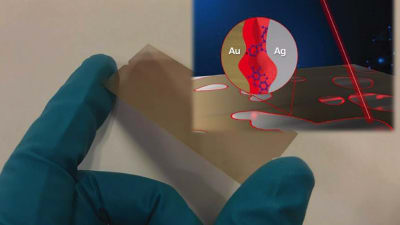
Study shows improvements to chemical sensing chip that aims to quickly and accurately identify drugs and other trace chemicals.
Briefs: Mechanical & Fluid Systems
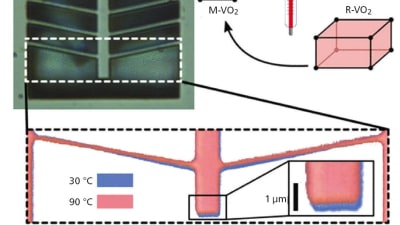
An ultra-small actuator has nanometer-scale precision.
Briefs: Materials
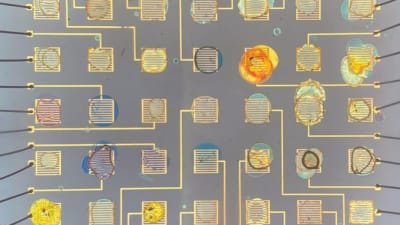
A team of researchers demonstrated the first light-emitting array with 49 different colors on a single chip. This novel optoelectronic device is built on metal-oxide semiconductor capacitors.
Briefs: Materials
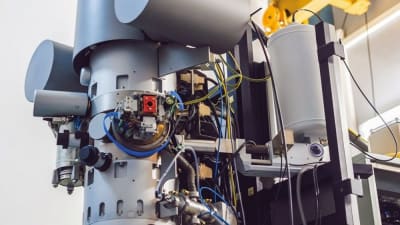
With a new microscopy technique that uses blue light to measure electrons in semiconductors and other nanoscale materials, a team of researchers is opening a new realm of possibilities in the study of these critical components, which can help power devices like mobile phones and laptops.
Briefs: Electronics & Computers
Praneeth Namburi is a research scientist at the MIT.nano Immersion Lab. One project that bridges the physical and digital worlds uses VR simulations to train people to fabricate computer chips and semiconductors.

Briefs: Semiconductors & ICs
A Northwestern University research team has developed a revolutionary transistor that is expected be ideal for lightweight, flexible, high-performance bioelectronics. The electrochemical transistor is compatible with blood and water and can amplify important signals.

Briefs: AR/AI
Researchers have demonstrated an energy-efficient method for transferring larger quantities of data over the fiber-optic cables that connect the nodes. This new technology improves on previous attempts to transmit multiple signals simultaneously over the same fiber-optic cables.

Briefs: Photonics/Optics
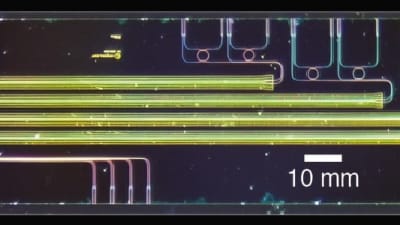
A team of researchers led by electrical engineer Marko Lončar at SEAS has developed a method for building a highly efficient integrated isolator that’s seamlessly incorporated into an optical chip made of lithium niobate.
Briefs: Semiconductors & ICs
MIT researchers have developed a quantum computing architecture that aims to enable extensible, high-fidelity communication between superconducting quantum processors.

Briefs: Photonics/Optics
Researchers have developed a colloidal synthesis method for alkaline earth chalcogenides. This method allows them to control the size of the nanocrystals in the material.

Top Stories
 Blog: Lighting

A Stretchable OLED that Can Maintain Most of Its Luminescence
 Blog: Energy

Batteries that Can Withstand the Cold
 INSIDER: Energy

Advancing All-Solid-State Batteries
 Quiz: Energy

 Blog: Physical Sciences

 Blog: Materials

Webcasts
 Upcoming Webinars: Test & Measurement

From Spreadsheets to Insights: Fast Data Analysis Without Complex...
 Upcoming Webinars: Electronics & Computers

Cooling a New Generation of Aerospace and Defense Embedded...
 Upcoming Webinars: Test & Measurement

Beyond AI-Copy-Paste Engineering: Advanced AI-Integration Success...
 Upcoming Webinars: Automotive

Battery Abuse Testing: Pushing to Failure
 Upcoming Webinars: Internet of Things

A FREE Two-Day Event Dedicated to Connected Mobility
 Upcoming Webinars: Test & Measurement

Choosing the Right N-Port Strategy: Multiport VNAs vs. Switch...