35
-1
30
30
Briefs: Lighting Technology
Researchers have designed a spiral ladder-inspired tool that allows precision control of light direction and polarization to control the direction of the emitted beam and the polarization of the light, while using a precisely engineered resonance of the structure. Read on to learn more.

Briefs: Photonics/Optics
A team from the University of Barcelona and the Universitat Oberta de Catalunya has designed a methodology that facilitates the recognition of QR codes in these physical environments, where reading is more complicated. Read on to learn more.

Briefs: Photonics/Optics
Researchers have successfully developed a wide-bandwidth, low-polarization semiconductor optical amplifier based on tensile-strained quantum wells. The study, published in the journal Sensors, presents a significant advancement in optical communication technology, addressing the growing demand for higher bandwidth and lower polarization sensitivity. Read on to learn more.

Briefs: Imaging
A team led by University of Maryland computer scientists invented a camera mechanism that improves how robots see and react to the world around them. Inspired by how the human eye works, their innovative camera system mimics the tiny involuntary movements used by the eye to maintain clear and stable vision over time. Read on to learn more.

Briefs: Nanotechnology
In a paper published in the journal Nature Nanotechnology, a team of Caltech engineers reports building a metasurface patterned with miniscule tunable antennas capable of reflecting an incoming beam of optical light to create many sidebands, or channels, of different optical frequencies. Read on to learn more.

Briefs: Data Acquisition
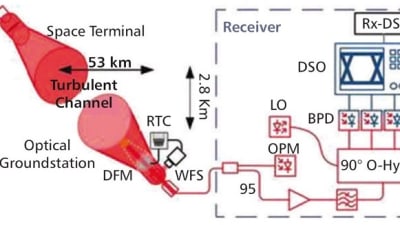
Researchers have achieved data rates as high as 424Gbit/s across a 53-km turbulent free-space optical link using plasmonic modulators — devices that uses special light waves called surface plasmon polaritons to control and change optical signals. The new research lays the groundwork for high-speed optical communication links that transmit data over open air or space. Read on to learn more.
Briefs: Photonics/Optics
A team of scientists has developed an ultrafast imaging technique, called femtosecond laser sheet-compressed ultrafast photography, that can compile videos of incredibly transient details. Read on to learn more about it.

Briefs: Photonics/Optics
Butterflies can see more of the world than humans, including more colors and the field oscillation direction, or polarization, of light. Other species, like the mantis shrimp, can sense an even wider spectrum of light, as well as the circular polarization, or spinning states, of light waves. Inspired by these abilities in the animal kingdom, researchers have developed an ultrathin optical element known as a metasurface, which can attach to a conventional camera and encode the spectral and polarization data of images captured in a snapshot or video through tiny, antenna-like nano-structures that tailor light properties.

Briefs: Photonics/Optics
A new type of organic light emitting diode (OLED) could replace bulky night vision goggles with lightweight glasses, making them cheaper and more practical for prolonged use, according to University of Michigan researchers. Read on to learn more.
Briefs: Imaging
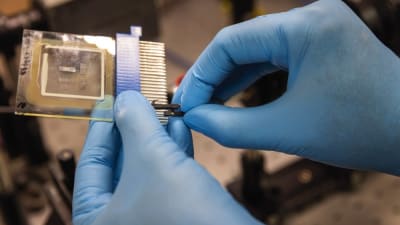
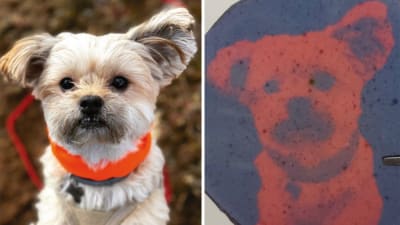
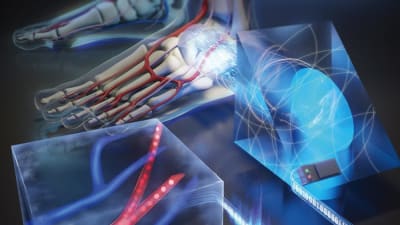
Imagine if physicians could capture 3D projections of medical scans, suspending them inside an acrylic cube to create a hand-held reproduction of a patient’s heart, brain, kidneys, or other organs. Then, when the visit is done, a quick blast of heat erases the projection, and the cube is ready for the next scan. A new report by researchers at Dartmouth and Southern Methodist University outlines a technical breakthrough that could enable such scenarios, and others, with widespread utility. Read on to learn more.
Briefs: Photonics/Optics
Researchers have developed a new way to map water on land in the tropics. Called the UC Berkeley Random Walk Algorithm WaterMask, this advanced monitoring technology uses L-band microwaves from the Cyclone Global Navigation Satellite System to “see” water hidden beneath visual barriers, like tree canopies and clouds. Read on to learn more.

Briefs: Materials
If the outside of clothing or a vehicle were covered with the coating, an infrared camera would have a harder time distinguishing what is underneath. Read on to learn what this means.

Briefs: Energy
The “nanoswimmers” could be used to remediate contaminated soil, improve water filtration, or even deliver drugs to targeted areas of the body.
Briefs: Photonics/Optics
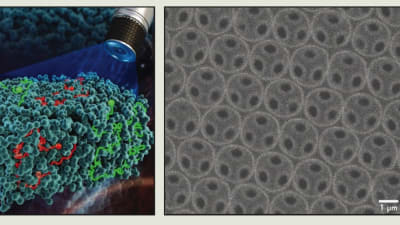
In a newly published paper in the journal Science, researcher Qiushi Guo demonstrated a novel approach for creating high-performance, ultrafast lasers on nanophotonic chips. His work centers on miniaturizing mode-lock lasers. Read on to learn more.
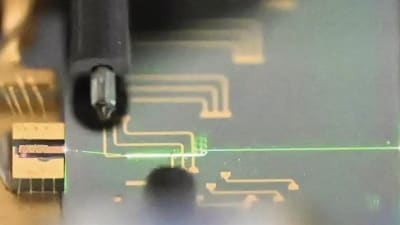
Briefs: AR/AI
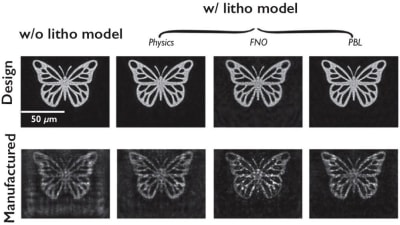
A new method enables optical devices that more closely match their design specifications, boosting accuracy and efficiency. Read on to learn more.
Briefs: Communications
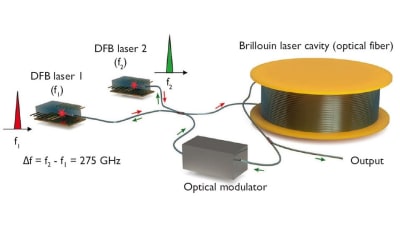
The researchers anticipate that with multiplexing techniques (where more than one channel can be used) and more sensitive receivers, the data rate can be increased to 1 terabit per second, ushering in a new era of near-instantaneous global communication. Read on to learn more.
Briefs: Photonics/Optics
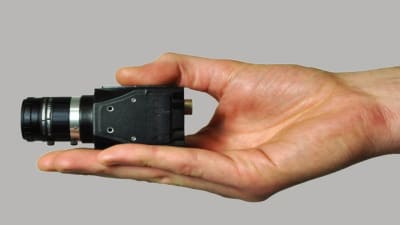
The palm-sized light field camera could improve autonomous driving, classification of recycled materials, and remote sensing. Read on to learn more about it.
Briefs: Photonics/Optics
This innovative camera technology represents a significant advance in object detection, offering numerous potential applications across various industries. Read on to learn more.
Briefs: Photonics/Optics
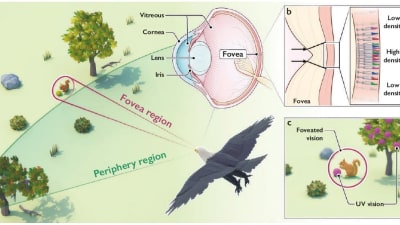
Penn Engineers have developed a new chip that uses light waves, rather than electricity, to perform the complex math essential to training AI. The chip has the potential to radically accelerate the processing speed of computers while also reducing their energy consumption. Read on to learn more.

Briefs: Sensors/Data Acquisition
Researchers at Chalmers University of Technology have developed an optical amplifier that they expect will revolutionize both space and fiber communication.

Briefs: Photonics/Optics
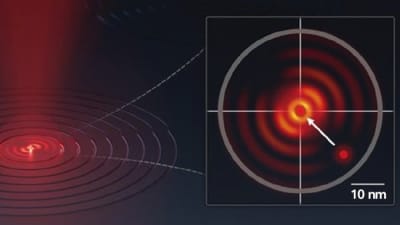
Researchers have developed standards and calibrations for optical microscopes that allow quantum dots to be aligned with the center of a photonic component to within an error of 10 to 20 nanometers (about one-thousandth the thickness of a sheet of paper). Such alignment is critical for chip-scale devices that employ the radiation emitted by quantum dots to store and transmit quantum information. Read on to learn more.
Briefs: Physical Sciences
Researchers have developed a new way to produce and shape large, high-quality mirrors that are much thinner than conventional space-telescope mirrors. The final product is even flexible enough to be rolled up and stored compactly inside a launch vehicle. Read on to learn more.

Briefs: Photonics/Optics
There are times when scientific progress comes in the form of discovering something completely new. Other times, progress boils down to doing something better, faster, or more easily. New research from the lab of Caltech’s Lihong Wang, the Bren Professor of Medical Engineering and Electrical Engineering, is the latter. Read on to learn more.
Briefs: Imaging
Mimicking the easy, instantaneous image processing power of the human eye, Penn State electrical engineering researchers created a metasurface, an optical element akin to a glass slide that uses tiny nanostructures, placed at different angles to control light.
Briefs: Photonics/Optics
A new approach has allowed researchers at Aalto University to design a kind of metamaterial that has so far been beyond the reach of existing technologies. Unlike natural materials, metamaterials and metasurfaces can be tailored to have specific electromagnetic properties, which means scientists can create materials with features desirable for industrial applications.
Briefs: Robotics, Automation & Control
Researchers from Japan have developed DPPFA–Net, an innovative network that overcomes challenges related to occlusion and noise introduced by adverse weather.

Briefs: RF & Microwave Electronics
Innovators at the NASA Glenn Research Center have developed the PLGRM system, which allows an installed antenna to be characterized in an aircraft hangar. All PLGRM components can be packed onto pallets, shipped, and easily operated.

Briefs: Photonics/Optics
Robots and cameras of the future could be made of liquid crystals, thanks to a new discovery that significantly expands the potential of the chemicals already common in computer displays and digital watches. The findings are a simple and inexpensive way to manipulate the molecular properties of liquid crystals with light exposure.

Briefs: Medical
Usually developing slowly over time, many cases of glaucoma are only picked up during routine eye tests, by which time lasting damage may already have been caused. But this could change in the future as academics from the U.K. and Türkiye have developed a contact lens which can detect changes in eye pressure which signal possible glaucoma.

Top Stories
 Blog: Lighting

A Stretchable OLED that Can Maintain Most of Its Luminescence
 Blog: Energy

Batteries that Can Withstand the Cold
 INSIDER: Energy

Advancing All-Solid-State Batteries
 Quiz: Energy

 Blog: Physical Sciences

 Blog: Materials

Webcasts
 Upcoming Webinars: Test & Measurement

From Spreadsheets to Insights: Fast Data Analysis Without Complex...
 Upcoming Webinars: Electronics & Computers

Cooling a New Generation of Aerospace and Defense Embedded...
 Upcoming Webinars: Test & Measurement

Beyond AI-Copy-Paste Engineering: Advanced AI-Integration Success...
 Upcoming Webinars: Automotive

Battery Abuse Testing: Pushing to Failure
 Upcoming Webinars: Internet of Things

A FREE Two-Day Event Dedicated to Connected Mobility
 Upcoming Webinars: Test & Measurement

Choosing the Right N-Port Strategy: Multiport VNAs vs. Switch...