35
-1
660
30
Briefs: Photonics/Optics
The field of view required for future missions is much larger than for the James Webb Space Telescope (JWST). Researchers at NASA’s Goddard Space Flight Center have created a new actuation scheme to...
Briefs: Photonics/Optics
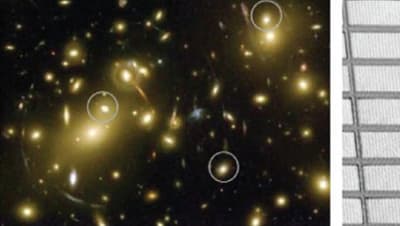
A Novel Orbiting Cloud Imager System for IR/UV/ X-Ray Bands
Typically, the cost of a spaceborne imaging system is driven by the size and mass of the primary aperture. Innovative solutions for imagers that are less complex and are lightweight are very desirable. Currently, telescopes such as JWST and ATLAST are very expensive and very complex.
Briefs: Photonics/Optics
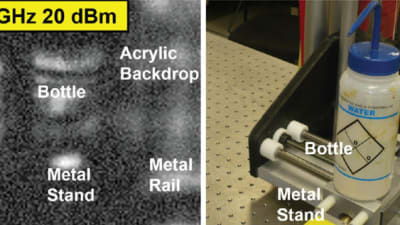
Millimeter-wave (mm-wave) imaging techniques are already a popular solution for imaging through dust and fog. While mm-wave offers excellent penetration to dust when compared with infrared or optical sensing,...
Briefs: Photonics/Optics
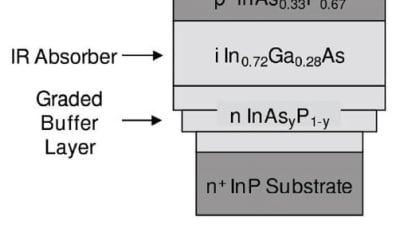
Traditional applications for 2-micron photodetectors have been largely dominated by passive remote sensing where detectors having bandwidth of even one...
Briefs: Photonics/Optics
Fourier Transform Spectrometer System
NASA's Langley Research Center and Science Applications International Corporation have developed a method of processing data from Fourier transform spectroscopy (FTS) measurements that improves upon existing methods. This method is simpler, more accurate, faster, and less expensive than previous methods. It...
Briefs: Photonics/Optics
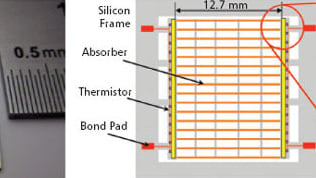
Measurements of the cosmic microwave background are a powerful probe of the early universe. Part-per-million fluctuations in the intensity of background trace the initial...
Briefs: Photonics/Optics
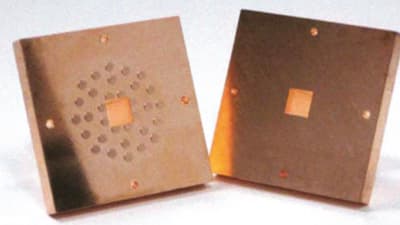
Photonic choke-joint (PCJ) structures for dual-polarization waveguides have been investigated at NASA's Goddard Space Flight Center for use in device and component packaging. This interface...
Briefs: Photonics/Optics
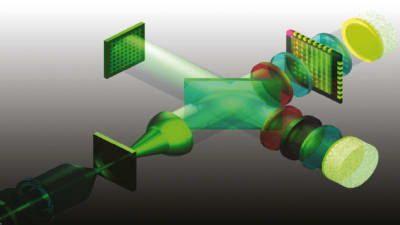
NASA's Langley Research Center has developed an adaptable and powerful interferometric test platform that uniquely enables multi-parameter evaluation of a wide variety of smart optical...
Briefs: Photonics/Optics
Compact Planar Microwave Blocking Filters
Innovators at NASA's Goddard Space Flight Center have designed, fabricated, and characterized absorptive thermal blocking filters for cryogenic microwave applications. The device allows direct integration of the high-frequency signal and microwave readout, and mitigates spurious resonances in the circuit...
Briefs: Photonics/Optics
NASA's Langley Research Center has made a breakthrough improvement in laser frequency modulation. Frequency modulation technology has been used for surface...
Briefs: Imaging
Systems and Methods for Mirror Mounting with Minimized Distortion
The use of larger, lighter, and more precise space optics requires not only a means of manufacture, but also a means of spacecraft integration and performance verification. Engineers at NASA's Goddard Space Flight Center (GSFC) have demonstrated a process capable of producing a...
Briefs: Photonics/Optics
Improved Approach to Exoplanet Coronagraphy
Visible nulling coronagraphy and interferometry requires that the wavefront errors be held to unprecedented precision in the presence of environmental disturbances. A Null Diversity algorithm is used to first attain the precision, but it does not execute at high enough temporal bandwidth to hold the...
Briefs: Photonics/Optics
Apparatus and Method for a Light Direction Sensor
This invention, developed at NASA's Goddard Space Flight Center, was originally conceived as a high-accuracy, high-sensitivity, bi-axial Sun angle sensor, but has also been proposed for applications involving the general field of precisely measuring the direction in which light travels toward the...
Briefs: Photonics/Optics
Apparatus and Method for Creating a Photonic Densely Accumulated Ray-Point
NASA's Langley Research Center has discovered a new approach to achieving a laser focal point size much smaller than the wavelength of light used, and smaller than that obtained using conventional micro zone plate lenses. The Photonic Densely Accumulated Ray-poinT...
Briefs: Imaging
CUDA Framework for Linear Time-Invariant Control of Adaptive Optics Systems
Current science objectives, such as high-contrast imaging of exoplanets, have led to the development of high-order adaptive optics (AO) systems possessing several thousand deformable mirror (DM) actuators. These systems typically rely on integrator-based control...
Briefs: Imaging
Invertible Time Invariant Linear Filtering (InTILF) Method for Pattern Detection and Modeling of Stochastic One- or Two-Dimensional Data
X-ray astronomy offers the opportunity to observe important phenomena, including the early accretion of massive black holes and detecting diffuse ionized intergalactic gas that is heated to X-ray temperatures...
Briefs: Imaging
One-Micron (1064-nm) Planar External Cavity Laser (PLANEX)
Ahighly reliable, very low-phase, and low-amplitude-noise laser is required as an oscillator for the LISA mission. A commercial product made by Redfern Integrated Optics met these requirements (1550-nm PLANEX External Cavity Laser), but it operated at 1.5 microns, not the required LISA...
Briefs: Imaging
Stereoscopic Imaging in Hypersonic Boundary Layers Using Planar Laser-Induced Fluorescence
Stereoscopic time-resolved visualization of three-dimensional structures in a hypersonic flow was performed for the first time in NASA Langley Research Center’s 31-inch Mach 10 Air Tunnel. Nitric oxide (NO) was seeded into hypersonic boundary layer flows...
Briefs: Photonics/Optics
A Novel Orbiting Cloud Imager System for IR/UV/X-Ray Bands
Typically, the cost of a spaceborne imaging system is driven by the size and mass of the primary aperture. Innovative solutions for imagers that are less complex and are lightweight are very desirable. Currently, telescopes such as JWST and ATLAST are very expensive and very complex.
Briefs: Imaging
Smartphone Video Guidance Sensor
The need arose to apply the state determination algorithms developed for the Advanced Video Guidance Sensor autonomous rendezvous and docking (AR&D) sensor onto a commercial off-the-shelf (COTS), smartphone-based platform to create a lower-mass, lower-cost sensor for small satellite and CubeSat applications....
Briefs: Imaging
A Smooth-Walled Feedhorn with Sub-30-dB Cross-Polarization Over a 30-Percent Bandwidth
The focus of this research was the design, optimization, and measurement of a monotonically profiled, smooth-walled scalar feedhorn with a diffraction-limited ~14° FWHM (full width at half maximum). It is an easier-to-manufacture, smooth-walled feed that...
Briefs: Photonics/Optics
Partially Transparent Circular Mask to Suppress Narrowband Laser Light
The evolved Laser Interferometry Space Antenna (eLISA) is the implementation of the original Laser Interferometry Space Antenna (LISA) concept that will be proposed for the European Space Agency’s (ESA) L.3 Cosmic Visions opportunity. The eLISA observatory uses lasers to range...
Briefs: Photonics/Optics
Characterizing Richness of Previously Unmapped Terrain and Estimating its Impact on Navigation Performance using 3D Range Sensors in Flight
Landers to large planetary bodies such as Mars typically use a secondary reconnaissance spacecraft to generate high-fidelity 3D terrain maps that are subsequently used for landing site selection and creating...
Briefs: Photonics/Optics
Measurements of the cosmic micro wave background are a powerful probe of the early universe. Part-per-million fluctuations in the intensity of background trace the initial...
Briefs: Photonics/Optics
A Novel Orbiting Cloud Imager System for IR/UV/X-Ray Bands
Typically, the cost of a spaceborne imaging system is driven by the size and mass of the primary aperture. Innovative solutions for imagers that are less complex and are lightweight are very desirable. Currently, telescopes such as JWST and ATLAST are very expensive and very complex.
Briefs: Photonics/Optics
One-Micron (1064-nm) Planar External Cavity Laser (PLANEX)
A highly reliable, very low-phase and low-amplitude-noise laser is required as an oscillator for the LISA mission. A commercial product made by Redfern Integrated Optics met these requirements (1550 nm PLANEX External Cavity Laser), but it operated at 1.5 microns, not the required LISA...
Briefs: Imaging
Micro Cylindrical Ion Trap Micro Mass Spectrometer Instrument System
The goal of this work was to advance the development of new, extremely small (≈2 cm3), low-power (≈3 W), and low-cost micro mass spectrometer instrument systems (μMSIS) through the application of microelectro-mechanical system (MEMS) design and fabrication, and microsystem...
Briefs: Imaging
Invertible Time Invariant Linear Filtering (InTILF) Method for Pattern Detection and Modeling of Stochastic One- or Two- Dimensional Data
X-ray astronomy offers the opportunity to observe important phenomena, including the early accretion of massive black holes and detecting diffuse ionized intergalactic gas that is heated to X-ray temperatures...
Briefs: Photonics/Optics
High-performance thermal imagers like Mars Climate Sounder (MCS) on the Mars Reconnaissance Orbiter (MRO) and the Diviner Lunar Radiometer Experiment on the Lunar...

Top Stories
 Blog: Lighting

A Stretchable OLED that Can Maintain Most of Its Luminescence
 Blog: Energy

Batteries that Can Withstand the Cold
 INSIDER: Energy

Advancing All-Solid-State Batteries
 Quiz: Energy

 Blog: Physical Sciences

 Blog: Materials

Webcasts
 Upcoming Webinars: Test & Measurement

From Spreadsheets to Insights: Fast Data Analysis Without Complex...
 Upcoming Webinars: Electronics & Computers

Cooling a New Generation of Aerospace and Defense Embedded...
 Upcoming Webinars: Test & Measurement

Beyond AI-Copy-Paste Engineering: Advanced AI-Integration Success...
 Upcoming Webinars: Automotive

Battery Abuse Testing: Pushing to Failure
 Upcoming Webinars: Internet of Things

A FREE Two-Day Event Dedicated to Connected Mobility
 Upcoming Webinars: Test & Measurement

Choosing the Right N-Port Strategy: Multiport VNAs vs. Switch...