35
-1
630
30
Briefs: Photonics/Optics
Dual-Field-of-View Multiband Optics
Multi-spectral-band systems are steadily emerging as a desired feature in a camera system. Each spectral band offers different image characteristics. Shorter-wavelength spectral bands provide the potential for better resolution due to the smaller impact of diffraction on the size of the optics blur. This means...
Briefs: Photonics/Optics
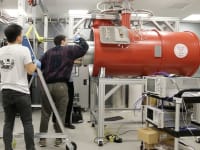
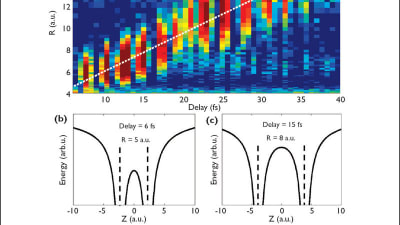
How fast is an electron? Australian scientists were able to measure it. Australia's fastest camera, located at the Attosecond Science Facility, has revealed the time it takes for molecules to break apart. The...
Briefs: Photonics/Optics
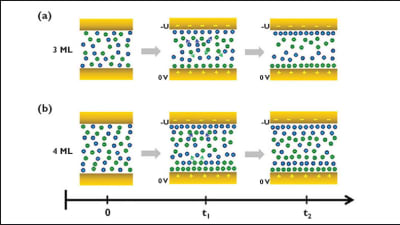
Ionic liquids—salts made by combining positively charged molecules (cations) and negatively charged molecules (anions) that are liquid at...
Briefs: Photonics/Optics
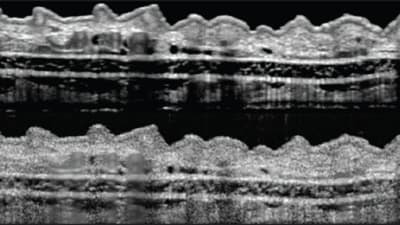
Optical coherence tomography (OCT) is a scanning technology commonly used by ophthalmologists to check for eye diseases. A team of scientists has figured out how to retrofit these high-performance machines with...
Briefs: Photonics/Optics
A team of researchers have designed, built, and tested two devices, called superconducting undulators, which could make X-ray free-electron lasers (FELs) more powerful,...

Briefs: Photonics/Optics
Compact, Lightweight, Athermal, Nanocomposite Telescopes with Freeform Optics
Small space missions such as CubeSats frequently require telescopes with highly sophisticated optical systems that are also low in mass and cost. The very limited spacecraft volume and mass limits also preclude adjustments to maintain critical alignment with change in...
Briefs: Photonics/Optics
The scanning tunneling microscope (STM) has become one of the most powerful tools used in studying the surface structure of electrically conducting solid-state materials at an atomic...

Briefs: Photonics/Optics
Fiber-Optic Environmental Radiation Dosimeter
An all-optical, fiber-optic-coupled remote radiation sensor was developed using luminescent, copper-doped quartz material. The key to the technology is the doped quartz material, which produces a luminescence signal that is directly proportional to the radiation dose.
Briefs: Photonics/Optics
Scientists at Argonne National Laboratory have developed a new X-ray technique to see inside continuously packed nanoparticles, also known as grains, to examine deformations and...

Briefs: Photonics/Optics
MIT researchers have developed a method for making extremely high-resolution images of tissue samples at a fraction of the cost of other techniques, yet with similar resolution. The new...
Briefs: Photonics/Optics
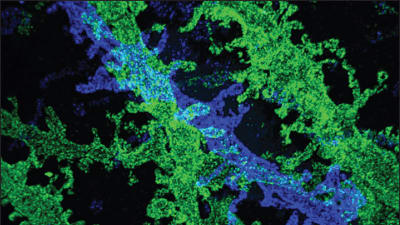
In recent years, a host of Hollywood blockbusters, including “The Fast and the Furious 7,” “Jurassic World,” and “The Wolf of Wall Street,” have included aerial tracking shots provided by drone helicopters...

Briefs: Photonics/Optics
When women undergo lumpectomies to remove breast cancer, doctors try to remove all the cancerous tissue while conserving as much of the healthy breast tissue as possible. But currently there's no...
Briefs: Photonics/Optics
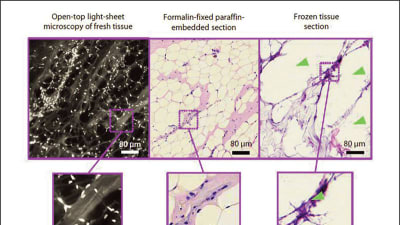
Researchers at Columbia University have made a significant step toward breaking the so-called “color barrier” of light microscopy for biological systems, allowing for much more...

Briefs: Photonics/Optics
Optical lenses that can see features smaller than the wavelength of light cannot be made from conventional materials. Creating “hyperlenses” that can take ultra-sharp images needs both designer...
Briefs: Photonics/Optics
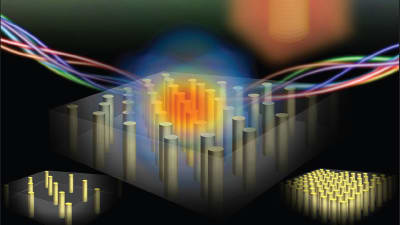
Neuroimaging Technique May Help Predict Autism Among High-Risk Infants
According to a recent study, functional connectivity magnetic resonance imaging (fcMRI) may predict which high-risk, 6-month-old infants will develop autism spectrum disorder by age 2 years.
Briefs: Photonics/Optics
The National Institute of Biomedical Imaging and Bioengineering (NBIB) has developed a microscope that increases resolution and contrast in thick biological samples. The new...

Briefs: Medical
The Micro-ring resonator detector can determine the speed of blood flow and the oxygen metabolic rate at the back of the eye. This information could help diagnose such common and debilitating...
Briefs: Photonics/Optics
Microstructural Explorations Inside Fuel Cells
Solid oxide fuel cells (SOFCs), a promising technology that can efficiently produce energy using fossil fuels with no moving parts and low emissions, present a particularly perplexing economic challenge: current systems operate at maximum efficiency between 700 and 1000 degrees Celsius, but such high...
Briefs: Imaging
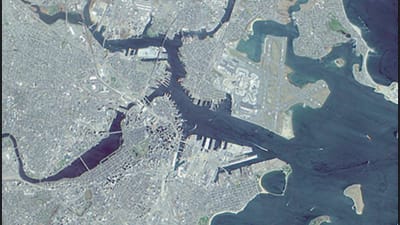
After more than 16 years of operation, NASA’s Earth Observing–1 (EO-1) spacecraft was decommissioned on March 30 of this year. The Advanced Land Imager (ALI) developed by MIT...
Briefs: Photonics/Optics
NASA Goddard Space Flight Center has developed a new radar approach that uses a single phased array antenna and a single-pass configuration to generate interferograms, known as Digital Beamforming...

Briefs: Photonics/Optics
Additive-Manufactured, Very Lightweight, Diamond Turned Aspheric Mirror
Industrial-grade, lightweight mirrors used in military and aeronautics have tight specifications brought on by demanding performance parameters. For example, a mirror that is used in an orbiting telescope would have to be extremely lightweight, stiff, and be configured to...
Briefs: Photonics/Optics
Development of a Sodium LiDAR for Spaceborne Missions
Laser and electro-optic technologies are under development to remotely measure sodium (Na) by adapting existing LiDAR technology with spaceflight heritage. The developed instrumentation will serve as the core for planning a heliophysics mission targeted to study the composition and dynamics of...
Briefs: Photonics/Optics
Invertible Time Invariant Linear Filtering (InTILF) Method for Pattern Detection and Modeling of Stochastic One- or Two-Dimensional Data
X-ray astronomy offers the opportunity to observe important phenomena, including the early accretion of massive black holes and detecting diffuse ionized intergalactic gas that is heated to X-ray temperatures...
Briefs: Sensors/Data Acquisition
Characterizing Richness of Previously Unmapped Terrain and Estimating its Impact on Navigation Performance using 3D Range Sensors in Flight
Landers to large planetary bodies such as Mars typically use a secondary reconnaissance spacecraft to generate high-fidelity 3D terrain maps that are subsequently used for landing site selection and creating...
Briefs: Photonics/Optics
Development of Sodium Lidar for Spaceborne Missions
The metal layers at mesospheric altitudes are excellent tracers of neutral atmosphere dynamics, and have been used since the 1960s to study the chemistry and dynamics of the mesosphere. Ablation from meteors is believed to be the chief source of metals such as Na, Mg, K, Fe, and Ca in the middle...
Briefs: Photonics/Optics
Additive-Manufactured, Very Lightweight, Diamond Turned Aspheric Mirror
Industrial-grade, lightweight mirrors used in military and aeronautics have tight specifications brought on by demanding performance parameters. For example, a mirror that is used in an orbiting telescope would have to be extremely lightweight, stiff, and be configured to...
Briefs: Photonics/Optics
Partially Transparent Circular Mask to Suppress Narrowband Laser Light
The evolved Laser Interferometry Space Antenna (eLISA) is the implementation of the original Laser Interferometry Space Antenna (LISA) concept that will be proposed for the European Space Agency's (ESA) L.3 Cosmic Visions opportunity. The eLISA observatory uses lasers to range...
Briefs: Photonics/Optics
Micro-Fresnel Zone Plate Optical Devices Using Densely Accumulated Ray Points
NASA Langley Research Center has developed a novel approach for a high-density optical data storage system to advance the typical capabilities of an optical data storage system. Operating at any laser wavelength from infrared (IR), visible, ultraviolet (UV), and X-ray...
Briefs: Photonics/Optics
CUDA Framework for Linear Time-Invariant Control of Adaptive Optics Systems
Current science objectives, such as high-contrast imaging of exoplanets, have led to the development of highorder adaptive optics (AO) systems possessing several thousand deformable mirror (DM) actuators. These systems typically rely on integrator-based control...
Top Stories
 Blog: Lighting

A Stretchable OLED that Can Maintain Most of Its Luminescence
 Blog: Energy

Batteries that Can Withstand the Cold
 INSIDER: Energy

Advancing All-Solid-State Batteries
 Quiz: Energy

 Blog: Physical Sciences

 Blog: Materials

Webcasts
 Upcoming Webinars: Test & Measurement

From Spreadsheets to Insights: Fast Data Analysis Without Complex...
 Upcoming Webinars: Electronics & Computers

Cooling a New Generation of Aerospace and Defense Embedded...
 Upcoming Webinars: Test & Measurement

Beyond AI-Copy-Paste Engineering: Advanced AI-Integration Success...
 Upcoming Webinars: Automotive

Battery Abuse Testing: Pushing to Failure
 Upcoming Webinars: Internet of Things

A FREE Two-Day Event Dedicated to Connected Mobility
 Upcoming Webinars: Test & Measurement

Choosing the Right N-Port Strategy: Multiport VNAs vs. Switch...