41,46
-1
30
30
Briefs: Manned Systems
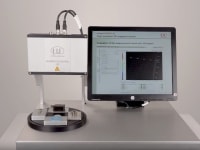
Innovators at NASA Johnson Space Center have developed a thin film sensor that measures temperatures up to 1200 °F, and whose prototype successor may achieve measurements up to ~3000 °F — which was the surface temperature of the Space Shuttle during its atmospheric reentry. Read on to learn more.

Briefs: Robotics, Automation & Control
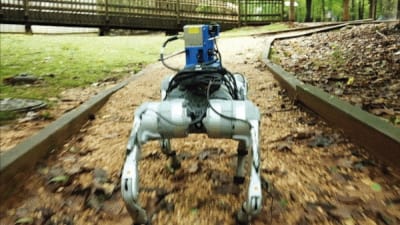
Researchers from Duke University have developed a novel framework named WildFusion that fuses vision, vibration, and touch to enable robots to “sense” complex outdoor environments much like humans do. Read on to learn more.
Briefs: Robotics, Automation & Control
A human clearing junk out of an attic can often guess the contents of a box simply by picking it up and giving it a shake, without the need to see what’s inside. Researchers from MIT, Amazon Robotics, and the University of British Columbia have taught robots to do something similar. Read on to learn more.

Briefs: Aerospace
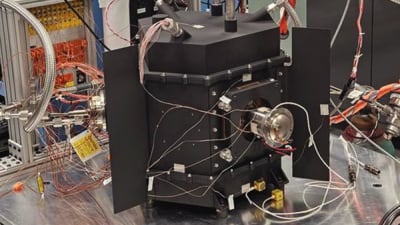
A spacecraft power system that combines the technological know-how of engineers and scientists at the University of Leicester and NASA Glenn has passed its first test with flying colors. Read on to learn more about it.
Briefs: Sensors/Data Acquisition
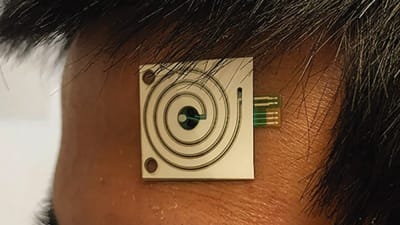
Researchers developed wearable skin sensors that can detect what’s in a person’s sweat. Using the sensors, monitoring perspiration could bypass the need for more invasive procedures like blood draws and provide real-time updates on health problems such as dehydration or fatigue. Read on to learn more.
Briefs: Materials
Researchers have developed a new type of sensor platform using a gold nanoparticle array. The sensor is made up of a series of gold disk-shaped nanoparticles on a glass slide. When an infrared laser is pointed at a precise arrangement of the particles, they start to emit unusual amounts of ultraviolet light. Read on to learn more.

Briefs: Power
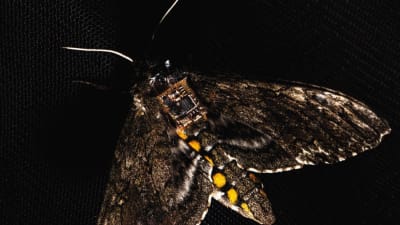
Researchers have created a 98-milligram sensor system — about one tenth the weight of a jellybean or less than one-hundredth of an ounce — that can ride aboard a small drone or an insect, such as a moth, until it gets to its destination. Then, when a researcher sends a Bluetooth command, the sensor is released from its perch and can fall up to 72 feet — from about the sixth floor of a building — and land without breaking. Once on the ground, the sensor can collect data, such as temperature or humidity, for almost three years.
Briefs: Sensors/Data Acquisition
These materials can detect when they are damaged, take the necessary steps to temporarily heal themselves, and then resume work.

Briefs: Materials
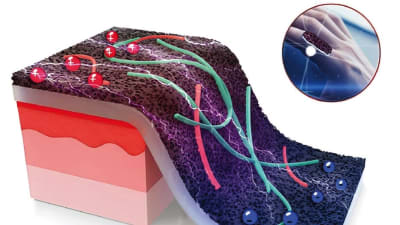
A major challenge in self-powered wearable sensors for health care monitoring is distinguishing different signals when they occur at the same time. Researchers addressed this issue by uncovering a new property of a sensor material, enabling the team to develop a new type of flexible sensor that can accurately measure both temperature and physical strain simultaneously but separately to more precisely pinpoint various signals. Read on to learn more.
Briefs: Sensors/Data Acquisition
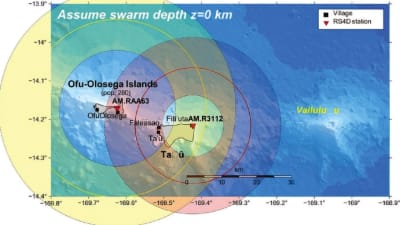
Residents of the Manu’a Islands in American Samoa were feeling the earth shake, raising concerns of an imminent volcanic eruption or tsunami. Scientists from the U.S. Geological Survey used machine learning and a technique called template matching on shaking data recorded from a single seismic sensor located 250 kilometers away to locate the source of the shaking. Read on to learn more.
Briefs: Materials
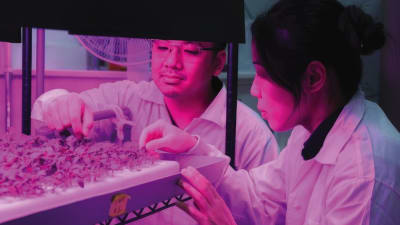
Researchers have developed a groundbreaking near-infrared fluorescent nanosensor capable of simultaneously detecting and differentiating between iron forms — Fe(II) and Fe(III) — in living plants. Read on to learn more about it.
Briefs: Internet of Things
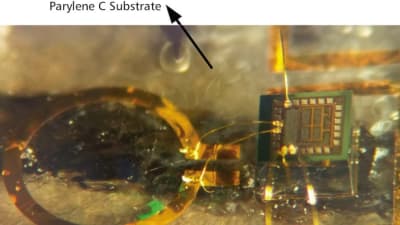
An invention that uses microchip technology in implantable devices and other wearable products such as smart watches can be used to improve biomedical devices including those used to monitor people with glaucoma and heart disease. Read on to learn more.
Briefs: Medical
A team of researchers has developed self-powered, wearable, triboelectric nanogenerators (TENGs) with polyvinyl alcohol (PVA)-based contact layers for monitoring cardiovascular health. TENGs help conserve mechanical energy and turn it into power. Read on to learn more.

Briefs: Test & Measurement
Batteries in electric vehicles can fail quickly, sometimes catching fire without much warning. Sandia National Laboratories is working to detect these failures early and provide sufficient warning time to vehicle occupants. Read on to learn more about it.

Briefs: Test & Measurement
Innovators at NASA Johnson Space Center have designed a pneumatic nail penetration trigger system that drives a Li-ion battery cell into thermal runaway using a tungsten nail. Read on to learn more.

Briefs: Robotics, Automation & Control
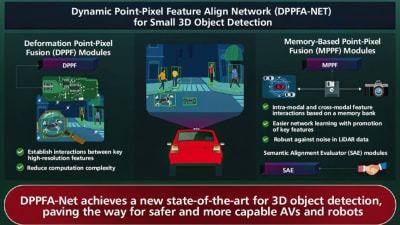
Scientists have developed multi-modal 3D object detection methods that combine 3D LiDAR data with 2D RGB images taken by standard cameras. While the fusion of 2D images and 3D LiDAR data leads to more accurate 3D detection results, it still faces its own set of challenges, with accurate detection of small objects remaining difficult. Read on to learn more about it.
Briefs: Sensors/Data Acquisition
New research unlocks the power of exceptional points (EPs) for advanced optical sensing. In a study published in Science Advances , a team showed that these unique EPs — specific conditions in systems where extraordinary optical phenomena can occur — can be deployed on conventional sensors to achieve a striking sensitivity to environmental perturbations. Read on to learn more.

Briefs: Sensors/Data Acquisition
Researchers from Skoltech and the University of Texas at Austin have presented a proof-of-concept for a wearable sensor that can track healing in sores, ulcers, and other kinds of chronic skin wounds, even without the need to remove the bandages. Read on to learn more.

Briefs: Design
A team has created a prototype for what it calls “living bioelectronics” — a combination of living cells, gel, and electronics that can integrate with living tissue. The patches are made of sensors, bacterial cells, and a gel made from starch and gelatin. Tests in mice found that the devices could continuously monitor and improve psoriasis-like symptoms, without irritating skin. Read on to learn more.

Briefs: Connectivity
The Brown University research team created a novel approach for a wireless communication network that can efficiently transmit, receive, and decode data from thousands of microelectronic chips that are each no larger than a grain of salt. Read on to learn more about it.
Briefs: Physical Sciences
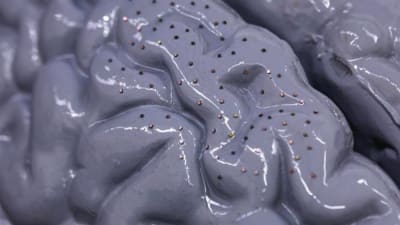
Jamie Paik and colleagues in the Reconfigurable Robotics Lab in EPFL’s School of Engineering have developed a sensor that can perceive combinations of bending, stretching, compression, and temperature changes, all using a robust system that boils down to a simple concept: color. Read on to learn more about it.

Briefs: Sensors/Data Acquisition
The technology has the potential for many applications including enhancing pilot training for peak performance and alertness, developing software, training programs, and services for well-being and healthcare, as well as revolutionize the gaming industry by creating interactive video games. Read on to learn more.

Briefs: Electronics & Computers
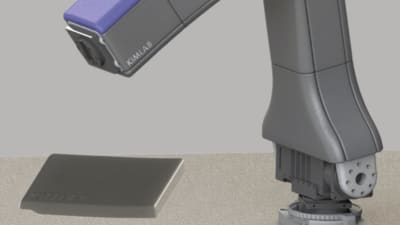
A recent study demonstrates that soft skin pads doubling as sensors made from thermoplastic urethane can be efficiently manufactured using 3D printers. Read on to learn more.
Briefs: Sensors/Data Acquisition
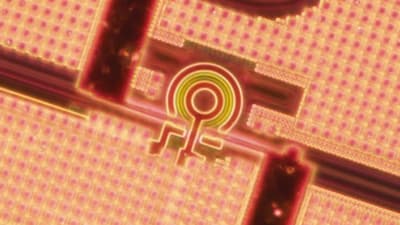
A Bristol-led team of physicists has found a way to operate mass manufacturable photonic sensors at the quantum limit. This breakthrough paves the way for practical applications such as monitoring greenhouse gases and cancer detection. Read on to learn more.
Briefs: Sensors/Data Acquisition
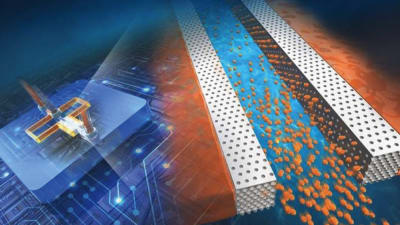
Researchers have introduced a microfluidic system that utilizes porous “inverse colloidal crystal” structures to dramatically improve the efficiency of microdroplet generation. Read on to learn more about it.
Blog: Manufacturing & Prototyping
In this video, we provide an overview of the Nancy Grace Roman Space Telescope’s mission, capabilities and timeline to launch.

Briefs: Design
A team has created a prototype for what it calls “living bioelectronics” — a combination of living cells, gel, and electronics that can integrate with living tissue. The patches are made of sensors, bacterial cells, and a gel made from starch and gelatin. Tests in mice found that the devices could continuously monitor and improve psoriasis-like symptoms, without irritating skin. Read on to learn more.

Briefs: Design
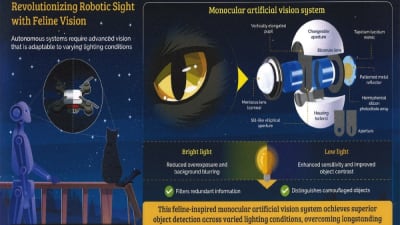
Researchers led by Professor Young Min Song from the Gwangju Institute of Science and Technology have unveiled a vision system inspired by feline eyes to enhance object detection in various lighting conditions. Featuring a unique shape and reflective surface, the system reduces glare in bright environments and boosts sensitivity in low-light scenarios. Read on to learn more.
Briefs: Information Technology
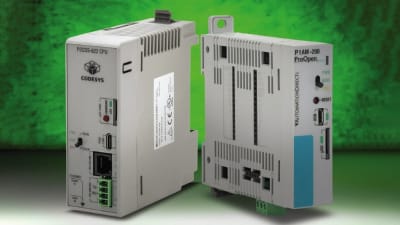
As industrial automation technologies continue to advance, the balance between traditional and open solutions will likely evolve. The emphasis will be on providing versatile platforms that meet varied user needs. Read on to learn more.
Top Stories
 Blog: Lighting

A Stretchable OLED that Can Maintain Most of Its Luminescence
 Blog: Energy

Batteries that Can Withstand the Cold
 INSIDER: Energy

Advancing All-Solid-State Batteries
 Quiz: Energy

 Blog: Physical Sciences

 Blog: Materials

Webcasts
 Upcoming Webinars: Test & Measurement

From Spreadsheets to Insights: Fast Data Analysis Without Complex...
 Upcoming Webinars: Electronics & Computers

Cooling a New Generation of Aerospace and Defense Embedded...
 Upcoming Webinars: Test & Measurement

Beyond AI-Copy-Paste Engineering: Advanced AI-Integration Success...
 Upcoming Webinars: Automotive

Battery Abuse Testing: Pushing to Failure
 Upcoming Webinars: Internet of Things

A FREE Two-Day Event Dedicated to Connected Mobility
 Upcoming Webinars: Test & Measurement

Choosing the Right N-Port Strategy: Multiport VNAs vs. Switch...