
Stories
36,38
0
5280
30
Briefs: Materials
Formulations for Stronger Solid Oxide Fuel-Cell Electrolytes
Tests have shown that modification of chemical compositions can increase the strengths and fracture toughnesses of solid oxide fuel-cell (SOFC) electrolytes. Heretofore, these solid electrolytes have been made of yttria- stabilized zirconia, which is highly conductive for oxygen ions at...
Briefs: Electronics & Computers
A finned-ladder structure has been invented in an effort to improve the design of the slow-wave circuit of a traveling-wave tube (TWT). The point of departure for the design effort was a prototype TWT...

Briefs: Materials
Some changes have been incorporated into a proposed method of manufacturing regular arrays of precisely sized, shaped, positioned, and oriented carbon nanotubes. Such arrays could be...

Briefs: Materials
Rod/coil block copolyimides that exhibit high levels of ionic conduction can be made into diverse products, including dimensionally stable solid electrolyte membranes that function well...

Briefs: Materials
Processable Polyimides Containing APB and Reactive End Caps
Imide copolymers that contain 1,3-bis (3- aminophenoxy) benzene (APB) and other diamines and dianhydrides and that are terminated with appropriate amounts of reactive end caps have been invented. The reactive end caps investigated thus far include 4-phenylethynyl phthalic anhydride (PEPA),...
Briefs: Materials
Liquid Coatings for Reducing Corrosion of Steel in Concrete
Inorganic coating materials are being developed to slow or stop corrosion of reinforcing steel members inside concrete structures. It is much simpler and easier to use these coating materials than it is to use conventional corrosion-inhibiting systems based on impressed electric currents....
Briefs: Materials
Less-Toxic Coatings for Inhibiting Corrosion of Aluminum
Two recently invented families of conversion- coating processes have been found to be effective in reducing or preventing corrosion of aluminum alloys. These processes offer less-toxic alternatives to prior conversion-coating processes that are highly effective but have fallen out of favor...
Briefs: Materials
A novel class of polymer/clay nanocomposites has been invented in an attempt to develop transparent, lightweight, durable materials for a variety of aerospace applications. As their name...

Briefs: Manufacturing & Prototyping
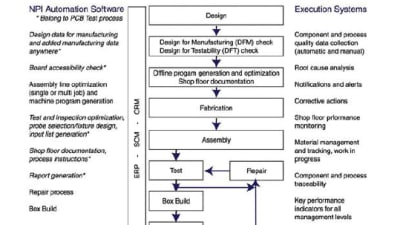
Test is critical to the board manufacturing process. Effective test ensures quality and customer satisfaction both for the OEM (original equipment manufacturer) and the CEM (contract electronics...
Briefs: Materials
Functionally Graded Nanophase Beryllium/Carbon Composites
Beryllium, beryllium alloys, beryllium carbide, and carbon are the ingredients of a class of nanophase Be/Be2C/C composite materials that can be formulated and functionally graded to suit a variety of applications. In a typical case, such a composite consists of a first layer of either pure...
Briefs: Materials
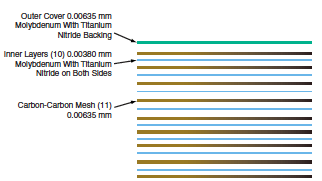
Thermal-insulation blankets of a proposed type would be exceptionally thin and would endure temperatures up to 2,100 °C. These blankets were originally intended to protect components...
Briefs: Materials
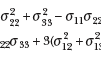
A temperature- and time-dependent mathematical model predicts the conditions for failure of a material subjected to multiaxial stress. The model was initially applied to a filled epoxy...
Briefs: Materials
Environmentally Safer, Less Toxic Fire-Extinguishing Agents
Fire-extinguishing agents comprising microscopic drops of water micro- encapsulated in flame-retardant polymers have been proposed as effective, less toxic, non-ozone- depleting, non-global- warming alternatives to prior fire-extinguishing agents. Among the prior fire-extinguishing agents...
Briefs: Materials
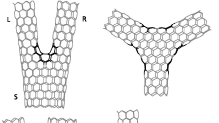
Multiterminal carbon-nanotube junctions are under investigation as candidate components of nanoscale electronic devices and circuits. Three-terminal "Y" junctions of carbon nanotubes...
Briefs: Materials
Scandia-and-Yttria-Stabilized Zirconia for Thermal Barriers
Zirconia stabilized with both scandia and yttria in suitable proportions has shown promise of being a superior thermal-barrier coating (TBC) material, relative to zirconia stabilized with yttria only. More specifically, a range of compositions in the zirconia/scandia/yttria material system...
Briefs: Materials
Improved Thermal-Insulation Systems for Low Temperatures
Improved thermal-insulation materials and structures and the techniques for manufacturing them are undergoing development for use in low-temperature applications. Examples of low-temperature equipment for which these thermal insulation systems could provide improved energy efficiency include...
Briefs: Materials
A relatively simple silanization process has been developed for waterproofing or rewaterproofing aerogels, xerogels, and aerogel/tile composites, and other, similar low-density, highly microporous materials....

Briefs: Materials
Oxide Protective Coats for Ir/Re Rocket Combustion Chambers
An improved material system has been developed for rocket engine combustion chambers for burning oxygen/hydrogen mixtures or novel monopropellants, which are highly oxidizing at operating temperatures. The baseline for developing the improved material system is a prior iridium/rhenium...
Briefs: Materials
Burn-Resistant, Strong Metal-Matrix Composites
Ceramic particulate fillers increase the specific strengths and burn resistances of metals: This is the conclusion drawn by researchers at Johnson Space Center's White Sands Test Facility. The researchers had theorized that the inclusion of ceramic particles in metal tools and other metal objects used...
Briefs: Materials
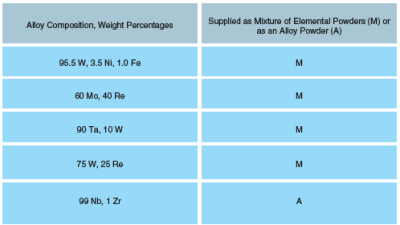
An experimental investigation has shown that by (1) vacuum plasma spraying (VPS) of suitable refractory metal alloys on graphite mandrels, and then (2) heat-treating the VPS alloy...
Briefs: Materials
Antistatic Polycarbonate/Copper Oxide Composite
A composite material consisting of polycarbonate filled with copper oxide has been found to be suitable as an antistatic material. This material was developed to satisfy a requirement for an antistatic material that has a mass density less than that of aluminum and that exhibits an acceptably low...
Briefs: Materials
Stable, Thermally Conductive Fillers for Bolted Joints
A commercial structural epoxy [Super Koropon (or equivalent)] has been found to be a suitable filler material for bolted joints that are required to have large thermal conductances. The contact area of such a joint can be less than 1 percent of the apparent joint area, the exact value depending...
Briefs: Manufacturing & Prototyping
Improved Process for Fabricating Carbon Nanotube Probes
An improved process has been developed for the efficient fabrication of carbon nanotube probes for use in atomic-force microscopes (AFMs) and nanomanipulators. Relative to prior nanotube tip production processes, this process offers advantages in alignment of the nanotube on the cantilever and...
Briefs: Manufacturing & Prototyping
A container designed for storing samples of hazardous material features a double wall, part of which is sacrificed during an explosion-welding process in which the container is sealed and...

Briefs: Materials
Shields for Enhanced Protection Against High-Speed Debris
A report describes improvements over the conventional Whipple shield (two thin, spaced aluminum walls) for protecting spacecraft against high-speed impacts of orbiting debris. The debris in question arises mainly from breakup of older spacecraft. The improved shields include exterior...
Briefs: Materials
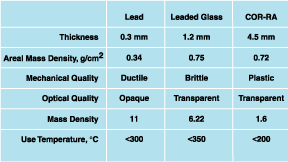
"COR-RA" (colorless atomic oxygen resistant — radiation shield) is the name of a transparent polymeric material filled with x-ray-absorbing salts of lead, bismuth, cesium, and...
Briefs: Materials
An improved, lightweight design has been proposed for super-pressure balloons used to carry scientific instruments at high altitudes in the atmosphere of Earth for times as long as 100 days. [A...

Briefs: Materials
Liquid/vapor-phase corrosion inhibitors (LVCIs) have been found to be additionally useful as penetrant dyes for neutron radiography (and perhaps also x-radiography). Enhancement of...

Briefs: Materials
An explicit material model that uses predicted pressure in the pores of a carbon-cloth phenolic (CCP) composite has been developed. This model is intended to be used within a...

Top Stories
 Blog: Robotics, Automation & Control

Aerial Microrobots That Can Match a Bumblebee's Speed
 Blog: Electronics & Computers

Turning Edible Fungi into Organic Memristors
 Blog: Manufacturing & Prototyping

Revolutionizing the Production of Semiconductor Chips
 News: Energy

 INSIDER: Electronics & Computers

World’s Smallest Programmable, Autonomous Robots
 INSIDER: Manufacturing & Prototyping

Webcasts
 Upcoming Webinars: Software

E/E Architecture Redefined: Building Smarter, Safer, and Scalable...
 Upcoming Webinars: Automotive

Hydrogen Engines Are Heating Up for Heavy Duty
 Upcoming Webinars: Electronics & Computers

Advantages of Smart Power Distribution Unit Design for Automotive...
 Upcoming Webinars: Transportation

Quiet, Please: NVH Improvement Opportunities in the Early Design...
 Upcoming Webinars: AR/AI

A FREE Two-Day Event Dedicated to Connected Mobility
 Podcasts: Manufacturing & Prototyping

How Sift's Unified Observability Platform Accelerates Drone Innovation