Stories
34
71
0
0
30
Products: Software
Last December, Tech Briefs readers were asked to select one product from our 2025 Products of the Month to be named Readers’ Choice Product of the Year. Thanks to all of our readers who cast their votes. Read on for the three 2025 winners.

Special Reports: Imaging
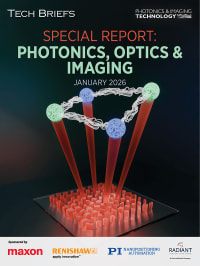
Photonics, Optics & Imaging - January 2026
Harvard research breakthrough could speed development of room‐temperature quantum computers…New generation of ultra‐lightweight, high‐res space cameras takes flight…NASA LiDAR advance gives...INSIDER: Unmanned Systems
The skies are getting crowded. Every day, the U.S. Federal Aviation Administration manages tens of thousands of flights — from drones and helicopters to commercial jets. As air traffic...

INSIDER: Imaging
A new imaging technique developed by MIT researchers could enable quality-control robots in a warehouse to peer through a cardboard shipping box and see that the handle of a...

Briefs: Imaging
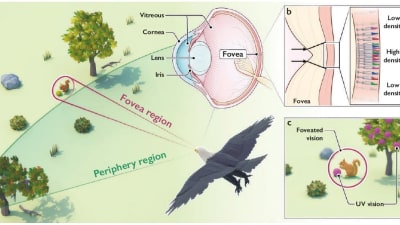
A team led by University of Maryland computer scientists invented a camera mechanism that improves how robots see and react to the world around them. Inspired by how the human eye works, their innovative camera system mimics the tiny involuntary movements used by the eye to maintain clear and stable vision over time. Read on to learn more.

Articles: AR/AI
Event-based sensing enables new approaches to machine learning. An object recognition or detection algorithm that, until now, could only use the spatial information from a frame can now access another dimension: time. Read on to learn more.

Briefs: Imaging
Butterflies can see more of the world than humans, including more colors and the field oscillation direction, or polarization, of light. Other species, like the mantis shrimp, can sense an even wider spectrum of light, as well as the circular polarization, or spinning states, of light waves. Inspired by these abilities in the animal kingdom, researchers have developed an ultrathin optical element known as a metasurface, which can attach to a conventional camera and encode the spectral and polarization data of images captured in a snapshot or video through tiny, antenna-like nano-structures that tailor light properties.

Briefs: Photonics/Optics
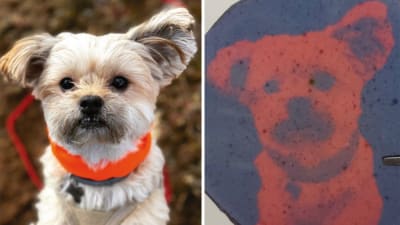
Imagine if physicians could capture 3D projections of medical scans, suspending them inside an acrylic cube to create a hand-held reproduction of a patient’s heart, brain, kidneys, or other organs. Then, when the visit is done, a quick blast of heat erases the projection, and the cube is ready for the next scan. A new report by researchers at Dartmouth and Southern Methodist University outlines a technical breakthrough that could enable such scenarios, and others, with widespread utility. Read on to learn more.
Briefs: Imaging
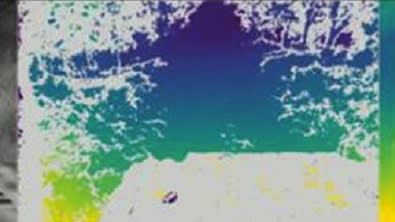
Southwest Research Institute has developed off-road autonomous driving tools with a focus on stealth for the military and agility for space and agriculture clients. The vision-based system pairs stereo cameras with novel algorithms, eliminating the need for LiDAR and active sensors. Read on to learn more.
Briefs: AR/AI
The camera mimics the involuntary movements of the human eye to create sharper, more accurate images for robots, smartphones, and other image-capturing devices. Read on to learn more about it.

Briefs: Imaging
This innovative camera technology represents a significant advance in object detection, offering numerous potential applications across various industries. Read on to learn more.
Articles: AR/AI
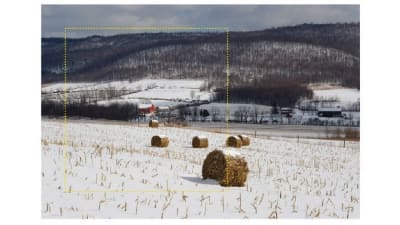
Increasing regulatory concentration on improving the protection of vulnerable road users (VRUs) against vehicle collisions at night has led to new evaluations of proven imaging modalities that might quickly, effectively, and economically identify VRUs and measure their positions relative to moving vehicles.

Briefs: AR/AI
Mimicking the easy, instantaneous image processing power of the human eye, Penn State electrical engineering researchers created a metasurface, an optical element akin to a glass slide that uses tiny nanostructures, placed at different angles to control light.
Special Reports: Sensors/Data Acquisition

ADAS/Connected Car - December 2023
In this compendium of popular articles from the editors of Automotive Engineering and ADAS & Autonomous Vehicle Engineering magazines, see how advances in simulation, testing, lidar/sensors, displays, and...Briefs: Imaging
Advanced technology plays a vital role in search and rescue operations after natural disasters such as earthquakes. Thermal imaging equipment and sensitive listening devices are deployed to seek out signs of life.

INSIDER: Sensors/Data Acquisition
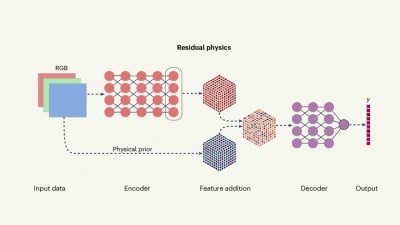
Researchers from UCLA and the United States Army Research Laboratory have laid out a new approach for enhancing artificial intelligence-powered computer vision technologies by...
Articles: Imaging
Spectral measurement is thus the basis of remote sensing, allowing for highly accurate material analysis and image recognition.

Briefs: Imaging
Vision sensing systems are needed to improve operations in many industrial applications, where they can be arranged to detect the presence, position, and other characteristics of objects and products.

Briefs: Materials
Engineers have developed a modeling and manufacturing technique that generates unique verification tools which simulate cracks in metals within X-ray setup part-testing geometries.

Briefs: Photonics/Optics
Using a new fabrication method, researchers developed a single-lens telescope and captured clear images of the lunar surface — achieving greater resolution of objects and much farther imaging distance than previous metalenses.

Articles: Imaging
In the age of industry digital transformation, visual data has received minimal focus yet can have significant impacts on a company's success.

Briefs: Imaging
Scientists have developed a new characterization tool that allowed them to gain unique insight into a possible alternative material for solar cells.

Application Briefs: Photonics/Optics
This measurement technique is particularly useful for, but not limited to, samples containing organic compounds.
Articles: Photonics/Optics
It began full scientific operations July 11, following six months of instrumentation cool-down, calibration, and other commissioning activities.

Briefs: Imaging
Researchers at University of Central Florida have developed an artificial intelligence device that mimics the retina of the eye.
Briefs: Electronics & Computers
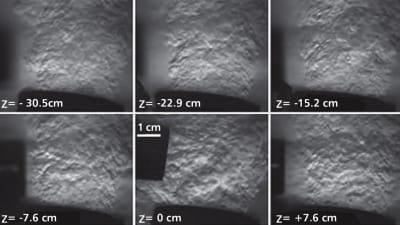
The assembly can simply be mounted in front of a camera to enable focusing schlieren imaging capability.
Application Briefs: Photonics/Optics
The European Southern Observatory (ESO) continues to enable exciting scientific advances that help us better understand the universe.

Briefs: Data Acquisition
The sensor works by detecting variations in microgravity using the principles of quantum physics, which is based on manipulating nature at the sub-molecular level.

Top Stories
 Blog: Sensors/Data Acquisition

Going for Gold in Winter Olympic Curling
 Blog: Energy

Batteries that Can Withstand the Cold
 INSIDER: Design

Advancing All-Solid-State Batteries
 Blog: Design

 Blog: Materials

Making Tungsten Carbide a More Viable Alternative
 INSIDER: Power

Webcasts
 Upcoming Webinars: Sensors/Data Acquisition

Beyond AI-Copy-Paste Engineering: Advanced AI-Integration Success...
 Upcoming Webinars: Energy

Battery Abuse Testing: Pushing to Failure
 Upcoming Webinars: Power

A FREE Two-Day Event Dedicated to Connected Mobility
 Upcoming Webinars: Test & Measurement

Choosing the Right N-Port Strategy: Multiport VNAs vs. Switch...
 Upcoming Webinars: Energy

2026 Battery & Electrification Summit (Online)
 Upcoming Webinars: Mechanical & Fluid Systems

The Over-Engineering Trap: Aligning Custom Equipment Specs with...