Stories
6
-1
780
30
Briefs: Physical Sciences
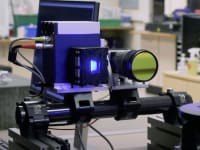
Simultaneous Spectral Temporal Adaptive Raman Spectrometer — SSTARS
Raman spectroscopy is a prime candidate for the next generation of planetary instruments, as it addresses the primary goal of mineralogical analysis, which is structure and composition. However, large fluorescence return from many mineral samples under visible light excitation...
Briefs: Physical Sciences
Optical Structural Health Monitoring Device
This non-destructive, optical fatigue detection and monitoring system relies on a small and unobtrusive light-scattering sensor that is installed on a component at the beginning of its life in order to periodically scan the component in situ. The method involves using a laser beam to scan the surface of...
Briefs: Physical Sciences
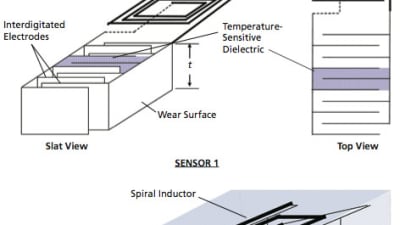
Sensors for monitoring surface wear and/or temperature without need for wire connections have been developed. Excitation and interrogation of these sensors are accomplished by means of a...
Briefs: Physical Sciences
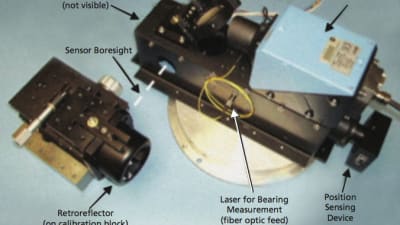
The optical pointing sensor provides a means of directly measuring the relative positions of JPL’s Formation Control Testbed (FCT) vehicles without communication. This innovation is a steerable infrared (IR)...
Briefs: Physical Sciences
Radio-Frequency Tank Eigenmode Sensor for Propellant Quantity Gauging
Although there are several methods for determining liquid level in a tank, there are no proven methods to quickly gauge the amount of propellant in a tank while it is in low gravity or under low-settling thrust conditions where propellant sloshing is an issue. Having the ability...
Briefs: Physical Sciences
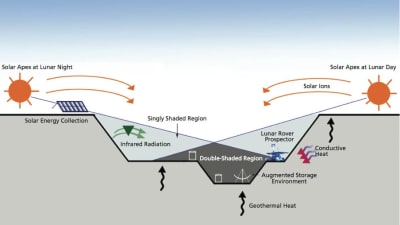
In the polar regions of the Moon, some areas within craters are permanently shadowed from solar illumination and can drop to temperatures of 100 K or lower. These sites...
Briefs: Physical Sciences
With this high-resolution imaging radar system, coherent illumination in the 576-to-589-GHz range and phase-sensitive detection are implemented in an all-solid-state design based on...
Briefs: Physical Sciences
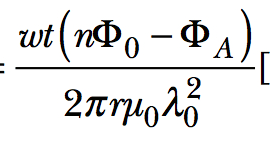
The temperature dependence of fluxoid quantization in a superconducting loop. The sensitivity of the device is expected to surpass that of other super-conducting-based bolometric devices, such as...
Briefs: Photonics/Optics
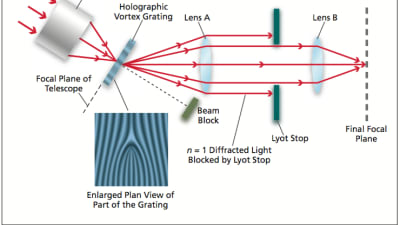
A holographic vortex coronagraph (HVC) has been proposed as an improvement over conventional coronagraphs for use in high-contrast astronomical imaging for detecting planets, dust disks, and other broadband light...
Briefs: Photonics/Optics
Photon Counting Using Edge-Detection Algorithm
New applications such as high-data-rate, photon-starved, free-space optical communications require photon counting at flux rates into gigaphoton-per-second regimes coupled with sub-nanosecond timing accuracy. Current single-photon detectors that are capable of handling such operating conditions are...
Briefs: Physical Sciences
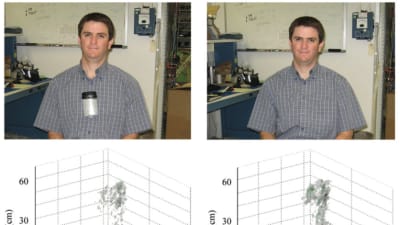
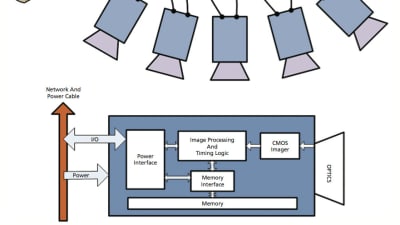
A method gathers scene information from a low-cost camera system. Existing surveillance systems using sufficient cameras for continuous coverage of a large field necessarily generate enormous...
Briefs: Physical Sciences
Data Acquisition System for Multi-Frequency Radar Flight Operations Preparation
A three-channel data acquisition system was developed for the NASA Multi-Frequency Radar (MFR) system. The system is based on a commercial-off-the-shelf (COTS) industrial PC (personal computer) and two dual-channel 14-bit digital receiver cards. The decimated complex...
Briefs: Physical Sciences
Planar Submillimeter-Wave Mixer Technology With Integrated Antenna
High-performance mixers at terahertz frequencies require good matching between the coupling circuits such as antennas and local oscillators and the diode embedding impedance. With the availability of amplifiers at submillimeter wavelengths and the need to have multi-pixel imagers...
Briefs: Physical Sciences
Graph-Based Path-Planning for Titan Balloons
A document describes a graph-based path-planning algorithm for balloons with vertical control authority and little or no horizontal control authority. The balloons are designed to explore celestial bodies with atmospheres, such as Titan, a moon of Saturn. The algorithm discussed enables the balloon to...
Briefs: Photonics/Optics
Nanolaminate Membranes as Cylindrical Telescope Reflectors
A document discusses a proposal to use axially stretched metal nanolaminate membranes as lightweight parabolic cylindrical reflectors in the Dual Anamorphic Reflector Telescope (DART) — a planned spaceborne telescope in which the cylindrical reflectors would be arranged to obtain a point...
Briefs: Physical Sciences
Air-Sea Spray Airborne Radar Profiler Characterizes Energy Fluxes in Hurricanes
A report discusses ASAP (Air-sea Spray Airborne Profiler), a dual-wavelength radar profiler that provides measurement information about the droplet size distribution (DSD) of sea-spray, which can be used to estimate heat and moisture fluxes for hurricane research....
Briefs: Physical Sciences
Large Telescope Segmented Primary Mirror Alignment
A document discusses a broadband (white light) point source, located at the telescope Cassegrain focus, which generates a cone of light limited by the hole in the secondary mirror (SM). It propagates to the aspheric null-mirror, which is optimized to make all the reflected rays to be normal to the...
Briefs: Physical Sciences
Simplified Night Sky Display System
A document describes a simple night sky display system that is portable, lightweight, and includes, at most, four components in its simplest configuration. The total volume of this system is no more than 106 cm3 in a disassembled state, and weighs no more than 20 kilograms. The four basic components are a...
Briefs: Physical Sciences
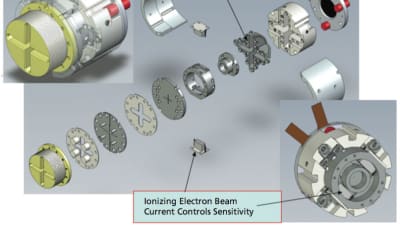
Determination of neutral winds and ion drifts in low-Earth-orbit missions requires measurements of the angular and energy distributions of the flux of neutrals and ions...
Briefs: Physical Sciences
Three proposed methods for measuring trace quantities of hydrazines involve ionization and detection of hydrazine derivatives. These methods are intended to overcome the limitations of prior...

Briefs: Physical Sciences
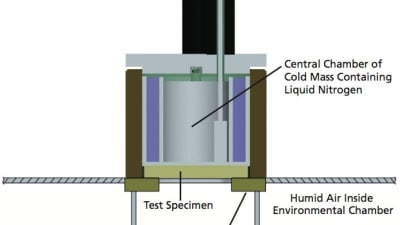
The Cryogenic Moisture Apparatus (CMA) is designed for quantifying the amount of moisture from the surrounding air that is taken up by cryogenic-tank-insulating material specimens while under typical conditions of...
Briefs: Physical Sciences
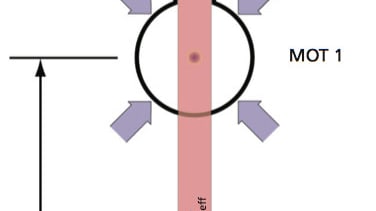
A transportable atom interferometer-based gravity gradiometer has been developed at JPL to carry out measurements of Earth’s gravity field at ever finer spatial resolutions, and...
Briefs: Unmanned Systems
An ocean thermal energy conversion (OTEC), now undergoing development, is a less-massive, more-efficient means of exploiting the same basic principle as that of the proposed system described in...

Briefs: Physical Sciences
Reflector Surface Error Compensation in Dual-Reflector Antennas
By probing the field on a small subreflector at a minimal number of points, the main reflector surface errors can be obtained and subsequently used to design a phase-correction subreflector that can compensate for main reflector errors. The compensating phase-error profile across the...
Briefs: Physical Sciences
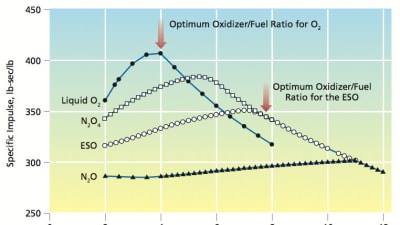
The name “enriched storable oxidizers” (ESOs) has been coined for a family of optimized mixtures of between two and four oxidizer fluids. For most applications, the constituents of these...
Briefs: Physical Sciences
AlGaN Ultraviolet Detectors for Dual-Band UV Detection
This innovation comprises technology that has the ability to measure at least two ultraviolet (UV) bands using one detector without relying on any external optical filters. This allows users to build a miniature UVA and UVB monitor, as well as to develop compact, multicolor imaging technologies...
Briefs: Physical Sciences
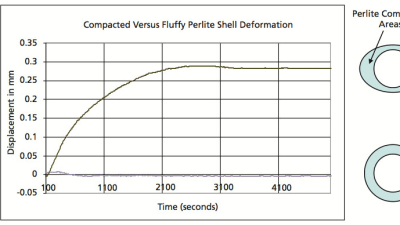
Perlite is the most typical insulating powder used to separate the inner and outer shells of cryogenic tanks. The inner tank holds the low-temperature commodity, while the outer...
Briefs: Physical Sciences
Using Thin-Film Thermometers as Heaters in Thermal Control Applications
A cryogenic sensor maintains calibration at ≈4.2 K to better than 2 mK (
Briefs: Physical Sciences
System for Hydrogen Sensing
A low-power, wireless gas-sensing system is designed to safeguard the apparatus to which it is attached, as well as associated personnel. It also ensures the efficiency and operational integrity of the hydrogen-powered apparatus. This sensing system can be operated with lower power consumption (less than 30 nanowatts),...
Top Stories
 Blog: Lighting

A Stretchable OLED that Can Maintain Most of Its Luminescence
 Blog: Energy

Batteries that Can Withstand the Cold
 INSIDER: Energy

Advancing All-Solid-State Batteries
 Quiz: Energy

 Blog: Physical Sciences

 Blog: Materials

Webcasts
 Upcoming Webinars: Test & Measurement

From Spreadsheets to Insights: Fast Data Analysis Without Complex...
 Upcoming Webinars: Electronics & Computers

Cooling a New Generation of Aerospace and Defense Embedded...
 Upcoming Webinars: Test & Measurement

Beyond AI-Copy-Paste Engineering: Advanced AI-Integration Success...
 Upcoming Webinars: Automotive

Battery Abuse Testing: Pushing to Failure
 Upcoming Webinars: Internet of Things

A FREE Two-Day Event Dedicated to Connected Mobility
 Upcoming Webinars: Test & Measurement

Choosing the Right N-Port Strategy: Multiport VNAs vs. Switch...