Stories
6
-1
0
30
INSIDER: Connectivity
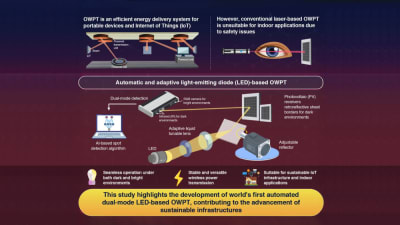
The world’s first automatic and adaptive, dual-mode light-emitting diode (LED)-based optical wireless power transmission system, that operates seamlessly under both dark and bright...
INSIDER: Electronics & Computers
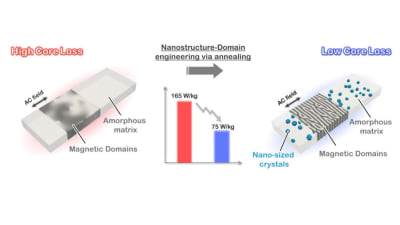
Our society's rapid pace of technological advancement is accompanied by an equally rapid growth in power consumption to meet our needs for AI-focused data...
INSIDER: Physical Sciences
In a cooperative project, Empa researchers investigated inductive charging of electric cars. This is not only similarly efficient to cable-based charging but could also simplify the integration...

Blog: Materials
Physicists have uncovered a link between magnetism and a mysterious phase of matter called the pseudogap, which appears in certain quantum materials just above the temperature at which they become superconducting.
Blog: Physical Sciences
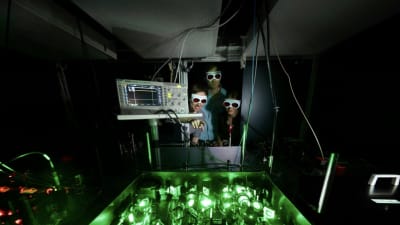
The new tracking method generates more detailed information in near real-time than authorities have today about the reentry of space debris from falling satellites — information that will help to quickly locate and retrieve the charred and sometimes toxic remains.

Briefs: Materials
To help meet surging demand and possible supply chain problems, scientists at the U.S. Department of Energy’s Argonne National Laboratory have developed an innovative membrane technology that efficiently extracts lithium from water. Read on to learn more.

Briefs: Physical Sciences
Using mechanisms inspired by nature to create new technological innovations is a signature of one Virginia Tech research team. The group led by Associate Professor Michael Bartlett has created an octopus-inspired adhesive, inspired by the shape of octopus suckers, that can quickly grab and controllably release challenging underwater objects. Read on to learn more about it.

Articles: Physical Sciences
See the products of tomorrow, including a new nanoscale optical device that works at room temperature to entangle the spin of photons (particles of light) and electrons to achieve quantum communication; a dust sensor for use in space environments; and more.

Quiz: Automotive
If you’ve ridden in a modern car, bus, truck, aircraft, or even on certain bicycles, you’ve used hydraulic brakes. You most certainly have used them, but do you know how they work? Find out with this quiz.

INSIDER: Nanotechnology
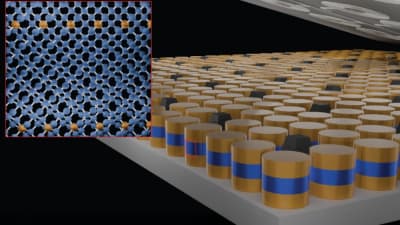
Scientists have long sought to make semiconductors that are also superconducting, thereby enhancing their speed and energy efficiency and enabling new quantum technologies. However,...
INSIDER: Semiconductors & ICs
As more devices get piled onto computer chips to increase processing power capacity, heat generation becomes increasingly concentrated. This heat must be removed to keep chip...

Products: Energy
See the new products, including Plasmatreat's HydroPlasma, a solution for the removal of stubborn contaminants from glass and metal surfaces; TDK Corporation's 3000-watt TDK-Lambda brand HWS3000G programmable AC-DC power supplies; Zircotec's new range of proprietary ceramic coatings; Thermo Fisher Scientific's expanded solutions for battery manufacturers; and more.

Briefs: Power
Researchers at the University of California San Diego have developed a soft robotic skin that enables vine robots that are just a few millimeters wide to navigate convoluted paths and fragile environments. Read on to learn more.

White Papers: Test & Measurement

Fatigue Analysis: Approaches to Design Characterization and the Reduction of Catastrophic Failure
Fatigue Analysis is a very powerful tool that can help engineers to improve their products through accurate predictions of fatigue failure of...INSIDER: AR/AI
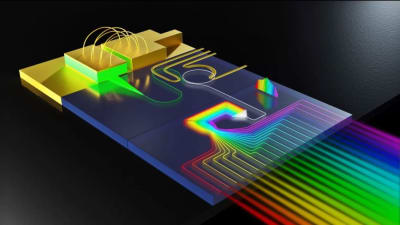
A few years ago, researchers in Michal Lipson’s Columbia Engineering lab noticed something remarkable. They were working on a project to design high-power chips that could...
INSIDER: Physical Sciences
University of Houston researchers have made a groundbreaking discovery in thermal conductivity, overturning an existing theory that boron arsenide (BAs) couldn’t compete with...

Briefs: Medical
Soft robots, medical devices and implants, and next-generation drug delivery methods could soon be guided with magnetism — thanks to a metal-free magnetic gel developed by researchers at the University of Michigan and the Max Planck Institute for Intelligent Systems in Stuttgart, Germany. Read on to learn more about it.

INSIDER: Robotics, Automation & Control
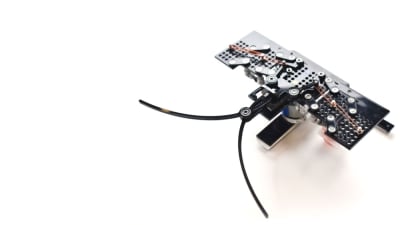
From sorting objects in a warehouse to navigating furniture while vacuuming, robots today use sensors, software control systems, and moving parts to perform tasks. The harder the task or more complex the...
INSIDER: Electronics & Computers
Transistors, the building blocks of modern electronics, are typically made of silicon. Because it’s a semiconductor, this material can control the flow of electricity in a...

INSIDER: Electronics & Computers
A research team led by physicists Ming Yi and Emilia Morosan from Rice University has developed a new material with unique electronic properties that could enable more powerful and...

Briefs: Physical Sciences
Animals like bats, whales, and insects have long used acoustic signals for communication and navigation. Now, an international team of scientists have taken a page from nature’s playbook to model micro-sized robots that use sound waves to coordinate into large swarms that exhibit intelligent-like behavior. Read on to learn more.

Briefs: Robotics, Automation & Control
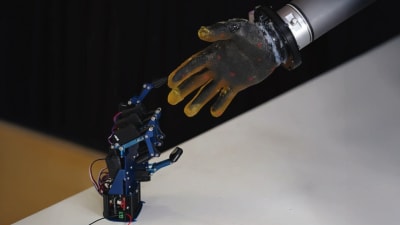
A team of engineers has developed a low-cost, durable, highly-sensitive robotic ‘skin’ that can be added to robotic hands like a glove, enabling robots to detect information about their surroundings in a way that’s similar to humans. Read on to learn more.
Briefs: Design
Researchers from the College of Engineering and Computer Science at Florida Atlantic University have proposed a design for an alternative, autonomous observational method, which holds promise for improving the autonomy of marine vehicles, aiding in maritime missions, and gaining a deeper understanding of how melting Arctic sea ice affects marine ecosystems. Read on to learn more.

Briefs: Sensors/Data Acquisition
Plans are underway to create more powerful particle accelerators, whose collisions will unleash large subatomic storms. How will researchers sift through the chaos? Read on to find out.

Blog: Design
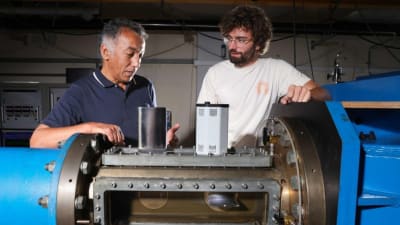
An EPFL Ph.D. student has developed a 3D-printable clever device that significantly dampens the flow-induced vibration caused by rotating parts.
INSIDER: Sensors/Data Acquisition
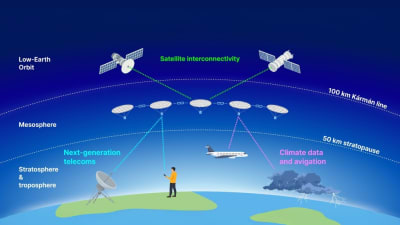
Between 50 and 100 kilometers (30-60 miles) above Earth’s surface lies a largely unstudied stretch of the atmosphere, called the mesosphere. It’s too high for airplanes and weather balloons,...
INSIDER: Motion Control
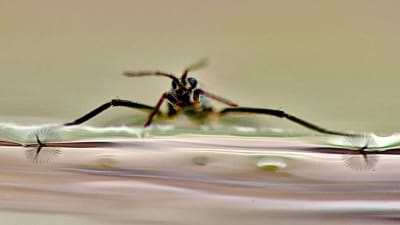
A new study explains how tiny water bugs use fan-like propellers to zip across streams at speeds up to 120 body lengths per second. The researchers then created...
INSIDER: Materials
In the quest for energy independence, researchers have studied solar thermoelectric generators (STEGs) as a promising source of solar electricity generation. Unlike the...

Briefs: Test & Measurement
Innovators at NASA Johnson Space Center have developed a thin film sensor that measures temperatures up to 1200 °F, and whose prototype successor may achieve measurements up to ~3000 °F — which was the surface temperature of the Space Shuttle during its atmospheric reentry. Read on to learn more.

Top Stories
 Blog: Lighting

A Stretchable OLED that Can Maintain Most of Its Luminescence
 Blog: Energy

Batteries that Can Withstand the Cold
 INSIDER: Energy

Advancing All-Solid-State Batteries
 Quiz: Energy

 Blog: Physical Sciences

 Blog: Materials

Webcasts
 Upcoming Webinars: Test & Measurement

From Spreadsheets to Insights: Fast Data Analysis Without Complex...
 Upcoming Webinars: Electronics & Computers

Cooling a New Generation of Aerospace and Defense Embedded...
 Upcoming Webinars: Test & Measurement

Beyond AI-Copy-Paste Engineering: Advanced AI-Integration Success...
 Upcoming Webinars: Automotive

Battery Abuse Testing: Pushing to Failure
 Upcoming Webinars: Internet of Things

A FREE Two-Day Event Dedicated to Connected Mobility
 Upcoming Webinars: Test & Measurement

Choosing the Right N-Port Strategy: Multiport VNAs vs. Switch...