Stories
6,36,37,43,46,48,50,56,58,59,60
7,8,36,110,131,134,135,138,139,141,142,144,145,151,152,201,202
-1
1560
30
Question of the Week: Nanotechnology
Can Borophane Beat Graphene?
A Tech Brief in our November issue highlights a new material that’s super-thin and super-strong. By combining hydrogen with an atom-thick sheet of boron known as borophane, researchers from Argonne National Laboratory (ANL) have created a potential alternative to the breakthrough 2D material graphene. The Argonne...
Articles: Materials
Thanos Yiagopoulos, Chief Technology Officer of Momentive Performance Materials, discusses how engineers can determine the best product for their application.

Articles: Materials
Once triggered, the enzyme-embedded plastics self-destruct, completely degrading and eliminating microplastics in days.

UpFront: Photonics/Optics
How to be a NASA intern; a new ideas for moon fabrics; and NASA's need for a better rover.
Articles: Test & Measurement
Freetouch turns a smartphone into a touchscreen remote control.

Articles: Energy
Nanotube fibers that turn heat to power; a NASA antenna system; and an antimicrobial coating.

Briefs: Nanotechnology
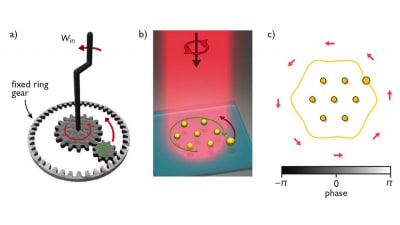
The optically powered machines self-assemble and could be used for nanoscale manipulation of tiny cargo.
Briefs: RF & Microwave Electronics
Researchers at Chalmers University of Technology have developed an optical amplifier that they expect will revolutionize both space and fiber communication.
Briefs: Photonics/Optics
Scientists are working to improve the image resolution of X-ray techniques.

Articles: Mechanical & Fluid Systems
Artemis I will launch from Kennedy Space Center into Earth orbit, where it will travel 40,000 miles beyond the Moon.
Briefs: Wearables
Flexible carbon nanotube fibers woven into clothing gather accurate EKG and heart rate.
Q&A: Automotive
Jingcheng Ma, along with a team of researchers at the University of Illinois, Urbana-Champaign, found a way to make ultra-thin water-resistant surface coatings robust enough to survive...

Articles: Motion Control
A vision-based control algorithm saves a quadrotor after the complete loss of a single motor.
Briefs: Energy
Applications include space structures, emergency shelters, backpack solar collectors, and inspection of hazardous environments.

Facility Focus: Sensors/Data Acquisition
The "ERDC" helps solve problems in civil and military engineering, geospatial sciences, water resources, and environmental sciences.
Briefs: Electronics & Computers
Incorporating semiconductor components, microscopic robots are made to walk with standard electronic signals.

Articles: Materials
With Artemis II — the first crewed flight of SLS and Orion — four astronauts will travel to the lunar environment in 2024.

Articles: Automotive
See this year's product designs from engineers, students, and entrepreneurs worldwide.

Briefs: Materials
The 2D materials boost device performance for electronic devices, solar cells, batteries, and medical equipment.

Articles: Robotics, Automation & Control
The third flight of SLS and Orion will carry the first woman and first person of color to the Moon.

NASA Spinoff: Materials
A long-time apparel insulator develops its own takes on popular NASA spinoff material.

Articles: Aerospace
With the Space Launch System (SLS) rocket and Orion spacecraft, NASA will return humans to the lunar surface.

Products: Test & Measurement
Power supply ICs, temperature sensors, DC-DC converters, and more.

Briefs: Materials
The material could be used to create housing in outer space.
Articles: Test & Measurement
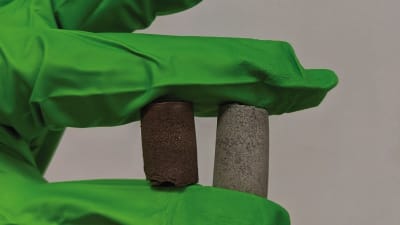
The invention could capture the potential of the edible packaging market.
Question of the Week: Materials
Will Coatings Reduce Food Waste?
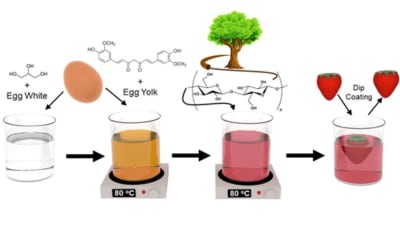
Today’s lead story highlighted an egg-based coating that extends the shelf life of fruits and vegetables.
Blog: Materials
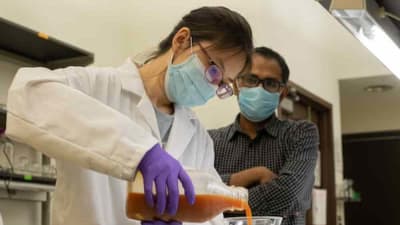
A micron-thick coating, made largely from leftover eggs, can extend the shelf life of the fruits and vegetables in your refrigerator.
Blog: Materials
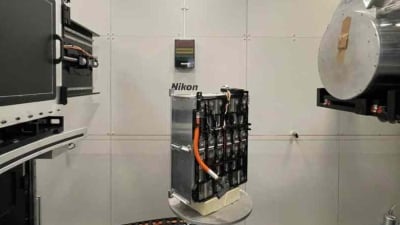
Tech Briefs readers ask two industry experts about the effectiveness of CT scans when you want a deeper look at a battery.
Question of the Week: Green Design & Manufacturing
Will Technology Help to Reduce Plastic Pollution?
Our October Q&A in Tech Briefs highlighted an achievement from Professor Aaron Sadow of Ames Laboratory in Iowa. Sadow’s chemical process produces valuable biodegradable chemicals from discarded plastics, which are then used as surfactants and detergents in a range of applications.
Top Stories
 Blog: Power

My Opinion: We Need More Power Soon — Is Nuclear the Answer?
 Blog: AR/AI

Aerial Microrobots That Can Match a Bumblebee's Speed
 News: Energy

 Blog: Electronics & Computers

Turning Edible Fungi into Organic Memristors
 Blog: Robotics, Automation & Control

Microscopic Swimming Machines that Can Sense, Respond to Surroundings
 INSIDER: Sensors/Data Acquisition

Webcasts
 Upcoming Webinars: Power

Hydrogen Engines Are Heating Up for Heavy Duty
 Upcoming Webinars: Electronics & Computers

Advantages of Smart Power Distribution Unit Design for Automotive...
 Upcoming Webinars: Transportation

Quiet, Please: NVH Improvement Opportunities in the Early Design...
 Upcoming Webinars: Sensors/Data Acquisition

From Spreadsheets to Insights: Fast Data Analysis Without Complex...
 Upcoming Webinars: Energy

Battery Abuse Testing: Pushing to Failure
 Upcoming Webinars: AR/AI