Stories
0
5280
30
INSIDER: Robotics, Automation & Control
The next generation of exploration rovers will need to be good at climbing hills covered with loose material and avoiding entrapment on soft granular surfaces. Built with wheeled appendages that can be...

Blog: Robotics, Automation & Control
New software sets the stage for A.I.-enabled robotic prostheses that predict user terrain and initiate mechanical changes accordingly.

Question of the Week: Materials
How Would You Use Gecko-Inspired Adhesion?
A team at Georgia Tech has discovered a Velcro-like way of mass-producing gecko-inspired adhesives. Principal investigator Prof. Michael Varenberg believes his team’s technology can someday be used on pick-and-place industrial machines, wall-scaling cleaners, and even small repair robots that travel on...
News: Sensors/Data Acquisition
Novel biosensors allow the simultaneous study of both neuronal activity and transcription factor dynamics.

News: Medical
A new tool for medical professionals may help shed light on tumors.

News: Medical
Simon Fraser University researchers will use their pioneering imaging technology – called Mango, for its bright color – to develop coronavirus testing kits.

News: Medical
Researchers have tested a new imaging method to understand the brain as an individual develops Alzheimer's disease.

Blog: Transportation
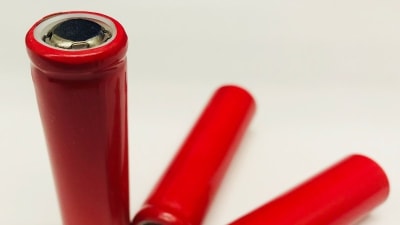
The Los Angeles, CA-based company Nanotech Energy is using graphene to prevent thermal runaway and create a non-flammable battery.
Question of the Week: Robotics, Automation & Control
Will Soft Robots Reach Cheetah-Like Speeds?
Our lead INSIDER story today featured a proof-of-concept robot that moves at almost 3 body lengths a second.
Blog: Manufacturing & Prototyping
A team at Georgia Tech has discovered a Velcro-like way of mass-producing gecko-inspired adhesives.

Blog: Mechanical & Fluid Systems
A proof-of-concept soft robot has a cheetah-like gait that avoids the usual crawl.

Question of the Week: Manufacturing & Prototyping
Will ‘Flexoskeletons’ Catch On?
Engineers at the University of California San Diego have found a new way to make soft, flexible, 3D-printed robots. The “flexoskeletons” are both made of a rigid material and a thin sheet of polycarbonate that acts as a flexible base. Watch the demo on Tech Briefs TV.
What do you think? Will...
Blog: Aerospace
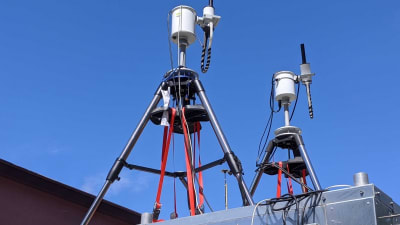
An empty airport tells you more than you might think.
INSIDER: Materials
The future’s getting brighter for solar power. Researchers from CU Boulder have created a low-cost solar cell with one of the highest power-conversion efficiencies to date...

INSIDER: Software
Stanford University researchers created an inverse design codebase called SPINS that can help researchers explore different design methodologies to find...

INSIDER: Photonics/Optics
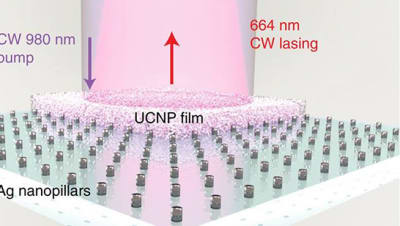
A research team has used the Molecular Foundry, a Department of Energy Office of Science user facility, to create miniature lasers. These lasers are stable and work continuously. What...
Question of the Week: Sensors/Data Acquisition
Will Biosensors Be Used Effectively in Crowded Environments?
A team used to making pollutant-detection systems is adapting their technologies to spot coronavirus.
INSIDER Product: Photonics/Optics
Low-Power Sealed Laser
Luxinar (Kingston Upon Hull, UK) has introduced the SR 08s for marking, scribing and kiss cutting applications requiring average rather than peak power. The new low-power sealed CO2 laser source targets...

Blog: Manufacturing & Prototyping
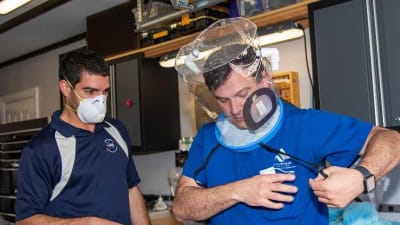
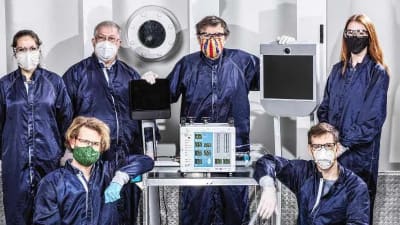
See how NASA engineer Mike Buttigieg is creating a device that will free up ventilators for patients with COVID-19
Blog: Regulations/Standards
A low-cost, low-complexity ventilator developed by NASA engineers at Jet Propulsion Laboratory (JPL) received approval from the Food and Drug Administration (FDA) this week.
Briefs: Transportation
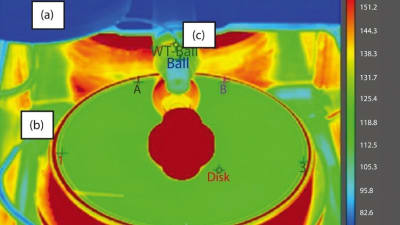
A new method could enable vehicles and equipment to better withstand high temperatures, loads, and speeds.
Briefs: Electronics & Computers
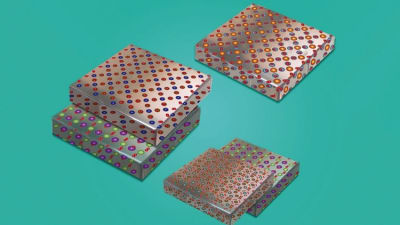
Next-generation devices made with a “peel and stack” method could include electronic chips worn on the skin.
Briefs: Test & Measurement
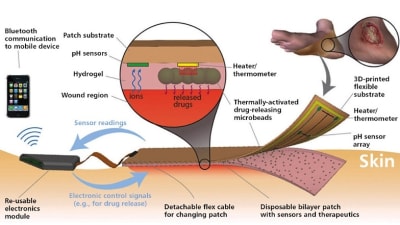
Bandages with integrated pH and temperature sensors, and electronically triggered drug release, improve healing.
Facility Focus: Materials
This NASA center hosts the world’s greatest collection of wind tunnels and flight simulation facilities

Briefs: Photonics/Optics
This method uses fiber optic probes for measurement of semiconductors, optical coatings, magnetic read/write heads, and precision machines.

Briefs: Test & Measurement
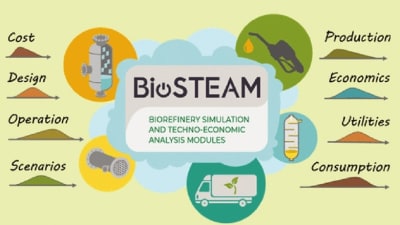
This fast, flexible tool allows researchers to quickly compare and prioritize strategies for converting biomass to fuels and products.
Q&A: Manufacturing & Prototyping
A new process will reduce the cost of manufacturing graphene by a factor of more than 100.

Application Briefs: Materials
With the recent boom in touch-based, polymer display substrates must be fingerprint-resistant.

Top Stories
 Blog: Sensors/Data Acquisition

Going for Gold in Winter Olympic Curling
 Blog: Energy

Batteries that Can Withstand the Cold
 Blog: Lighting

A Stretchable OLED that Can Maintain Most of Its Luminescence
 INSIDER: Design

Advancing All-Solid-State Batteries
 Blog: Data Acquisition

 Blog: Materials

Webcasts
 On-Demand Webinars: Defense

Cooling a New Generation of Aerospace and Defense Embedded Computing...
 Upcoming Webinars: Software

Beyond AI-Copy-Paste Engineering: Advanced AI-Integration Success...
 Upcoming Webinars: Automotive

Battery Abuse Testing: Pushing to Failure
 Upcoming Webinars: Power

A FREE Two-Day Event Dedicated to Connected Mobility
 Upcoming Webinars: RF & Microwave Electronics

Choosing the Right N-Port Strategy: Multiport VNAs vs. Switch...
 Upcoming Webinars: AR/AI