Stories
0
90
30
5 Ws: Robotics, Automation & Control
One of the 2026 CES Innovation Awards honorees in the robotics category is AEON — a humanoid robot developed to address labor shortages as industries adapt to ageing populations and shifting workforce demands.

Podcasts: Aerospace
On this episode of the Aerospace & Defense Technology Podcast, we learn about a new tool that could help manufacturers optimize the way they design and create new drones. Austin Spiegel, CTO of Sift, is the guest to explain their "unified observability platform" and how drone manufacturers can leverage it to optimize their design, validation, manufacturing, and overall engineering processes from prototype to operations.

INSIDER: AR/AI
Viavi Solutions Inc. has integrated the "RF Viewer" augmented reality (AR) application into its OneAdvisor 800 Wireless test platform. Designed to address telecommunications, network...

INSIDER: Electronics & Computers
A new transceiver invented by electrical engineers at the University of California, Irvine boosts radio frequencies into 140-gigahertz territory, unlocking data...

INSIDER: RF & Microwave Electronics
The U.S. Navy has awarded Data Link Solutions, a joint venture between BAE Systems and Collins Aerospace, a $248 million production contract to deliver hundreds of Multifunctional...

Products: Information Technology
See the product of the month: Altech Corporation's C-TEC Series of uninterruptible power supplies (UPS).

Articles: Information Technology
To address the staggering power and energy demands of AI, engineers have developed a revolutionary new thin-film material that promises to make AI devices significantly faster while dramatically cutting energy consumption. In this interview, Alamgir Karim, who is leading the research, discusses the new approach, its benefits, and how Nobel Prize-winning chemistry enabled this discovery.

Articles: Robotics, Automation & Control
See the products of tomorrow, including a new nanoscale optical device that works at room temperature to entangle the spin of photons (particles of light) and electrons to achieve quantum communication; a dust sensor for use in space environments; and more.

Products: Information Technology
See what's new on the market, including COMSOL Multiphysics® version 6.4; Novotechnik's Vert-X 26 Series of non-contacting magnetic angle sensors; HMS Networks' N-Tron NT110-FX2, an unmanaged Ethernet switch with two fiber ports; Littelfuse's MMIX1T500N20X4 X4-Class Ultra-Junction Power MOSFET; and more.
Briefs: Nanotechnology
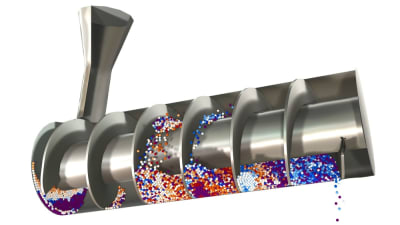
Researchers at NASA have developed new methods to manufacture carbon materials (e.g., nanotubes, graphene) with holes through the graphitic surface of the particles. The methods generate materials with increased accessible surface area, increased functional groups at damage sites, and improved through-surface molecular transport properties.

Briefs: Green Design & Manufacturing
Researchers in Korea have successfully developed a new material that significantly enhances the efficiency of green hydrogen production while reducing costs. Read on to learn more about it.

Briefs: Wearables
MIT researchers have developed an autonomous programmable computer in the form of an elastic fiber, which could monitor health conditions and physical activity, alerting the wearer to potential health risks in real-time. Read on to learn more.

Briefs: Design
In two papers, one released in Nature Materials and a second in ACS Nano, researchers describe a new methodology for fabricating targeted 3D nanoscale structures via self-assembly that can find use in a variety of applications, and they provide a design algorithm for others to follow suit. And it’s all based on the most basic biomolecular building blocks: DNA. Read on to learn more.

Briefs: Design
Using mechanisms inspired by nature to create new technological innovations is a signature of one Virginia Tech research team. The group led by Associate Professor Michael Bartlett has created an octopus-inspired adhesive, inspired by the shape of octopus suckers, that can quickly grab and controllably release challenging underwater objects. Read on to learn more about it.

Briefs: Materials
Dr. Mustafa Akbulut, Professor of Chemical engineering, has teamed up with Horticultural Science Professor Luis Cisneros-Zevallos to engineer longer-lasting, bacteria-free produce. Read on to learn more about it.

Briefs: Materials
To help meet surging demand and possible supply chain problems, scientists at the U.S. Department of Energy’s Argonne National Laboratory have developed an innovative membrane technology that efficiently extracts lithium from water. Read on to learn more.

Briefs: Mechanical & Fluid Systems
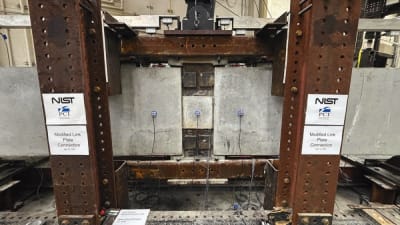
Researchers have developed five new ways to securely connect large concrete pieces. These connection methods are intended for a type of material called “precast concrete,” in which parts such as beams and columns are made in a factory and assembled later at a construction site. Read on to learn more.
Briefs: Sensors/Data Acquisition
A new system that brings together real-world sensing and virtual reality would make it easier for building maintenance personnel to identify and fix issues in commercial buildings that are in operation. The system was developed by computer scientists at the University of California San Diego and Carnegie Mellon University. Read on to learn more.

Briefs: Sensors/Data Acquisition
Clean, safe water is vital for human health and well-being. However, detecting contamination quickly and accurately remains a major challenge in many parts of the world. A groundbreaking new device developed by researchers at the National University of Singapore has the potential to significantly advance water quality monitoring and management. Read on to learn more.

Briefs: Software
A new study from NC State University combines three-dimensional embroidery techniques with machine learning to create a fabric-based sensor that can control electronic devices through touch. Read on to learn more.

Briefs: Sensors/Data Acquisition
When it comes to haptic feedback, most technologies are limited to simple vibrations. But our skin is loaded with tiny sensors that detect pressure, vibration, stretching and more. Now, Northwestern University engineers have unveiled a new technology that creates precise movements to mimic these complex sensations. Read on to learn more.

Briefs: Medical
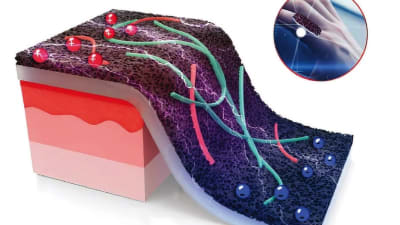
A major challenge in self-powered wearable sensors for health care monitoring is distinguishing different signals when they occur at the same time. Researchers from Penn State and China’s Hebei University of Technology addressed this issue by uncovering a new property of a sensor material, enabling the team to develop a new type of flexible sensor that can accurately measure both temperature and physical strain simultaneously but separately to more precisely pinpoint various signals.
Briefs: Energy
University of Minnesota Twin Cities researchers have discovered a new method to move objects using ultrasound waves, which opens the door for using contactless manipulation in industries in which devices wouldn’t need a built-in power source to move. Read on to learn more.
Briefs: RF & Microwave Electronics
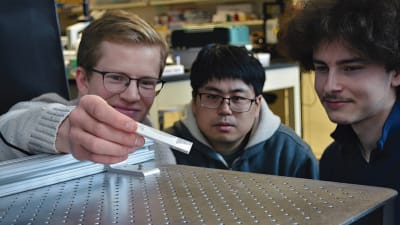
NASA has developed an innovative combination of a Magnetometer, low-powered ElectroMagnets, and Resonant Inductive Coupling (MEMRIC) to create and control relative positioning of nano satellites within a cluster. This is a game-changing approach to enable distributed nanosatellite (nanosat) clusters. Read on to learn more.

Briefs: Lighting Technology
Researchers have created a light-powered soft robot that can carry loads through the air along established tracks, similar to cable cars or aerial trams. The soft robot operates autonomously, can climb slopes at angles of up to 80°, and can carry loads up to 12 times its weight. Read on to learn more.

Briefs: AR/AI
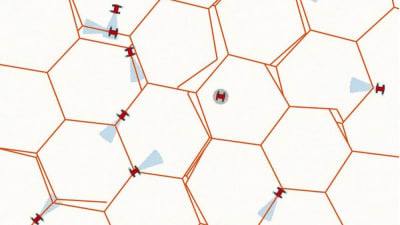
Bees, ants, and termites don’t need blueprints. They may have queens, but none of these species breed architects or construction managers. Each insect worker, or drone, simply responds to cues like warmth or the presence or absence of building material. Now, researchers at Penn Engineering have developed mathematical rules that allow virtual swarms of tiny robots to do the same. Read on to learn more.
Briefs: AR/AI
For a robot, the real world is a lot to take in. Making sense of every data point in a scene can take a huge amount of computational effort and time. Using that information to then decide how to best help a human is an even thornier exercise. Now, MIT roboticists have a way to cut through the data noise, to help robots focus on the features in a scene that are most relevant for assisting humans. Read on to learn more.

Articles: Software
Pinggao Group focuses on the development and production of high-voltage and ultra-high-voltage electrical equipment. Different teams at the company use simulation to explore in depth the factors that affect the performance of high-voltage switches as well as to optimize switch designs and predict the operational status of equipment. Read on to learn more about the work.

Top Stories
 Blog: Software

Going for Gold in Winter Olympic Curling
 Blog: Energy

Batteries that Can Withstand the Cold
 Blog: Lighting

A Stretchable OLED that Can Maintain Most of Its Luminescence
 INSIDER: Energy

Advancing All-Solid-State Batteries
 Blog: Physical Sciences

 Blog: Design

Webcasts
 On-Demand Webinars: Aerospace

Cooling a New Generation of Aerospace and Defense Embedded Computing...
 Upcoming Webinars: Test & Measurement

Beyond AI-Copy-Paste Engineering: Advanced AI-Integration Success...
 Upcoming Webinars: Test & Measurement

Battery Abuse Testing: Pushing to Failure
 Upcoming Webinars: Automotive

A FREE Two-Day Event Dedicated to Connected Mobility
 Upcoming Webinars: Test & Measurement

Choosing the Right N-Port Strategy: Multiport VNAs vs. Switch...
 Upcoming Webinars: AR/AI