

An array of small optical receivers is proposed as an alternative to a single large optical receiver for high-data-rate communications in NASA's Deep Space Network (DSN). Because the telescope for a single receiver capable of satisfying DSN requirements must be greater than 10 m in diameter, the design, building, and testing of the telescope would be very difficult and expensive. The proposed array would utilize commercially available telescopes of 1-m or smaller diameter and, therefore, could be developed and verified with considerably less difficulty and expense.
The essential difference between a single-aperture optical-communications receiver and an optical-array receiver is that a single-aperture receiver focuses all of the light energy it collects onto the surface of an optical detector, whereas an array receiver focuses portions of the total collected energy onto separate detectors, optically detects each fractional energy component, then combines the electrical signal from the array of detector outputs to form the observable, or "decision statistic," used to decode the transmitted data.
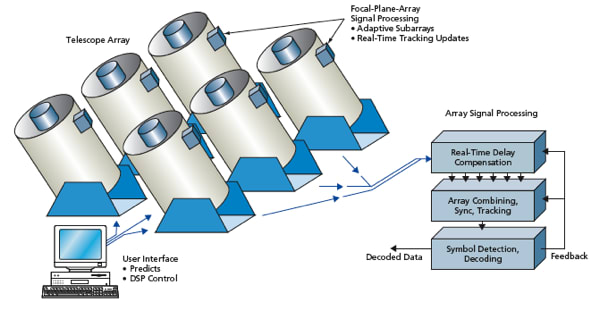
A conceptual block diagram identifying the key components of the optical-array receiver suitable for deep-space telemetry reception is shown in the figure. The most conspicuous feature of the receiver is the large number of small- to medium-size telescopes, with individual apertures and number of telescopes selected to make up the desired total collecting area. This array of telescopes is envisioned to be fully computer-controlled via the user interface and prediction-driven to achieve rough pointing and tracking of the desired spacecraft. Fine-pointing and tracking functions then take over to keep each telescope pointed toward the source, despite imperfect pointing predictions, telescope-drive errors, and vibration caused by wind.
The turbulence-degraded image of the laser source in each telescope would be sensed by a focal-plane photodetector array, the outputs of which would then be digitized. The digitized array outputs would be synchronized and combined by field-programmable gate-array circuits that would execute digital-signal-processing algorithms, for both the individual telescopes and the entire array. Symbol detection and decoding operations would then be carried out on the synchronized and combined array signal. Receiver parameters would be controlled adaptively at each telescope to accommodate changing atmospheric conditions, thus optimizing the performance of the optical-array receiver in real time.
This work was done by Victor Vilnrotter, Chi-Wung Lau, Meera Srinivasan, Kenneth Andrews, and Ryan Mukai of Caltech for NASA's Jet Propulsion Laboratory. For further information, access the Technical Support Package (TSP) free on-line at www.techbriefs.com/tsp under the Electronics/ Computers category.
NPO-40190
This Brief includes a Technical Support Package (TSP).
An Array of Optical Receivers for Deep-Space Communications
(reference NPO-40190) is currently available for download from the TSP library.
Don't have an account?
Overview
The document discusses an innovative technology developed by NASA's Jet Propulsion Laboratory (JPL) aimed at improving deep-space communications through the use of an optical array receiver. This technology, identified by NTR Number 40190, proposes a shift from traditional large optical receivers, typically around 10 meters in diameter, to an array of smaller optical receivers that collectively maintain the same total collecting area.
The primary motivation behind this innovation is the challenges associated with constructing and operating large telescopes. Such large receivers are not only difficult to implement but also come with significant costs. By utilizing an array of smaller telescopes, the proposed system offers several advantages, including ease of implementation and reduced overall costs. This approach allows for more flexible deployment and potentially enhances the robustness of signal collection from deep-space missions.
The concept of the optical array receiver was first introduced in a memo titled "Array of Optical FPA Receivers for Deep-Space Communications," which was disclosed on April 10, 2002. It was later the subject of a Research and Technology Development (R&TD) proposal submitted on July 26, 2002. The document emphasizes that this technology not only addresses the logistical and financial challenges of large telescopes but also incorporates advanced signal processing techniques to improve the quality of the received signals.
The technical support package provided in the document is part of NASA's Commercial Technology Program, which aims to disseminate aerospace-related developments that have broader technological, scientific, or commercial applications. The document also includes contact information for further inquiries regarding research and technology in this area, specifically through the Innovative Technology Assets Management at JPL.
Overall, the optical array receiver represents a significant advancement in the field of deep-space communication, promising to enhance the capabilities of future space missions by providing a more efficient and cost-effective means of collecting weak signals from distant celestial sources. This innovation aligns with NASA's ongoing efforts to improve communication technologies and support ambitious exploration goals in the realm of space science.











