

There are no existing ultra-sterile lab-on- a-chip systems that can accept solid samples and perform complete chemical analyses without human intervention. The proposed solution is to demonstrate completely automated lab-on- a-chip manipulation of powdered solid samples, followed by on-chip liquid extraction and chemical analysis.
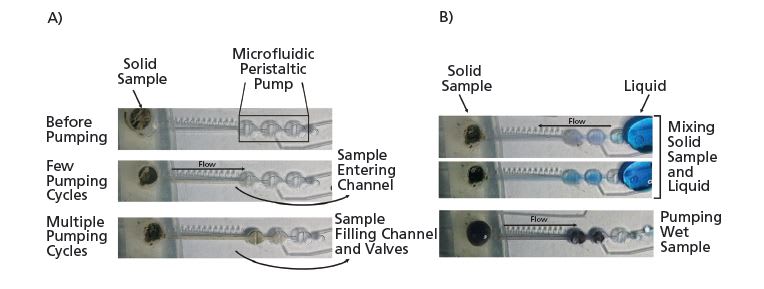
This approach utilizes an existing portable instrument that houses optics, high-voltage power supplies, and solenoids for fully autonomous microfluidic sample processing and ..CE analysis with laser-induced fluorescence (LIF) detection. Furthermore, the entire system can be sterilized and placed in a cleanroom environment for analyzing samples returned from extraterrestrial targets, if desired.
This is an entirely new capability never demonstrated before. The ability to manipulate solid samples, coupled with lab-on-a-chip analysis technology, will enable ultraclean and ultrasensitive endto- end analysis of samples that is orders of magnitude more sensitive than the ppb goal given in the Science Instruments, Observatories, and Sensor Systems Roadmap. This technology has potential applications for highly sensitive analyses of organic compounds elsewhere in the solar system, including Mars, Europa, Titan, and small bodies. It will also enable contamination-free analysis of returned samples. Finally, this could also be employed for a wide range of terrestrial applications including environmental, biomedical, or forensic analyses.
This work was done by Maria F. Mora, Amanda M. Stockton, and Peter A. Willis of Caltech for NASA’s Jet Propulsion Laboratory. NPO-48603
This Brief includes a Technical Support Package (TSP).
Automated, Ultra-Sterile Solid Sample Handling and Analysis on a Chip
(reference NPO-48603) is currently available for download from the TSP library.
Don't have an account?
Overview
The document is a Technical Support Package from NASA’s Jet Propulsion Laboratory (JPL) that discusses advancements in automated, ultra-sterile solid sample handling and analysis on a chip, specifically focusing on the search for signs of life on extraterrestrial planetary bodies. This search is a top priority for NASA in Solar System exploration, as it involves the pursuit of organic compounds that may indicate past or present life.
Given the challenges of conducting sample return missions, the document emphasizes the necessity for in situ investigations on planetary bodies. These investigations require sophisticated instrumentation capable of performing sensitive chemical analyses on complex mixtures of organic molecules. The technology described includes microchip capillary electrophoresis (CE) coupled with laser-induced fluorescence (LIF) detection, which provides the required sensitivity while maintaining low mass, volume, and power consumption.
The document highlights the innovative use of microfabricated pneumatically-actuated monolithic membrane valves, which facilitate fluidic sample processing. These microvalves are created using glass/polymer hybrid stacks and are integrated with microfluidic analytical techniques. The development of glass/PDMS microdevices allows for automated CE-LIF analysis, enabling the processing of samples through labeling, dilution, and standard spiking, followed by electrophoretic analysis.
A significant advancement mentioned is the Chemical Laptop, the first battery-powered, automated, reprogrammable, and portable astrobiology instrument. This device integrates multiple detection modes for a wide array of chemical targets and features a novel 32-valve chemical processor for fluidic manipulation.
The document acknowledges the collaborative research carried out at JPL under NASA's sponsorship, emphasizing the importance of these technological advancements in the broader context of astrobiology and planetary exploration. It serves as a resource for those interested in aerospace-related developments with potential applications beyond space exploration.
For further inquiries or assistance regarding this research and technology, the document provides contact information for the Innovative Technology Assets Management team at JPL. Overall, the Technical Support Package underscores the critical role of advanced microfluidic technologies in the ongoing quest to uncover the mysteries of life beyond Earth.










