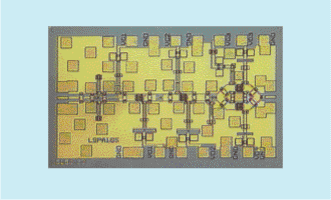
Figure 1 shows a three-stage monolithic microwave integrated circuit (MMIC) power amplifier that features high-electron-mobility transistors (HEMTs) as gain elements. This amplifier is designed to operate in the frequency range of 140 to 170 GHz, which contains spectral lines of several atmospheric molecular species plus subharmonics of other such spectral lines. Hence, this amplifier could serve as a prototype of amplifiers to be incorporated into heterodyne radiometers used in atmospheric science. The original intended purpose served by this amplifier is to boost the signal generated by a previously developed 164-GHz MMIC HEMT doubler [which was described in "164-GHz MMIC HEMT Frequency Doubler" (NPO-21197), NASA Tech Briefs, Vol. 27, No. 9 (September 2003), page 48.] and drive a 164-to-328-GHz doubler to provide a few milliwatts of power at 328 GHz.
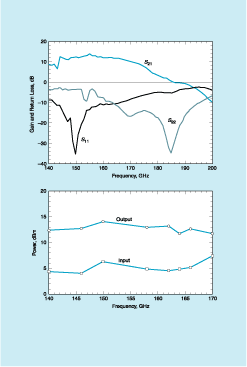
For the power measurements, the amplifier circuit was biased at a drain potential of 2.1 V, a drain current of 250 mA, and gate potential of 0 V (these biases were chosen to optimize the output power). As shown in the lower part of Figure 2, the output power ranged from a low of about 11.8 dBm (≈15 mW) to a high of about 14 dBm (≈25 mW). The peak power output of about 14 dBm was achieved at
150 GHz at an input power of
6.3 mW, yielding a large-signal
gain of slightly less than 8 dBm.
This work was done by Lorene Samoska of NASA's Jet Propulsion Laboratory, and Vesna Radisic, Catherine Ngo, Paul Janke, Ming Hu, and Miro Micovic of HRL Laboratories, LLC. For further information, access the Technical Support Package (TSP) free on-line at www.techbriefs.com/tsp under the Computers/Electronics category. NPO-30127
This Brief includes a Technical Support Package (TSP).
MMIC HEMT Power Amplifier for 140 to 170 GHz
(reference NPO-30127) is currently available for download from the TSP library.
Don't have an account?
Overview
The document presents a technical overview of a 140-170 GHz InP MMIC HEMT (High Electron Mobility Transistor) power amplifier developed by researchers at NASA's Jet Propulsion Laboratory and HRL Laboratories. This amplifier is designed to enhance signal strength for applications in atmospheric science, particularly in radiometers used for probing the atmosphere.
The amplifier operates within the frequency range of 140 to 170 GHz, which encompasses spectral lines of various atmospheric molecular species. Its primary function is to boost signals generated by a previously developed 164-GHz MMIC HEMT doubler, ultimately driving a 165-330 GHz doubler to provide several milliwatts of power at 330 GHz. This capability is crucial for improving the sensitivity and accuracy of atmospheric measurements.
The design features a three-stage configuration, with the first two stages containing one HEMT each, while the output stage incorporates two HEMTs to maximize output power. Each HEMT has gate-periphery dimensions of 4 by 37 μm, and the amplifier employs grounded coplanar waveguides for impedance matching in input, output, and interstage coupling.
Small-signal gain measurements indicated that the amplifier achieved a gain (S21) greater than 10 dB across the frequency range of 144 to 170 GHz, with input and output return losses (S11 and S22) approximately at 10 dB at 165 GHz. For power measurements, the amplifier was biased at a drain potential of 2.1 V and a drain current of 250 mA, resulting in output power ranging from about 11.8 dBm (approximately 15 mW) to a peak of 14 dBm (approximately 25 mW) at 150 GHz, with a large-signal gain of slightly less than 8 dBm.
The document emphasizes the novelty of this amplifier, noting that it represents the highest frequency MMIC HEMT-based power amplifier developed to date, surpassing previous models that operated up to 146 GHz. The work was motivated by the need for a high-performance amplifier to meet specific requirements set by the DAPRA THz task, aiming for a gain of 10 dB, a return loss of 10 dB, and an output power of approximately 25 mW.
Overall, this document highlights significant advancements in microwave technology and its potential applications in atmospheric research, showcasing the collaborative efforts of leading scientists and engineers in the field.