

Specially shaped mounting rings keep lenses precisely centered, regardless of temperature, in the lens housings of cameras and other optical systems. These rings feature (1) well-defined contact spots for alignment, plus (2) relieved surfaces that form flexures to accommodate small manufacturing tolerances and differences among the thermal expansions of lenses, lens housings, and the rings themselves. These rings are made by numerically controlled machining of recently developed clean, strong, machinable plastics.
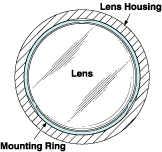
The Elastomeric Ring Holds the Lens with its three inner concave arced stubs and engages the lens housing with its three outer convex arced stubs. Thermal expansion and/or contraction of the lens, the housing, and/or the ring itself are absorbed by flexure of the ring. For greater precision, a ring could be made with six inner and six outer stubs.
This work was done by Virginia G. Ford of Caltech for NASA's Jet Propulsion Laboratory. For further information, access the Technical Support Package (TSP) free on-line at www.nasatech.com/tsp under the Mechanics category.
This invention is owned by NASA, and a patent application has been filed. Inquiries concerning nonexclusive or exclusive license for its commercial development should be addressed to the Patent Counsel, NASA Management Office–JPL; (818) 354-7770. Refer to NPO-19518.
This Brief includes a Technical Support Package (TSP).
Flexure Rings for Centering Lenses
(reference NPO19518) is currently available for download from the TSP library.
Don't have an account?
Overview
The document outlines the development of flexure rings designed to maintain precise lens centering in optical systems, such as cameras, regardless of temperature fluctuations. This innovation, created by Virginia G. Ford at NASA's Jet Propulsion Laboratory (JPL), addresses the challenges posed by manufacturing tolerances and thermal expansion differences among lenses, lens housings, and the rings themselves.
The flexure rings are made from advanced, clean, and strong machinable plastics, specifically a commercial polyimide. The manufacturing process involves numerically controlled machining to achieve precise inner and outer diameters. The rings feature well-defined contact spots for alignment and relieved surfaces that allow for flexure, accommodating small variations in size and thermal expansion. The design includes three convex arcs on the outer surface that contact the lens housing and three concave arcs on the inner surface that engage with the lens. This configuration ensures that the lens remains centered while allowing for necessary flexibility to absorb thermal expansion and contraction.
The document emphasizes the importance of these specially shaped mounting rings in enhancing the performance of optical systems by ensuring that lenses are held securely in place, even under varying temperature conditions. The potential for greater precision is also noted, with the possibility of designing rings with six inner and six outer stubs for improved stability.
The invention is owned by NASA, and a patent application has been filed. The document encourages inquiries regarding nonexclusive or exclusive licenses for commercial development to be directed to the Patent Counsel at NASA Management Office–JPL, referencing the patent number NPO-19518.
Overall, this technical support package highlights a significant advancement in optical technology, showcasing how innovative engineering solutions can improve the reliability and performance of optical systems in various applications. The work conducted at JPL underlines NASA's commitment to advancing technology for both space exploration and practical applications on Earth.











