A method of fabricating membrane electrode structures for methanol fuel cells involves, among other things, the use of improved sprayers to deposit inks containing catalytic metals on membranes of Nafion™ (or equivalent) perfluorosulfonic acid-based hydrophilic, proton-conducting ion-exchange polymer. In comparison with older methods, the present method provides for faster production with more efficient utilization of the expensive catalytic metals. The present method is thus better suited to mass production.
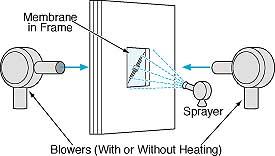
The older methods do not provide for deposition of uniformly thin catalytic layers on membranes, nor do they afford the flexibility of depositing well-defined multiple thin catalytic layers of different compositions. The present method does provide these capabilities, thus making it possible to tailor catalytic layers more precisely to achieve comparable cell performances with reduced catalyst loadings. The improved sprayers used in the present method contribute to the attainment of these objectives in that they produce slow, fine sprays that can be aimed more precisely on the surface areas to be coated, without wasting sprays on adjacent areas. Moreover, whereas the sprayers used in the older methods frequently became clogged, the improved sprayers are designed to prevent clogging.
The catalytic ink usually comprises the catalytic metal (Pt for the cathode or a mixture of Pt and Ru for the anode), a Nafion™ (or equivalent) ionomer solution, water, and isopropanol, with perhaps a small amount of a polytetrafluoroethylene-based additive. The ingredients of the ink are mixed well by use of ultrasound, and the viscosity of the ink is adjusted, by addition of small amounts of water and isopropanol, to enhance sprayability. The ink is then transferred to the sprayer.
In fabricating a membrane electrode according to the present method, the membrane is first conditioned in water, then soaked in an aqueous solution of isopropanol or methanol; this soaking is necessary to swell the membrane to prevent wrinkling that would otherwise occur when the sprayed catalytic ink subsequently comes into contact with the membrane. The membrane is then mounted in a frame (see figure), which must be nonmetallic to prevent corrosion. Then before the membrane dries out, it is sprayed on one side with catalytic ink. The position and settings of the spray head and the rate of flow of compressed air that drives the sprayer are adjusted to regulate the characteristics of the spray to ensure that the spray does not dry out on its way to the membrane and so that the deposited material bonds to the membrane and forms an electrochemically active surface. The spray-coated membrane is then dried with air at ambient temperature or, optionally, air heated to a temperature between 40 and 60 °C to accelerate drying.
Additional coats of catalytic ink on the same side or on opposite sides can be applied by repeating the spraying and drying steps. Preferably, the layers are applied alternately on the anode and cathode sides to minimize any stresses remaining after the coating process. The areal mass density of a single coat can be as small as 0.1 mg/cm².
Upon completion of coating, the membrane is released from the frame and hot-pressed between anode- and cathode-side carbon-paper supports. The resulting sandwich electrode structure is then stored in water until use.
In experiments, the performances of fuel cells containing electrode structures made by the present method were found to be comparable to those of fuel cells containing electrode structures made by older methods. However, the amounts of catalysts used in the present method ranged from 1 to 2 mg/cm², whereas the amounts used in the older methods were typically about 4 mg/cm². The achievement of comparable performance with less catalytic material by use of techniques suitable for mass production is a significant step toward commercialization and lowering the costs of producing fuel cells.
This work was done by William Chun, Sekharipuram Narayanan, Barbara Jeffries-Nakamura, Thomas I. Valdez, and Juergen Linke of Caltech for NASA's Jet Propulsion Laboratory. For further information, access the Technical Support Package (TSP) free on-line at www.techbriefs.com under the Materials category. In accordance with Public Law 96-517, the contractor has elected to retain title to this invention. Inquiries concerning rights for its commercial use should be addressed to
Technology Reporting Office JPL Mail Stop 122-116 4800 Oak Grove Drive Pasadena, CA 91109 (818) 354-2240
Refer to NPO-19941, volume and number of this NASA Tech Briefs issue, and the page number.
This Brief includes a Technical Support Package (TSP).
Improved fabrication of electrodes for methanol fuel cells
(reference NPO19941) is currently available for download from the TSP library.
Don't have an account?
Overview
The document provides details about two significant engineering expos scheduled for 1999: the New England Design & Manufacturing Expo in Boston and Technology 2009 in Miami Beach.
The New England Design & Manufacturing Expo will take place from September 20-22, 1999, at the Hynes Convention Center in Boston, Massachusetts. This expo aims to showcase the latest products and services that assist engineers in overcoming challenges related to design, prototyping, testing, and production. A notable feature of this event is the CAD & Rapid Prototyping Pavilion, which highlights advancements in computer-aided design and rapid prototyping technologies. Additionally, the expo is colocated with two other significant events: Photonics East, the only optics and photonics exhibition in the Northeast, and Electronic Imaging International, recognized as the East Coast’s leading annual imaging expo.
Following this, Technology 2009 is scheduled for November 1-3, 1999, at the Fontainebleau Hilton in Miami Beach, Florida. This event is described as the tenth annual "Engineering Innovation Show" and is positioned as America’s premier showcase for new and next-generation technologies that are available for licensing and commercial development. It is colocated with the Southeast Design & Manufacturing Expo, which specifically targets the high-tech corridor in the Southeast, and the Small Business Tech Expo, which focuses on resources and technologies for launching new products and partnerships.
Both expos are free to attend, providing an excellent opportunity for attendees to explore hundreds of exhibits and engage with industry leaders. The document encourages potential attendees to plan their visit and highlights the benefits of attending these events, such as discovering engineering solutions, product ideas, and profitable partnerships.
For more information, attendees are directed to contact Stephanie Torchinsky at the provided phone number and email, or to visit the website www.techeast.net. The document emphasizes the dual opportunity presented by these two venues to explore cutting-edge technologies and innovations in the engineering field.