

The fabrication of membrane/electrode assemblies (MEAs) for direct methanol fuel cells can be modified to make the cathodes hydro- phobic. These modifications improve the performances of the fuel cells, as explained below.
(a large multiple of the stoichiometric rate) of flow of air or oxygen past the cathode, the blockage is less severe because the excess flow evaporates the water. However, the equipment needed to pump the air and condense the evaporated water adds to the size and weight of the fuel-cell system and consumes a significant amount of power, thereby decreasing the efficiency of the fuel-cell system.
The size and weight of the system could be reduced and/or the efficiency of the system could be increased if it were not necessary to rely on evaporation to remove the water from the cathode and thus the system could be operated at a lower airflow rate. To reduce or eliminate reliance on evaporation, it would be desirable to exclude the water (or at least some of the water) from the cathode in the first place by rendering the cathode at least partly hydrophobic. The essence of the present modifications of the fabrication process is to implement this concept by adding a hydrophobic constituent to the cathode material.
The hydrophobic constituent in question is a poly(tetrafluoroethylene) powder with a particle size ranging from 1 to 4 μm. The powder is added to the catalytic inks used to make the electrodes. Each ink is applied to both (a) a sheet of poly(tetrafluoroethylene)-impregnated porous carbon paper and (b) a surface of a perfluoro-sulfonated ion-exchange membrane that has been roughened by use of abrasive paper to increase adhesion. Then as in the process described in the preceding article, the membrane is sandwiched between the carbon papers and the sandwich is consolidated by applying heat and pressure.
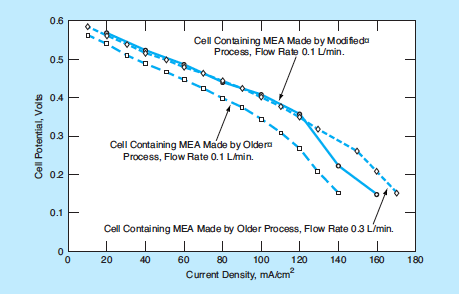
In an experiment, the electrical performance of a fuel cell containing an MEA made by the modified process was tested, along with that of a fuel cell containing an MEA made by an older process. The cell containing the MEA made by the modified process performed nearly equivalently to other cell at a third of the flow rate, and performed better at the same flow rate (see figure).
This work was done by Sekharipuram Narayanan and Thomas Valdez of Caltech for NASA’s Jet Propulsion Laboratory.
In accordance with Public Law 96-517, the contractor has elected to retain title to this invention. Inquiries concerning rights for its commercial use should be addressed to
Intellectual Property group
JPL
Mail Stop 202-233
4800 Oak Grove Drive
Pasadena, CA 91109
(818) 354-2240
Refer to NPO-20646, volume and number of this NASA Tech Briefs issue, and the page number.
This Brief includes a Technical Support Package (TSP).
Making Hydrophobic Cathodes for MEAs in Fuel Cells
(reference NPO-20646) is currently available for download from the TSP library.
Don't have an account?
Overview
The document discusses advancements in the fabrication of membrane-electrode assemblies (MEAs) for direct methanol fuel cells, focusing on improving performance at low air flow rates. A significant challenge in fuel cell operation is the production of water at the cathode, which can block access to catalyst sites, leading to decreased output voltage. Traditional methods rely on high air flow rates to evaporate this water, but this approach increases system size, weight, and power consumption, ultimately reducing efficiency.
To address these issues, the document introduces a novel process that incorporates hydrophobic materials into the cathode structure. Specifically, poly(tetrafluoroethylene) (PTFE) powder is added to the catalytic inks used for the electrodes. This modification aims to render the cathode partially hydrophobic, thereby minimizing water retention and improving air access to the catalyst sites. The process involves applying the hydrophobic inks to both a PTFE-impregnated porous carbon paper and a roughened perfluoro-sulfonated ion-exchange membrane, which enhances adhesion.
The performance of the new MEAs is evaluated at low flow rates, specifically at 0.1 L/min, which is approximately 1.5 times the stoichiometric rate for a 25 cm² cell operating at 100 mA/cm². Results indicate that the new design maintains the same cell voltage as previous versions at lower air flow rates, demonstrating improved performance. While high current densities typically suffer at low flow rates due to insufficient air, the new design shows a slight improvement in this area as well.
The document emphasizes the importance of achieving efficient water removal without relying heavily on evaporation, which can be cumbersome and inefficient. By enabling operation at lower air flow rates, the new MEA design not only enhances performance but also contributes to a more compact and efficient fuel cell system.
Overall, the innovations presented in this document represent a significant step forward in fuel cell technology, addressing critical challenges related to water management and air flow efficiency, ultimately paving the way for more effective and practical direct methanol fuel cells.











