Stories
56
-1
0
30
INSIDER: Photonics/Optics
Miniaturization ranks as the driving force behind the semiconductor industry. The tremendous gains in computer performance since the 1950s are largely due to the fact that ever smaller...

INSIDER: Electronics & Computers
Scientists have long sought to make semiconductors that are also superconducting, thereby enhancing their speed and energy efficiency and enabling new quantum technologies. However,...
INSIDER: Electronics & Computers
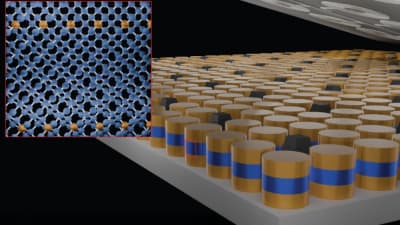
As more devices get piled onto computer chips to increase processing power capacity, heat generation becomes increasingly concentrated. This heat must be removed to keep chip...
INSIDER: Sensors/Data Acquisition
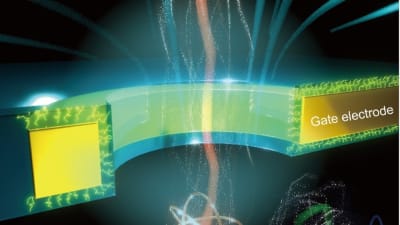
The phrase ‘liquid metal’ may bring to mind something hazardous, like mercury or molten steel. But in the Laboratory of Photonic Materials and Fiber Devices (FIMAP) in EPFL’s School of...

Briefs: Materials
Researchers at the U.S. Department of Energy (DOE)’s Oak Ridge National Laboratory (ORNL) have developed an innovative new technique using carbon nanofibers to enhance binding in carbon fiber and other fiber-reinforced polymer composites — an advance likely to improve structural materials for automobiles, airplanes and other applications that require lightweight and strong materials.
INSIDER: Semiconductors & ICs
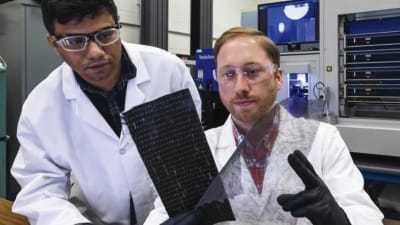
Transistors, the building blocks of modern electronics, are typically made of silicon. Because it’s a semiconductor, this material can control the flow of electricity in a...

INSIDER: Electronics & Computers
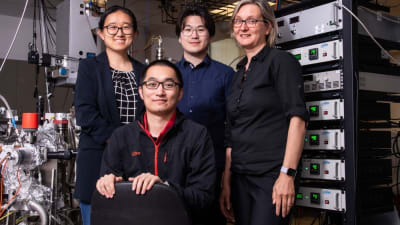
A research team led by physicists Ming Yi and Emilia Morosan from Rice University has developed a new material with unique electronic properties that could enable more powerful and...
INSIDER: Sensors/Data Acquisition
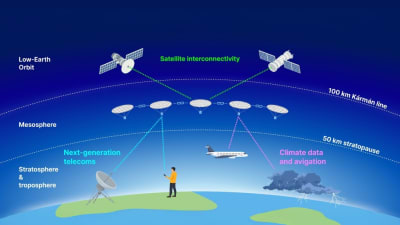
Between 50 and 100 kilometers (30-60 miles) above Earth’s surface lies a largely unstudied stretch of the atmosphere, called the mesosphere. It’s too high for airplanes and weather balloons,...
INSIDER: Design
Researchers at North Carolina State University have unveiled Rainbow, a first-of-its-kind multi-robot self-driving laboratory that autonomously discovers high-performance quantum dots...

Briefs: Materials
MIT researchers have used 3D printing to produce self-heating microfluidic devices, demonstrating a technique which could someday be used to rapidly create cheap, yet accurate, tools to detect a host of diseases. Read on to learn more.

INSIDER: Materials
As electronics become smaller, it is becoming increasingly difficult to continue scaling down silicon-based transistors. Now, a research team led by the Institute of Industrial...

INSIDER: Electronics & Computers
A new class of synthetic materials could herald the next revolution of wireless technologies, enabling devices to be smaller, require less signal strength and use less power.
Briefs: Materials
Researchers at the U.S. Department of Energy (DOE)’s Oak Ridge National Laboratory (ORNL) have developed an innovative new technique using carbon nanofibers to enhance binding in carbon fiber and other fiber-reinforced polymer composites — an advance likely to improve structural materials for automobiles, airplanes and other applications that require lightweight and strong materials.
Blog: Data Acquisition
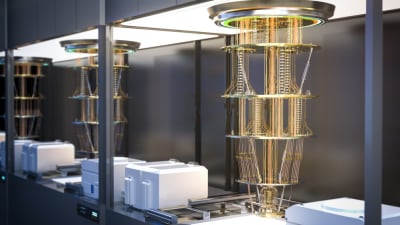
My Opinion: Quantum computing is coming but has this engineer puzzled. As we celebrate 2025, the International Year of Quantum Science and Technology, I find that thinking about these things from an engineer’s point of view is quite challenging.
INSIDER: Data Acquisition
Analog computing is making a comeback with hardware that processes and stores information in the same location, similar to biological...

INSIDER: Photonics/Optics
What if ultrafast pulses of light could operate computers at speeds a million times faster than today's best processors? A team of scientists, including researchers from...
Briefs: Materials
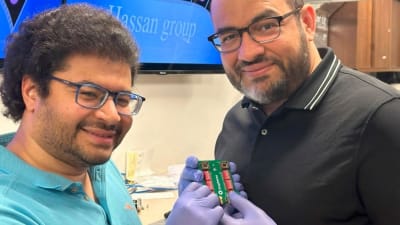
Researchers have developed a new type of sensor platform using a gold nanoparticle array. The sensor is made up of a series of gold disk-shaped nanoparticles on a glass slide. When an infrared laser is pointed at a precise arrangement of the particles, they start to emit unusual amounts of ultraviolet light. Read on to learn more.
INSIDER: Materials
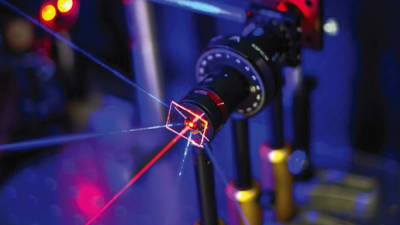
The mechanism holding new ferroelectric semiconductors together produces a conductive pathway that could enable high power transistors. A new class of...
Briefs: AR/AI
Magnets generate invisible fields that attract certain materials. Far more important to our everyday lives, magnets also can store data in computers. Exploiting the direction of the magnetic field, microscopic bar magnets each can store one bit of memory as a zero or a one — the language of computers.

INSIDER: Wearables
Imagine navigating a virtual reality with contact lenses or operating your smartphone under water — this and more could soon be a reality thanks to innovative e-skins. A research team...

INSIDER: Government
Scientists at the National Institute of Standards and Technology (NIST) have created a new thermometer using atoms boosted to such high energy levels that they are a thousand...
Blog: Nanotechnology
An interdisciplinary team of researchers has introduced a new way to improve textile-based filters by coating them with a type of two-dimensional nanomaterial called MXene.

INSIDER: Nanotechnology
DNA-nanoparticle motors are exactly as they sound — tiny artificial motors that use the structures of DNA and RNA to propel motion by enzymatic RNA degradation. Essentially,...

INSIDER: Design
The electronics industry is approaching a limit to the number of transistors that can be packed onto the surface of a computer chip. So, chip manufacturers are looking to build up rather than out.

INSIDER: Electronics & Computers
Existing computer systems have separate data processing and storage devices, making them inefficient for processing complex data like AI. A Korea Advanced Institute of Science and...

Briefs: Nanotechnology
Researchers have designed a way to levitate and propel objects using only light by creating specific nanoscale patterning on the objects' surfaces. The work could be a step toward developing a spacecraft that could reach the nearest planet outside of our solar system in 20 years, powered and accelerated only by light. Read on to learn more.

Briefs: Materials
MIT engineers have shown they can prevent cracks from spreading between composite’s layers, using an approach they developed called “nanostitching,” in which they deposit chemically grown microscopic forests of carbon nanotubes between composite layers. Read on to learn more about it.

Briefs: Nanotechnology
Researchers have introduced a microfluidic system that utilizes porous “inverse colloidal crystal” structures to dramatically improve the efficiency of microdroplet generation. Read on to learn more about it.

INSIDER: Medical
Cornell researchers in physics and engineering have created the smallest walking robot yet. Its mission: to be tiny enough to interact with waves of visible light and still move...
Top Stories
 Blog: Lighting

A Stretchable OLED that Can Maintain Most of Its Luminescence
 INSIDER: Energy

Advancing All-Solid-State Batteries
 Blog: Power

My Opinion: We Need More Power Soon — Is Nuclear the Answer?
 Quiz: Energy

 Blog: Lighting Technology

Microscopic Swimming Machines that Can Sense, Respond to Surroundings
 Blog: Data Acquisition

Webcasts
 Upcoming Webinars: Automotive

Advantages of Smart Power Distribution Unit Design for Automotive...
 Upcoming Webinars: Automotive

Quiet, Please: NVH Improvement Opportunities in the Early Design...
 Upcoming Webinars: Test & Measurement

From Spreadsheets to Insights: Fast Data Analysis Without Complex...
 Upcoming Webinars: Electronics & Computers

Cooling a New Generation of Aerospace and Defense Embedded...
 Upcoming Webinars: Test & Measurement

Beyond AI-Copy-Paste Engineering: Advanced AI-Integration Success...
 Upcoming Webinars: Energy