Find the latest advancements in the software used in simulation software, CAD, CAM, CAE, and mathematical and scientific software. Access technical and application briefs from NASA and other major research labs.
Researchers have created a simulation model to analyze how coastal management activities meant to protect barrier islands from sea-level rise can disrupt the natural processes that are keeping barrier islands above water. Read on to learn more about it.
Researchers have successfully demonstrated the U.K.’s first long-distance ultra-secure transfer of data over a quantum communications network, including the U.K.’s first long-distance quantum-secured video call. Read on to learn more.
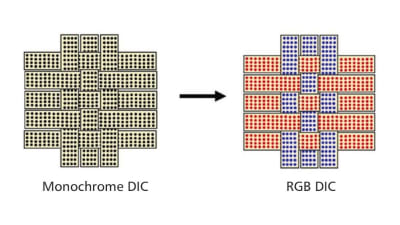
Innovators at NASA Johnson Space Center have developed a technology that can isolate a single direction of tensile strain in biaxially woven material. This is accomplished using traditional digital image correlation (DIC) techniques in combination with custom red-green-blue (RGB) color filtering software. Read on to learn more.
Through a combination of modeling, simulation, and machine learning (ML), USM researchers are laying the groundwork for intelligent uncrewed underwater vehicles (UUVs) capable of autonomously and accurately revealing what lies beneath the waves. Read on to learn more.
The future of industrial autonomy will not be defined by systems that operate as opaque black boxes, but by approaches that deliberately embed the expertise of the people who know the processes best. Machine teaching makes this possible by making the skills and strategies of expert operators the foundation of AI system design. Read on to learn more.
Robots may soon have a new way to communicate with people. Not through words or screens, but with light and images projected directly onto the world around them. University of South Florida's Zhao Han is developing technology that could transform how people interact with robots in both emergencies and everyday life. Read on to learn more.
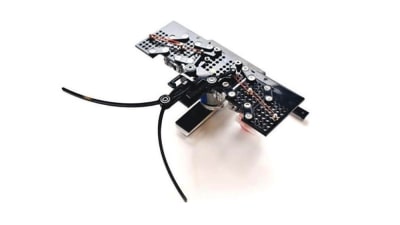
Mechanical engineering researchers in the Harvard John A. Paulson School of Engineering and Applied Sciences think there’s another way to design robots: Programming intended functions directly into a robot’s physical structure, allowing the robot to react to its surroundings without the need for extensive on-board electronics. Read on to learn more.
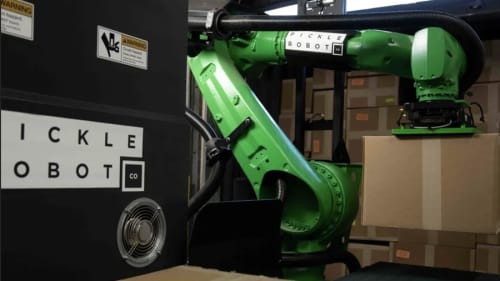
Without integrated vision, robots can only perform tasks in precisely the same way every time. If a part is even slightly out of position or rotated differently, the robot may fail to complete its task, or worse, cause an error in the process. Read on to learn more.
On the latest episode of the Aerospace & Defense Technology podcast, we sit down with two experts from Dassault Systèmes: Mariah Otte, Aerospace & Defense Solution Architect, and Jason Roberson, Industry Value Expert. Listen now!
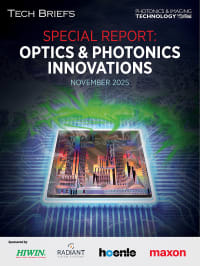
Photonic processor enables ultrafast AI computations…how new polishing technique could revolutionize optical manufacturing…facial mapping technology is a leap forward in augmented reality. Read...
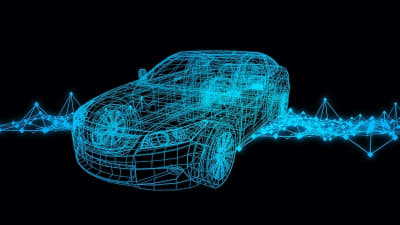
The automotive industry is under constant pressure to deliver faster, smarter, and more cost-effective solutions. Global competitors already are reducing time-to-market,...
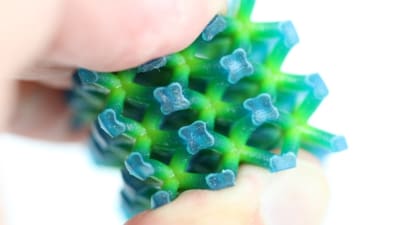
Charles Wade, a fourth-year Ph.D. student in the Matter Assembly Computation Lab (MACLab) at the University of Colorado, Boulder, and Professor Rob MacCurdy, who leads the MACLab, have created a design package that uses functions and code to map not just shapes but where different materials belong in a 3D object.
SAE International’s Software-Defined Vehicle Summit is where industry experts gather to discuss the latest advancements, challenges, and opportunities in the realm of software-defined vehicles.
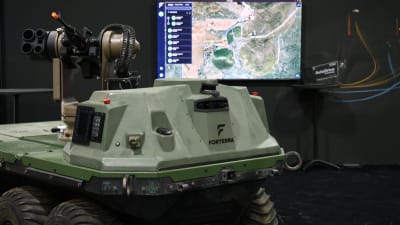
On this episode of the Aerospace & Defense Technology podcast, Patrick Acox, Forterra Vice President of Defense Growth, is the guest to explain how the company provides autonomy-enabling modules for a wide variety of military applications.
Chatbots like ChatGPT and Claude have experienced a meteoric rise in usage over the past three years because they can help you with a wide range of tasks....
Richtech Robotics’ Dex is an industrial humanoid robot that learns in simulation and works in reality to elevate productivity and safety on the factory floor.
Finding the next groundbreaking polymer is always a challenge, but now Georgia Tech researchers are using artificial intelligence (AI) to shape and transform the future of the field. Read on to learn more.
Multi-Path is a new audio digital-to-analog conversion (DAC) architecture that improves today’s best DAC performance by 100X (40dB) or more. Noise, linearity, and dynamic range are so advanced that today’s finest test equipment cannot fully measure it (40nVrms broadband noise floor). Read on to learn more about the 2025 Create the Future Design Contest Electronics finalist.
Silent Sentry is a software system that transforms existing passive microwave sensors into advanced threat detectors. The system is based on Passive Microwave Radiometry (PMR), which “listens” for the faint, naturally emitted thermal radiation from all objects. Read on to learn more about Silent Sentry, which was the Aerospace & Defense finalist at the 2025 Create the Future Design contest.
Benchmarking the impact of climatic conditions on EV charging times…how battery simulation is speeding EV development…a new standard for battery leak testing. Read about these and other...
Some applications of generative AI are quite useful, some not so much. One way to tame its exponentially expanding hunger for power is to use it intelligently.
Introducing X1: The world's first multirobot system that integrates a humanoid robot with a transforming drone that can launch off the humanoid's back and, later, drive away. The versatile team can...
A digital, voice-controlled hand could improve the convenience and accessibility of virtual and augmented reality by enabling hands-free use of games and apps. The prototype software was developed by computer scientists at the University of Michigan.
This paper provides actionable insights into overcoming the challenges of workstation-based limitations. Unlock the full potential of engineering workflows with high-performance computing (HPC)...
With increasing demands and requirements for building complex embedded systems that involve complex machines, the demand for resilient embedded systems is even higher today. Building safe and secure embedded systems is paramount in the context of pervasive embedded systems across multiple domains and industries. Read on to learn more.
Norway-based startup Sonair has developed a 3D ultrasonic sensor that uses sound waves in air to give robots a precise, real-time 3D view of their surroundings, helping them operate safely in shared spaces.