Design engineers working in the electronics and computer sectors will find essential developments in technology and applications by browsing technical briefs, articles, and new products.
Digital innovations in hydraulic components, such as digitally enhanced high-response directional valves, are moving the needle for machine builders and raising performance standards for machine builders. As hydraulic systems evolve, smart technology is enabling deeper connectivity for more productive machines. Read on to learn more.
Recognizing the potential of modular systems, researchers from The Grainger College of Engineering at the University of Illinois Urbana-Champaign have presented an enhanced approach to scalable quantum computing by demonstrating a viable and high-performance modular architecture for superconducting quantum processors. Read on to learn more about it.
Innovators at NASA Johnson Space Center have developed an Earthbound robotic training system called “ARGOS” for short. It can actively simulate an astronaut’s weightlessness in space by using an overhead runway and bridge drive system to partially or fully offload their weight using attached cables, effectively suspending them off the ground. Read on to learn more.
Last December, Tech Briefs readers were asked to select one product from our 2025 Products of the Month to be named Readers’ Choice Product of the Year. Thanks to all of our readers who cast their votes. Read on for the three 2025 winners.
A research team has designed a passive metasurface-based filtering system that breaks free from LTI constraints through an innovative time-varying interlocking mechanism. The design incorporates metasurface panels with internally coupled circuit elements, including metal-oxide-semiconductor field-effect transistors (MOSFETs). Read on to learn more.
The technique promises immediate impact not only on high-capacity optical communications but also on real-time endoscopic imaging, vibration-tolerant fiber sensors, and any application that demands fast, energyefficient phase retrieval. Read on to learn more.
In a new collaboration, the Argonne National Laboratory and National Energy Technology Laboratory are leveraging their expertise in RDEs to develop advanced computational fluid dynamics tools that can give scientists a deeper understanding of the combustion process to unlock more of the engine's potential. Read on to learn more.
Building on her experience volunteering at retirement homes, Carnegie Mellon researcher Jasmine Li decided to focus her research on assistive robotics that help people with everyday tasks....
A new study from NC State University combines three-dimensional embroidery techniques with machine learning to create a fabric-based sensor that can control electronic devices through touch. Read on to learn more.
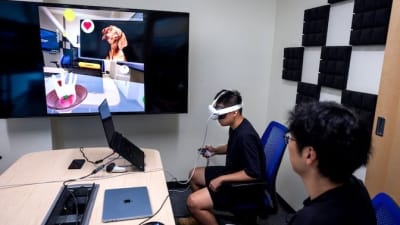
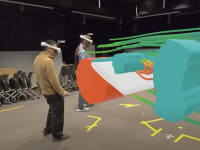
A new system that brings together real-world sensing and virtual reality would make it easier for building maintenance personnel to identify and fix issues in commercial buildings that are in operation. The system was developed by computer scientists at the University of California San Diego and Carnegie Mellon University. Read on to learn more.
International research collaboration has unlocked a new approach that performs complex tensor computations using a single propagation of light. The result is single-shot tensor computing, achieved at the speed of light itself.
How the NVIDIA‐Magna collaboration is redefining autonomy…ultra‐realistic simulation speeds AV development…the 'autonomy underdogs' driving ADAS forward. Read about these and other new...
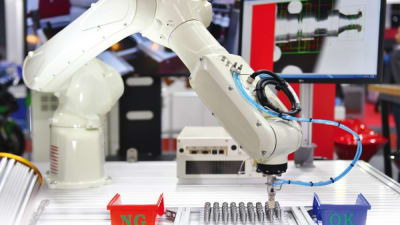
Without integrated vision, robots can only perform tasks in precisely the same way every time. If a part is even slightly out of position or rotated differently, the robot may fail to complete its task, or worse, cause an error in the process. Read on to learn more.
The future of industrial autonomy will not be defined by systems that operate as opaque black boxes, but by approaches that deliberately embed the expertise of the people who know the processes best. Machine teaching makes this possible by making the skills and strategies of expert operators the foundation of AI system design. Read on to learn more.
See what's new on the market, including the new ImageIR® 9800 from infraTec; Instron's new 100 kN table model for the 6800 and 3400 Series universal testing systems; Sumida Corporation's CIUH10D46 and CIUH10D47 pulse transformers; and much more.
Robots may soon have a new way to communicate with people. Not through words or screens, but with light and images projected directly onto the world around them. University of South Florida's Zhao Han is developing technology that could transform how people interact with robots in both emergencies and everyday life. Read on to learn more.
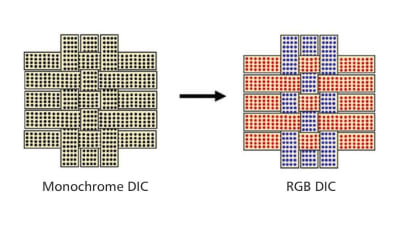
Innovators at NASA Johnson Space Center have developed a technology that can isolate a single direction of tensile strain in biaxially woven material. This is accomplished using traditional digital image correlation (DIC) techniques in combination with custom red-green-blue (RGB) color filtering software. Read on to learn more.
Photonic processor enables ultrafast AI computations…how new polishing technique could revolutionize optical manufacturing…facial mapping technology is a leap forward in augmented reality. Read...
Multi-Path is a new audio digital-to-analog conversion (DAC) architecture that improves today’s best DAC performance by 100X (40dB) or more. Noise, linearity, and dynamic range are so advanced that today’s finest test equipment cannot fully measure it (40nVrms broadband noise floor). Read on to learn more about the 2025 Create the Future Design Contest Electronics finalist.
Introducing X1: The world's first multirobot system that integrates a humanoid robot with a transforming drone that can launch off the humanoid's back and, later, drive away. The versatile team can...
A digital, voice-controlled hand could improve the convenience and accessibility of virtual and augmented reality by enabling hands-free use of games and apps. The prototype software was developed by computer scientists at the University of Michigan.
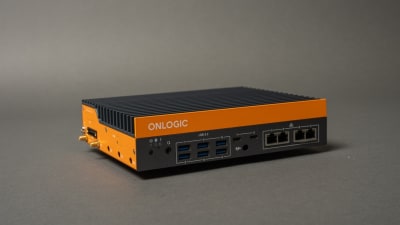
With increasing demands and requirements for building complex embedded systems that involve complex machines, the demand for resilient embedded systems is even higher today. Building safe and secure embedded systems is paramount in the context of pervasive embedded systems across multiple domains and industries. Read on to learn more.
See the new products, including Kassow Robots' Sensitive Arm technology across its complete range of 7-axis collaborative robots; igus' first humanoid robot, Iggy Rob, designed to support industrial production, service environments, and transport tasks; Weidmuller USA's unmanaged Single Pair Ethernet Switch that enables a seamless networking experience for users in a wide array of industrial environments; BizLink's careDP, an AI-powered condition monitoring system designed to revolutionize maintenance in robotic production lines; and more.
It is no exaggeration to say that AI will be the next big leap across all of industry, reimagining the way people work, products are designed, and factories are operated. But AI doesn’t mean a fully autonomous future but rather a harmony, uniting people and technology in a way that plays to the strength of both to achieve a result greater than what either could achieve alone. Read on to learn more.
MIT researchers have developed a method that anyone can use to design an energy management interface between the harvester and the sensor load to minimize the drain on the harvester and maximize the amount of data that can be transmitted by the sensor. Read on to learn more via this Q&A with Daniel Monagle and Steven B. Leeb.