
33
-1
30
30
Briefs: Sensors/Data Acquisition
A team has created a prototype for what it calls “living bioelectronics” — a combination of living cells, gel, and electronics that can integrate with living tissue. The patches are made of sensors, bacterial cells, and a gel made from starch and gelatin. Tests in mice found that the devices could continuously monitor and improve psoriasis-like symptoms, without irritating skin. Read on to learn more.

Briefs: Design
Growing Bio-Inspired Polymer Brains for Artificial Neural Networks
Read on to learn about a technique for growing conductive polymer wire connections between electrodes to realize artificial neural networks that overcome the limits of traditional computer hardware.
Briefs: Physical Sciences
Researchers have developed a new soft robot design that engages in three simultaneous behaviors: rolling forward, spinning like a record, and following a path that orbits around a central point. The device, which operates without human or computer control, holds promise for developing soft robotic technologies that can be used to navigate and map unknown environments. The new soft robots are called twisted ringbots. Read on to learn more about them.

Briefs: Power
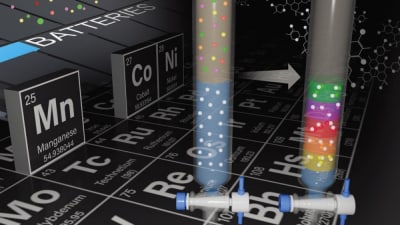
A PNNL research team used a simple mixed-salt water-based solution and their knowledge of metal properties to separate valuable minerals in continuously flowing reaction chambers. Read on to learn more.
Briefs: Robotics, Automation & Control
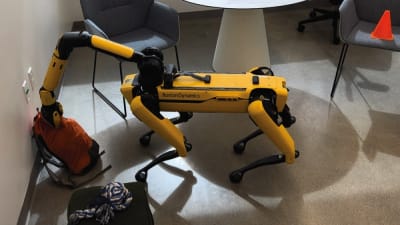
MIT engineers have developed a method that enables robots to make similarly intuitive, task-relevant decisions. The team’s new approach, named Clio, enables a robot to identify the parts of a scene that matter, given the tasks at hand. Read on to learn more about Clio.
Briefs: Power
All-in-One, High-Power Microwave System
A device was developed that uses composite-based nonlinear transmission lines (NLTLs) for a complete high-power microwave system, eliminating the need for multiple auxiliary systems. Read on to learn more.
Briefs: Test & Measurement
As industrial automation technologies continue to advance, the balance between traditional and open solutions will likely evolve. The emphasis will be on providing versatile platforms that meet varied user needs. Read on to learn more.

Briefs: Unmanned Systems
Yen-Ling Kuo at the University of Virginia School of Engineering and Applied Science is collaborating with a team at the Toyota Research Institute to build language representations of driving behavior that enable a robot to associate the meaning of words with what it sees by watching how humans interact with the environment or by its own interactions with the environment. Read on to learn more.

Briefs: Software
High-performance servo motion is now more affordable and accessible than ever due to integrated controllers, making the technology viable even for applications, which could not formerly support the cost or complexity of traditional implementations. Read on to learn more.

Briefs: Sensors/Data Acquisition
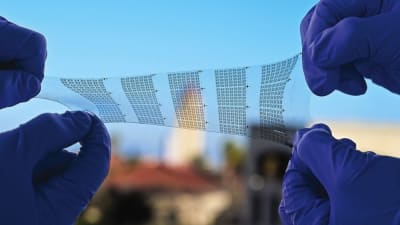
Researchers at Stanford have been working on skin-like, stretchable electronic devices for over a decade. Recently, they presented a new design and fabrication process for skin-like integrated circuits that are five times smaller and operate at one thousand times higher speeds than earlier versions. Read on to learn more about it.
Briefs: Electronics & Computers
A research team has created an innovative microelectronic device that can potentially function as a sustainable, high-performance “bit-switch.” This paves the way for future computing technologies to process data much faster while using significantly less energy. Read on to learn more.

Briefs: Materials
Now, a team from the Max Planck Institute for Polymer Research has developed a new material concept that could allow efficient blue OLEDs with a strongly simplified structure. Read on to learn more.

Briefs: AR/AI
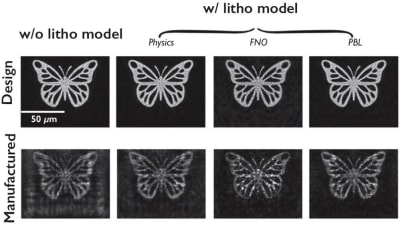
A new method enables optical devices that more closely match their design specifications, boosting accuracy and efficiency. Read on to learn more.
Briefs: AR/AI
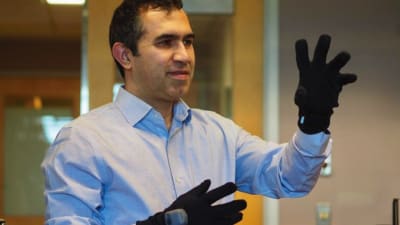
A new groundbreaking “smart glove” is capable of tracking the hand and finger movements of stroke victims during rehabilitation exercises. The glove incorporates a sophisticated network of highly sensitive sensor yarns and pressure sensors that are woven into a comfortable stretchy fabric. Read on to learn more about the smart glove.
Briefs: Electronics & Computers
After announcing a ferroelectric semiconductor at the nanoscale thinness required for modern computing components, a University of Michigan team has demonstrated a reconfigurable transistor using that material. Read on to learn more.

Briefs: Photonics/Optics
Penn Engineers have developed a new chip that uses light waves, rather than electricity, to perform the complex math essential to training AI. The chip has the potential to radically accelerate the processing speed of computers while also reducing their energy consumption. Read on to learn more.

Briefs: Electronics & Computers
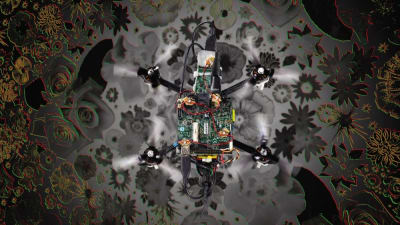
A team of researchers at Delft University of Technology has developed a drone that flies autonomously using neuromorphic image processing and control based on the workings of animal brains.
Briefs: Medical
Researchers at NASA Johnson Space Center have developed the Portable Knee Dynamometer, a device that enables quadricep and hamstring strength assessment, rehabilitation, and exercise capabilities for a user outside of a traditional clinical setting.

Briefs: Electronics & Computers
Innovators at NASA’s Johnson Space Center (JSC) have developed computer vision software that derives target posture determinations quickly and then instructs an operator how to properly align a robotic end-effector with a target that they are trying to grapple.

Briefs: AR/AI
Researchers from Tsinghua University worked to break through the difficulties of robotic recognition of various common, yet complex, items. Read on to learn more.

Briefs: Manufacturing & Prototyping
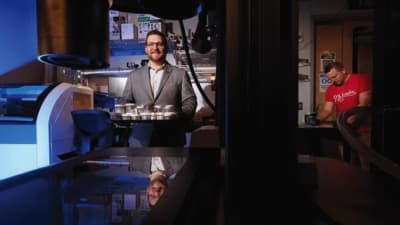
In bringing bio-inspired robots to life, scientists must first create soft matter counterparts that match the softness and functionality of biological tissue. University of Nebraska–Lincoln engineer Eric Markvicka is at the forefront of these efforts. Read on to learn more.
Briefs: Electronics & Computers
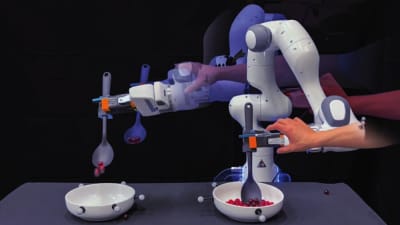
MIT engineers are aiming to give robots a bit of common sense when faced with situations that push them off their trained path. They’ve developed a method that connects robot motion data with the “common sense knowledge” of large language models, or LLMs.
Briefs: Sensors/Data Acquisition
Innovators have developed a method and apparatus to multiplex Radio Frequency Identification (RFID) signals efficiently. The resulting Hyper-Distributed RFID Antenna (HYDRA) system enhances distribution of the RFID reader signal, providing improved coverage for large areas as well as for small, fixed regions requiring a high density of reader antennas.

Briefs: Materials
Researchers have found ways to develop soft OECTs for wearable pressure sensors. They first experimented with a solid type of gating substance: a charged, gelatinous substance called an ionic hydrogel. Read on to learn more.

Briefs: Software
Microelectronics face a key challenge because of their small size. To avoid overheating, microelectronics need to consume only a fraction of the electricity of conventional electronics while still operating at peak performance. Researchers have achieved a breakthrough that could allow for a new kind of microelectronic material to do just that.

Briefs: Electronics & Computers
Modern PLC+HMI platforms have overcome weaknesses of older devices and now provide a top-performing and space-optimized option for designers to implement control and visualization for a variety of diverse applications.

Briefs: AR/AI
An innovative approach to artificial intelligence (AI) enables reconstructing a broad field of data, such as overall ocean temperature, from a small number of field-deployable sensors using low-powered edge computing, with broad applications across industry, science, and medicine.
Briefs: Information Technology
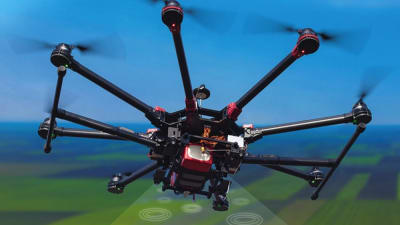
The team, led by Data Scientist Sumit Purohit, is trying to create a tool that sorts and prioritizes cyber threats on the fly. The idea is to give grid operators a clear blueprint to identify and address the biggest threats first and to protect against them without a mad scramble for resources down the road.

Briefs: Photonics/Optics
There are times when scientific progress comes in the form of discovering something completely new. Other times, progress boils down to doing something better, faster, or more easily. New research from the lab of Caltech’s Lihong Wang, the Bren Professor of Medical Engineering and Electrical Engineering, is the latter. Read on to learn more.

Top Stories
 Blog: AR/AI

Aerial Microrobots That Can Match a Bumblebee's Speed
 Blog: Materials

Turning Edible Fungi into Organic Memristors
 Blog: Manufacturing & Prototyping

Revolutionizing the Production of Semiconductor Chips
 News: Power

 INSIDER: Motion Control
World’s Smallest Programmable, Autonomous Robots
 Blog: Manufacturing & Prototyping
A Highly Accurate Simulator for Spray-Based Concrete 3D Printing
Webcasts
 Upcoming Webinars: Automotive

E/E Architecture Redefined: Building Smarter, Safer, and Scalable...
 Upcoming Webinars: Energy

Hydrogen Engines Are Heating Up for Heavy Duty
 Upcoming Webinars: Semiconductors & ICs

Advantages of Smart Power Distribution Unit Design for Automotive...
 Upcoming Webinars: Unmanned Systems

Quiet, Please: NVH Improvement Opportunities in the Early Design...
 Upcoming Webinars: Power

A FREE Two-Day Event Dedicated to Connected Mobility
 On-Demand Webinars: Robotics, Automation & Control

Next-Generation Linear and Rotary Stages: When Ultra Precision Movement Is a...