8,33,42,44,45,47,52,54,68
-1
3240
30
Briefs: Software
Marsviewer 2008
Marsviewer 2008 is designed for quality control, browsing, and operational and science analysis of images and derived image products returned by spacecraft. This program allows all derived products (reduced data records, or RDRs) associated with each original image (experiment data record, or EDR) to be viewed in various ways,...
Briefs: Software
Mission Services Evolution Center Message Bus
The Goddard Mission Services Evolution Center (GMSEC) Message Bus is a robust, lightweight, fault-tolerant middleware implementation that supports all messaging capabilities of the GMSEC API, including publish/subscribe and request/reply. The Message Bus enables NASA to provide an open-source middleware...
Briefs: Software
Major Constituents Analysis for the Vehicle Cabin Atmosphere Monitor
Vehicle Cabin Atmosphere Monitor (VCAM) can provide a means for monitoring the air within enclosed environments such as the International Space Station, the Crew Exploration Vehicle (CEV), a Lunar habitat, or another vehicle traveling to Mars. Its miniature preconcentrator, gas...
Briefs: Software
Astronaut Health Participant Summary Application
The Longitudinal Study of Astronaut Health (LSAH) Participant Summary software captures data based on a custom information model designed to gather all relevant, discrete medical events for its study participants. This software provides a summarized view of the study participant’s entire medical...
Briefs: Software
Natural Language Interface for Safety Certification of Safety-Critical Software
Model-based design and automated code generation are being used increasingly at NASA. The trend is to move beyond simulation and prototyping to actual flight code, particularly in the guidance, navigation, and control domain. However, there are substantial obstacles to...
Briefs: Software
Adaption of the AMDIS Method to Flight Status on the VCAM Instrument
Software has been developed to function onboard the International Space Station (ISS) to help safeguard human health by detecting compounds of concern in the cabin atmosphere, both in identity and concentration. This software calibrates and processes a standard 2D dataset (mass...
Briefs: Information Technology
Visual SLAM Using Variance Grid Maps
An algorithm denoted “Gamma-SLAM” performs further processing, in real time, of preprocessed digitized images acquired by a stereoscopic pair of electronic cameras aboard an off-road robotic ground vehicle to build accurate maps of the terrain and determine the location of the vehicle with respect to the...
Briefs: Information Technology
Modeling Electromagnetic Scattering From Complex Inhomogeneous Objects
This software innovation is designed to develop a mathematical formulation to estimate the electromagnetic scattering characteristics of complex, inhomogeneous objects using the finite-element-method (FEM) and method-of-moments (MoM) concepts, as well as to develop a FORTRAN...
Briefs: Information Technology
Visual Object Recognition and Tracking of Tools
A method has been created to automatically build an algorithm off-line, using computer-aided design (CAD) models, and to apply this at runtime. The object type is discriminated, and the position and orientation are identified. This system can work with a single image and can provide improved...
Briefs: Information Technology
Predicting Spacecraft Trajectories by the WeavEncke Method
A combination of methods is proposed of predicting spacecraft trajectories that possibly include multiple maneuvers and/or perturbing accelerations, with greater speed, accuracy, and repeatability than were heretofore achievable. The combination is denoted the WeavEncke method because it is...
Briefs: Information Technology
An Augmentation of G-Guidance Algorithms
The original G-Guidance algorithm provided an autonomous guidance and control policy for small-body proximity operations that took into account uncertainty and dynamics disturbances. However, there was a lack of robustness in regards to object proximity while in autonomous mode. The modified G-Guidance...
Briefs: Information Technology
Rapid Calculation of Spacecraft Trajectories Using Efficient Taylor Series Integration
A variable-order, variable-step Taylor series integration algorithm was implemented in NASA Glenn’s SNAP (Spacecraft N-body Analysis Program) code. SNAP is a high-fidelity trajectory propagation program that can propagate the trajectory of a spacecraft about...
Briefs: Information Technology
Comparison of Aircraft Icing Growth Assessment Software
A research project is underway to produce computer software that can accurately predict ice growth under any meteorological conditions for any aircraft surface. An extensive comparison of the results in a quantifiable manner against the database of ice shapes that have been generated in the...
Briefs: Information Technology
Efficient Kriging Algorithms
More efficient versions of an interpolation method, called kriging, have been introduced in order to reduce its traditionally high computational cost. Written in C++, these approaches were tested on both synthetic and real data.
Briefs: Information Technology
Estimation of Coriolis Force and Torque Acting on Ares-1
A document describes work on the origin of Coriolis force and estimating Coriolis force and torque applied to the Ares-1 vehicle during its ascent, based on an internal ballistics model for a multi-segmented solid rocket booster (SRB).
Briefs: Electronics & Computers
High-Precision Pulse Generator
A document discusses a pulse generator with subnanosecond resolution implemented with a low-cost field-programmable gate array (FPGA) at low power levels. The method used exploits the fast carry chains of certain FPGAs. Prototypes have been built and tested in both Actel AX and Xilinx Virtex 4 technologies. In-flight...
Briefs: Electronics & Computers
Silicon-Germanium Voltage-Controlled Oscillator at 105 GHz
A group at UCLA, in collaboration with the Jet Propulsion Laboratory, has designed a voltage-controlled oscillator (VCO) created specifically for a compact, integrated, electronically tunable frequency generator useable for submillimeter-wave science instruments operating in extreme cold...
Briefs: Energy
High-Resolution Wind Measurements for Offshore Wind Energy Development
A mathematical transform, called the Rosette Transform, together with a new method, called the Dense Sampling Method, have been developed. The Rosette Transform is invented to apply to both the mean part and the fluctuating part of a targeted radar signature using the Dense...
Briefs: Electronics & Computers
Coherent Frequency Reference System for the NASA Deep Space Network
The NASA Deep Space Network (DSN) requires state-of-the-art frequency references that are derived and distributed from very stable atomic frequency standards. A new Frequency Reference System (FRS) and Frequency Reference Distribution System (FRD) have been developed, which...
Briefs: Electronics & Computers
180-GHz I-Q Second Harmonic Resistive Mixer MMIC
An indium phosphide MMIC (monolithic microwave integrated circuit) mixer was developed, processed, and tested in the NGC 35-nm-gate-length HEMT (high electron mobility transistor) process. The MMIC mixers were tested and assembled in the miniature MMIC receiver module described in “Miniature...
Briefs: Electronics & Computers
Diamond Heat-Spreader for Submillimeter-Wave Frequency Multipliers
The planar GaAs Shottky diode frequency multiplier is a critical technology for the local oscillator (LO) for submillimeter-wave heterodyne receivers due to low mass, tenability, long lifetime, and room-temperature operation. The use of a W-band (75–100 GHz) power amplifier...
Briefs: Electronics & Computers
Power Amplifier Module With 734-mW Continuous Wave Output Power
Research findings were reported from an investigation of new gallium nitride (GaN) monolithic millimeter-wave integrated circuit (MMIC) power amplifiers (PAs) targeting the highest output power and the highest efficiency for class-A operation in W-band (75–110 GHz). W-band PAs are a...
Briefs: Electronics & Computers
Ultra-Low-Noise W-Band MMIC Detector Modules
A monolithic microwave integrated circuit (MMIC) receiver can be used as a building block for next-generation radio astronomy instruments that are scalable to hundreds or thousands of pixels. W- band (75–110 GHz) low-noise receivers are needed for radio astronomy interfer- ometers and spectrometers,...
Briefs: Electronics & Computers
338-GHz Semiconductor Amplifier Module
A 35-nm-gate-length InP, high-electron-mobility transistor (HEMT) with a high-indium-content channel as the key component was developed to produce an MMIC (monolithic microwave integrated circuit) power amplifier. With a shorter gate length than previous transistor generations, it allows for electrons to...
Briefs: Electronics & Computers
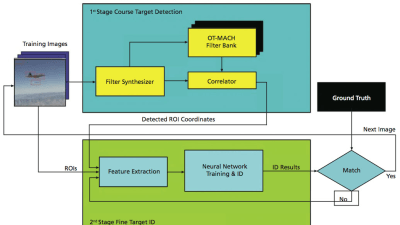
A multi-stage automated target recognition (ATR) system has been designed to perform computer vision tasks with adequate proficiency in mimicking human vision. The system is able to detect,...
Briefs: Electronics & Computers
Multiple Differential-Amplifier MMICs Embedded in Waveguides
Compact amplifier assemblies of a type now being developed for operation at frequencies of hundreds of gigahertz comprise multiple amplifier units in parallel arrangements to increase power and/or cascade arrangements to increase gains. Each amplifier unit is a monolithic microwave...
Briefs: Electronics & Computers
Special Component Designs for Differential-Amplifier MMICs
Special designs of two types of electronic components — transistors and transmission lines — have been conceived to optimize the performances of these components as parts of waveguide-embedded differential-amplifier monolithic microwave integrated circuits (MMICs) of the type described...
Briefs: Electronics & Computers
Update on Waveguide-Embedded Differential MMIC Amplifiers
There is an update on the subject matter of “Differential InP HEMT MMIC Amplifiers Embedded in Waveguides” (NPO-42857) NASA Tech Briefs, Vol. 33, No. 9 (September 2009), page 35. To recapitulate: Monolithic microwave integrated-circuit (MMIC) amplifiers of a type now being developed for...
Briefs: Electronics & Computers
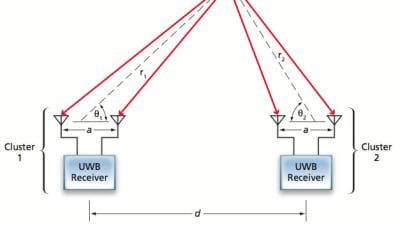
Systems that measure the angles of arrival of ultra-wideband (UWB) radio signals and perform triangulation by use of those angles in order to locate the sources of those signals are undergoing...
Top Stories
 Blog: Lighting

A Stretchable OLED that Can Maintain Most of Its Luminescence
 Blog: Energy

Batteries that Can Withstand the Cold
 INSIDER: Energy

Advancing All-Solid-State Batteries
 Blog: Power

My Opinion: We Need More Power Soon — Is Nuclear the Answer?
 Quiz: Power

 Blog: Data Acquisition

Webcasts
 Upcoming Webinars: Test & Measurement

From Spreadsheets to Insights: Fast Data Analysis Without Complex...
 Upcoming Webinars: Defense

Cooling a New Generation of Aerospace and Defense Embedded...
 Upcoming Webinars: AR/AI

Beyond AI-Copy-Paste Engineering: Advanced AI-Integration Success...
 Upcoming Webinars: Automotive

Battery Abuse Testing: Pushing to Failure
 Upcoming Webinars: Connectivity

A FREE Two-Day Event Dedicated to Connected Mobility
 Upcoming Webinars: RF & Microwave Electronics

Choosing the Right N-Port Strategy: Multiport VNAs vs. Switch...