36
-1
60
30
Briefs: Materials
Innovators at NASA’s Glenn Research Center have made several breakthroughs in treating hexagonal boron nitride (hBN) nanomaterials, improving their properties to supplant carbon nanotubes in many applications.

Briefs: Power
A research team from Pohang University has successfully enhanced the performance and durability of all-solid-state batteries. This breakthrough was made possible through the implementation of a novel approach known as bottom electrodeposition. Read on to learn more.

Briefs: Manufacturing & Prototyping
A new synthesis process for solid electrolytes marks a crucial stride toward the commercialization of all-solid-state batteries free from the risks of explosion and fire. Read on to learn more.

Briefs: Manufacturing & Prototyping
Researchers from NC State University have demonstrated mini soft hydraulic actuators that can be used to control the deformation and motion of soft robots that are less than a millimeter thick. The researchers also demonstrated that this technique works with shape memory materials.

Briefs: Materials
Researchers have found a way to bind engineered skin tissue to the complex forms of humanoid robots. This brings with it potential benefits to robotic platforms such as increased mobility, self-healing abilities, embedded sensing capabilities and an increasingly lifelike appearance.

Briefs: Manufacturing & Prototyping
Perovskites are among the most researched topics in materials science. Recently, a research team solved an age-old challenge to synthesize all-organic two-dimensional perovskites, extending the field into the exciting realm of 2D materials. This breakthrough opens up a new field of 2D all-organic perovskites, which holds promise for both fundamental science and potential applications.

Briefs: Medical
Innovators at NASA Johnson Space Center have designed a science enclosure system for science experiments conducted aboard the International Space Station (ISS). It allows users the ability to safely manipulate objects of study within the transparent enclosure by utilizing protective boundary layer innovations whose designs may be transferable to other containment systems.

Briefs: Manufacturing & Prototyping
A global team of researchers and industry collaborators led by RMIT University has invented recyclable ’water batteries’ that won’t catch fire or explode. Read on to learn more.

Briefs: Materials
In bringing bio-inspired robots to life, scientists must first create soft matter counterparts that match the softness and functionality of biological tissue. University of Nebraska–Lincoln engineer Eric Markvicka is at the forefront of these efforts. Read on to learn more.

Briefs: Robotics, Automation & Control
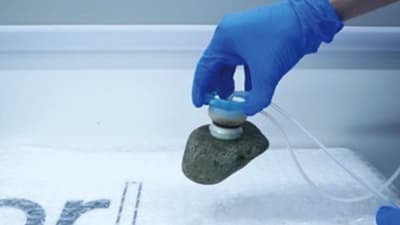
A new robotic suction cup which can grasp rough, curved, and heavy stone, has been developed by scientists at the University of Bristol. The team, based at Bristol Robotics Laboratory, studied the structures of octopus biological suckers, which have superb adaptive suction abilities enabling them to anchor to rock.
Briefs: Nanotechnology
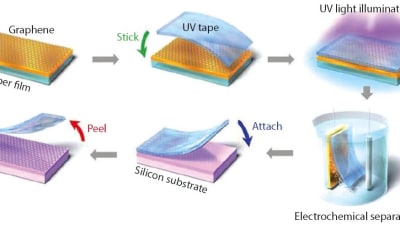
A research team from Kyushu University, in collaboration with Japanese company Nitto Denko, has developed a tape that can be used to stick 2D materials to many different surfaces, in an easy and user-friendly way.
Briefs: Electronics & Computers
Innovators have developed a method and apparatus to multiplex Radio Frequency Identification (RFID) signals efficiently. The resulting Hyper-Distributed RFID Antenna (HYDRA) system enhances distribution of the RFID reader signal, providing improved coverage for large areas as well as for small, fixed regions requiring a high density of reader antennas.

Briefs: Sensors/Data Acquisition
Because it requires no battery that must be recharged or replaced, and because it requires no special wiring, such a sensor could be embedded in a hard-to-reach place, like inside the inner workings of a ship’s engine. There, it could automatically gather data on the machine’s power consumption and operations for long periods of time.

Briefs: Electronics & Computers
Modern PLC+HMI platforms have overcome weaknesses of older devices and now provide a top-performing and space-optimized option for designers to implement control and visualization for a variety of diverse applications.

Briefs: Energy
The improved method for fabricating battery electrodes may lead to high-performance batteries that would enable more energy-efficient EVs, as well as such benefits as enhancing power grid storage, according to Hongtao Sun, Assistant Professor of Industrial and Manufacturing Engineering at Penn State.

Briefs: Energy
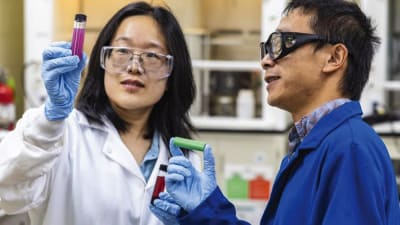
Researchers at the Department of Energy’s Oak Ridge National Laboratory have improved on approaches that dissolve a battery in a liquid solution in order to reduce the amount of hazardous chemicals used in the process.
Briefs: Power
Modine Targets Off-Highway EVs with ‘Plug-and-Play’ BTMS
Deutronic is not alone in developing and integrating thermal-management solutions to meet the specific demands of off-highway EVs. Modine, for example, in 2023 launched a new edition of its EVantage battery thermal-management system with a liquid-cooled condenser (L-CON BTMS). Read on to learn more.
Briefs: Manufacturing & Prototyping
Diamond Maker Technology Simulates Alien Geology in Laboratories
Innovators at NASA Johnson Space Center have developed a novel, double capsule control system that allows for high temperature and high-pressure geologic research to be performed in a contained environment relevant to a broad array of materials.
Briefs: Materials
The advance, detailed in a paper published recently in the journal Physica Scripta, could enable more efficient compact fusion reactors that are easier to repair and maintain.
Briefs: Materials
To aid the development of gel-like materials, MIT and Harvard University researchers have created a set of computational models to predict the material’s structure and mechanical properties, as well as functional performance outcomes.

Briefs: Materials
A durable, copper-based coating developed by a team at Dartmouth University can be integrated into fabric to create responsive, reusable materials such as protective equipment, environmental sensors, and smart filters.

Briefs: Sensors/Data Acquisition
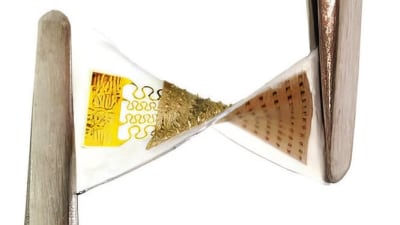
In a new study, engineers from Korea and the United States have developed a wearable, stretchy patch that could help to bridge the divide between people and machines — and with benefits for the health of humans around the world. In lab experiments, the researchers showed that humans could use these devices to operate robotic exoskeletons more efficiently.
Briefs: Design
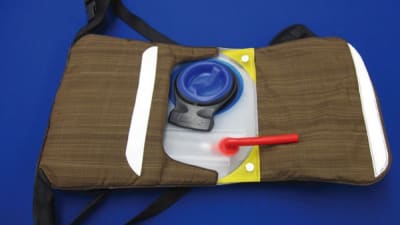
NASA’s Johnson Space Center is offering an innovative freeze-resistant hydration system for licensing. The technology substantially improves on existing hydration systems because it prevents water from freezing in the tubing, container, and mouthpiece, even in the harshest conditions on Earth.
Briefs: Medical
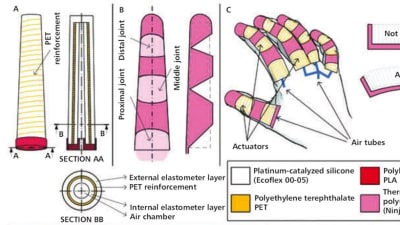
A research paper by scientists at the University of Coimbra proposed a soft robotic hand comprising soft actuator cores and an exoskeleton, featuring a multimaterial design aided by finite element analysis to define the hand geometry and promote finger’s bendability.
Briefs: Manufacturing & Prototyping
New Solid-State Battery Design Charges in Minutes
Researchers from the Harvard John A. Paulson School of Engineering and Applied Sciences have developed a new lithium metal battery that can be charged and discharged at least 6,000 times — more than any other pouch battery cell — and can be recharged in a matter of minutes.
Briefs: Green Design & Manufacturing
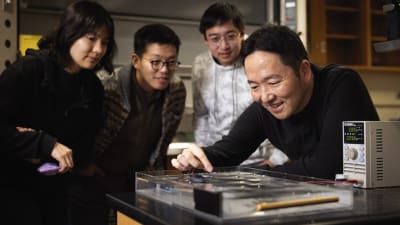
Inspired by a small and slow snail, scientists have developed a robot prototype that may one day scoop up microplastics from the surfaces of oceans, seas, and lakes.
Briefs: Manufacturing & Prototyping
Reporting on their work in the proceedings of the IEEE Robotics and Automation Society’s International Conference on Intelligent Robots and Systems, the mini-bug weighs in at eight milligrams, while the water strider weighs 55 milligrams. Both can move at about six millimeters a second.

Briefs: Materials
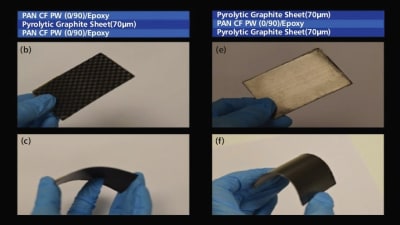
Inventors from NASA Langley and NASA Ames have created a new type of carbon fiber polymer composite that has a high thermal conductivity.
Briefs: Materials
A promising, more durable fuel cell design could help transform heavy-duty trucking and other clean fuel cell applications.

Top Stories
 Blog: Power

My Opinion: We Need More Power Soon — Is Nuclear the Answer?
 Blog: AR/AI

Aerial Microrobots That Can Match a Bumblebee's Speed
 News: Energy

 Blog: Electronics & Computers

Turning Edible Fungi into Organic Memristors
 Blog: Robotics, Automation & Control

Microscopic Swimming Machines that Can Sense, Respond to Surroundings
 INSIDER: Sensors/Data Acquisition

Webcasts
 Upcoming Webinars: Energy

Hydrogen Engines Are Heating Up for Heavy Duty
 Upcoming Webinars: Transportation

Advantages of Smart Power Distribution Unit Design for Automotive...
 Upcoming Webinars: Automotive

Quiet, Please: NVH Improvement Opportunities in the Early Design...
 Upcoming Webinars: Test & Measurement

From Spreadsheets to Insights: Fast Data Analysis Without Complex...
 Upcoming Webinars: Power

Battery Abuse Testing: Pushing to Failure
 Upcoming Webinars: Internet of Things