36
-1
90
30
Briefs: Electronics & Computers
A multi-institutional project led by a Penn State researcher is focused on developing an all-in-one semiconductor device that can both store data and perform computations. The project recently received $2 million in funding over three years as part of the new National Science Foundation Future of Semiconductors (FuSe) program.

Briefs: Software
Researchers at Universidad Carlos III de Madrid (UC3M) have created software and hardware for a 4D printer with applications in the biomedical field.

Briefs: Electronics & Computers
A research team led by Lawrence Berkeley National Laboratory (Berkeley Lab) has developed “supramolecular ink,” a new technology for use in OLED (organic light-emitting diode) displays or other electronic devices.

Briefs: Medical
Researchers at The Ohio State University have fabricated the first wearable sensor designed to detect and monitor muscle atrophy. This new study published in the journal IEEE Transactions on Biomedical Engineering suggests that an electromagnetic sensor made out of conductive “e-threads” could be used as an alternative to frequent monitoring using MRI.

Briefs: Motion Control
A technique enables manufacturing of minuscule robots by interlocking multiple materials in a complex way.

Briefs: Medical
A first-of-its-kind robotic glove is lending a “hand” and providing hope to piano players who have suffered a disabling stroke. Developed by researchers from Florida Atlantic University’s College of Engineering and Computer Science, the soft robotic hand exoskeleton uses artificial intelligence to improve hand dexterity.

Briefs: Software
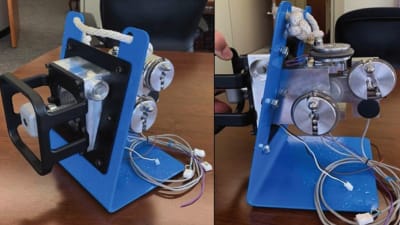
Innovators at NASA’s Johnson Space Center have designed a circumferential scissor spring mechanism, that when incorporated into a hand controller, improves the restorative force to a control stick’s neutral position. The design also provides for operation on a more linear portion of the spring’s force deflection curve, yielding better feedback to the user.
Briefs: Manufacturing & Prototyping
Inventors at the NASA Langley Research Center have developed a novel method to model and ingest point-wise process data to evaluate an additive manufacturing build and its file for issues by highlighting potential anomalies or other areas where the build may have issues with fusion of the material.

Briefs: Materials
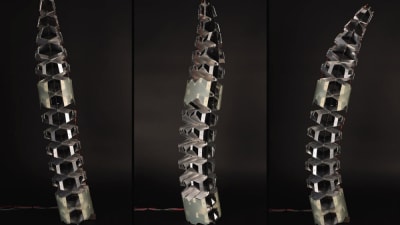
Using kirigami, the ancient Japanese art of folding and cutting paper, MIT researchers have now manufactured a type of high-performance architected material known as a plate lattice, on a much larger scale than scientists have previously been able to achieve by additive fabrication.
Briefs: Manufacturing & Prototyping
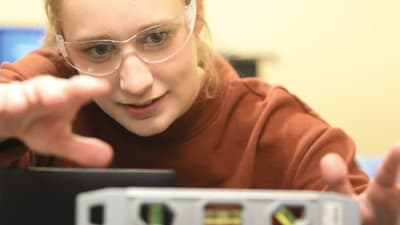
Recent experiments by a team from the West Virginia University focused on how a weightless microgravity environment affects 3D printing using titania foam, a material with potential applications ranging from UV blocking to water purification. ACS Applied Materials and Interfaces published their findings.
Briefs: Manufacturing & Prototyping
A new method for metal 3D printing aims to make more efficient use of resources by allowing structural modifications to be “programmed” into metal alloys during 3D printing, fine-tuning their properties without the “heating and beating” process that’s been in use for thousands of years.

Briefs: Manufacturing & Prototyping
Harvard researchers have realized a key milestone in the quest for stable, scalable quantum computing, an ultra-high-speed technology that will enable game-changing advances in a variety of fields, including medicine, science, and finance.

Briefs: Robotics, Automation & Control
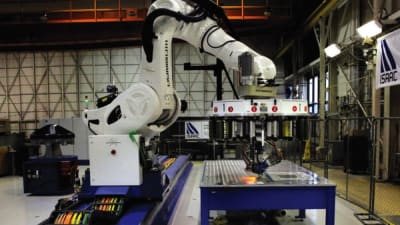
NASA’s Langley Research Center has developed a simplified, tool-less automated tow/tape placement (ATP) system. This invention enables several benefits that mitigate limitations associated with conventional ATP systems. Read on to learn more.
Briefs: Materials
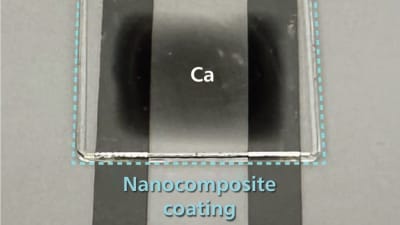
Developed by a team led by Lawrence Berkeley National Laboratory, a self-assembling nanosheet could significantly extend the shelf life of consumer products. And because the new material is recyclable, it could also enable a sustainable manufacturing approach that keeps single-use packaging and electronics out of landfills.
Briefs: Manufacturing & Prototyping
Researchers have unveiled a remarkable new material with potential to impact the world of material science: amorphous silicon carbide (a-SiC). Beyond its exceptional strength, this material demonstrates mechanical properties crucial for vibration isolation on a microchip. It is therefore particularly suitable for making ultra-sensitive microchip sensors.

Briefs: Photonics/Optics
The NIST camera is made up of grids of ultrathin electrical wires, cooled to near absolute zero, in which current moves with no resistance until a wire is struck by a photon. In these superconducting-nanowire cameras, the energy imparted by even a single photon can be detected because it shuts down the superconductivity at a particular location (pixel) on the grid. Combining all the locations and intensities of all the photons makes up an image.

Briefs: Manufacturing & Prototyping
Using 3D Bioprinting to Create Eye Tissue
The research team from the National Eye Institute printed a combination of cells that form the outer blood-retina barrier — eye tissue that supports the retina’s light-sensing photoreceptors. The technique provides a theoretically unlimited supply of patient-derived tissue to study degenerative retinal diseases such as age-related macular degeneration.
Briefs: Energy
A stretchable system that can harvest energy from human breathing and motion for use in wearable health-monitoring devices may be possible, according to an international team of researchers.

Briefs: Design
The ventilators are simpler and cheaper to make than those currently available.

Briefs: Nanotechnology
Macquarie University engineers have developed a new technique to make the manufacturing of nanosensors far less carbon-intensive, much cheaper, more efficient, and more versatile — substantially improving a key process in this trillion-dollar global industry.

Briefs: Materials
A Molecular-Sized, More Efficient Electronic Sensor
Australian researchers have developed a molecular-sized, more efficient version of a widely used electronic sensor, in a breakthrough that could bring widespread benefits.
Briefs: Robotics, Automation & Control
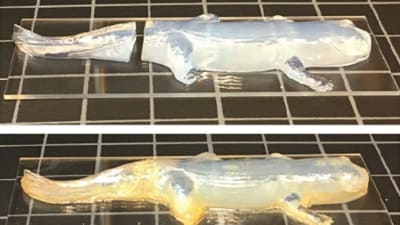
Using a new type of dual-polymer material capable of responding dynamically to its environment, researchers have developed a set of modular hydrogel components that could be useful in a variety of soft robotic and biomedical applications.
Briefs: Robotics, Automation & Control
A team at ETH Zurich has developed an ultrasonically actuated glass needle that can be attached to a robotic arm. This lets them pump and mix minuscule amounts of liquid and trap particles.

Briefs: Energy
To improve battery performance and production, Penn State researchers and collaborators have developed a new fabrication approach that could make for more efficient batteries that maintain energy and power levels.

Briefs: Materials
A team developed a framework for designing solid-state batteries (SSBs) with mechanics in mind. Their paper, published in Science, reviewed how these factors change SSBs during their cycling.

Briefs: Robotics, Automation & Control
Cornell researchers have combined soft microactuators with high-energy-density chemical fuel to create an insect-scale quadrupedal robot that is powered by combustion and can outrace, outlift, outflex, and outleap its electric-driven competitors.

Briefs: Manufacturing & Prototyping
Dr. Song Kahye along with Professor Lee, Dae-Young have jointly developed a soft gripper with a woven structure that can grip objects weighing more than 100 kg with 130 g of material. To increase the loading capacity of the soft robot gripper, the team applied a new structure inspired by textiles.

Briefs: Electronics & Computers
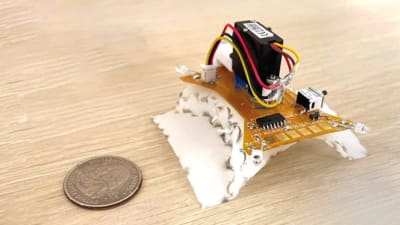
Centimeter-scale walking and crawling robots are in demand both for their ability to explore tight or cluttered environments and for their low fabrication costs. Pulling from origami-inspired construction, researchers have crafted a more simplified approach to the design and fabrication of these robots.
Briefs: RF & Microwave Electronics
A research team at the Illinois Institute of Technology has for the first time demonstrated the use of a novel control method in a tailless aircraft. The technology allows an aircraft to be as smooth and sleek as possible — making it safer to fly in dangerous areas where radar scans the sky for sharp edges.

Top Stories
 Blog: Power

My Opinion: We Need More Power Soon — Is Nuclear the Answer?
 Blog: AR/AI
Aerial Microrobots That Can Match a Bumblebee's Speed
 News: Energy

 Blog: Electronics & Computers

Turning Edible Fungi into Organic Memristors
 Blog: Robotics, Automation & Control

Microscopic Swimming Machines that Can Sense, Respond to Surroundings
 INSIDER: Sensors/Data Acquisition

Webcasts
 Upcoming Webinars: Energy

Hydrogen Engines Are Heating Up for Heavy Duty
 Upcoming Webinars: Electronics & Computers

Advantages of Smart Power Distribution Unit Design for Automotive...
 Upcoming Webinars: Unmanned Systems

Quiet, Please: NVH Improvement Opportunities in the Early Design...
 Upcoming Webinars: AR/AI

From Spreadsheets to Insights: Fast Data Analysis Without Complex...
 Upcoming Webinars: Automotive

Battery Abuse Testing: Pushing to Failure
 Upcoming Webinars: AR/AI