38
-1
840
30
Briefs: Sensors/Data Acquisition
A method was developed to make atom-flat sensors that seamlessly integrate with devices to report on what they perceive. Electronically active 2D materials, touted for their strength, are difficult to move to...
Briefs: Sensors/Data Acquisition
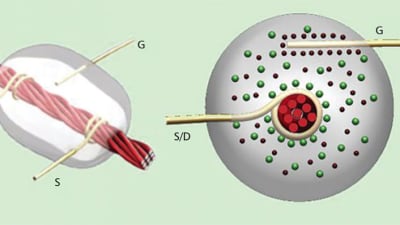
A transistor has been made from linen thread, enabling the creation of electronic devices made entirely of thin threads that could be woven into fabric, worn on the skin, or implanted...
Briefs: Manufacturing & Prototyping
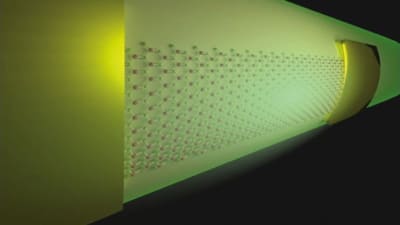
Engineers at the University of Illinois have found a way to redirect misfit light waves to reduce energy loss during optical data transmission. In a study,...
Briefs: Materials
High quality camera performance on mobile devices has proven to be one of the features that most end-users aim for. The importance of optical image quality improvement and the trend to have thinner and thinner...
Briefs: Imaging
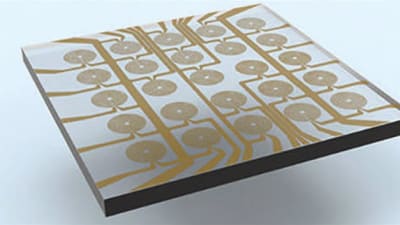
A new imaging method extracts a color image from a single exposure of light scattered through a mostly opaque material.
Briefs: Sensors/Data Acquisition
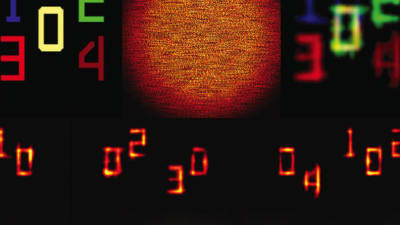
UCLA engineers have made major improvements on their design of an optical neural network — a device inspired by how the human brain works — that can identify objects or process...
Briefs: Energy
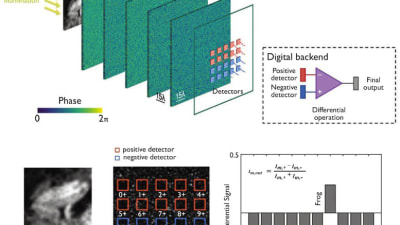
Car engines, laptop computers, cellphones, and refrigerators all heat up with overuse. That heat can be captured and turned into energy using a method that produces electricity from heat. The...

Briefs: Manufacturing & Prototyping
3D printers that build small parts layer by layer from melted plastic can take up to an hour to produce a pocket-sized piece. This process is far too slow for the mass-production of components...
Briefs: Electronics & Computers
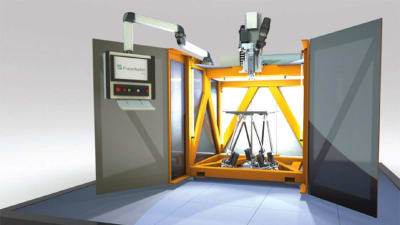
Excess heat given off by smartphones, laptops, and other electronic devices contributes to malfunctions and, in extreme cases, can even cause lithium batteries to explode. To guard against...

Briefs: Manufacturing & Prototyping
Materials with controlled porosity have found diverse applications in separation, catalysis, energy storage, sensors and actuators, tissue engineering, and drug delivery. Multiple...

Briefs: IoMT
A method was developed that enables information to be contained in simple plastic foils with a thickness of less than 50 μm, which is thinner than a human hair. Organic luminescent molecules...

Briefs: Manufacturing & Prototyping
3D printing via direct laser writing involves a computer-controlled focused laser beam that acts as a pen and creates the desired structure in the printer ink — a photoresist. In this way,...

Briefs: Automotive
An advanced manufacturing process was developed to produce nano-structured rods and tubes directly from high-performance aluminum alloy powder in a single step. Using a Solid Phase Processing approach,...

Briefs: Energy
Researchers have 3D-printed an all-liquid device that, with the click of a button, can be repeatedly reconfigured on demand to serve a wide range of applications from making battery materials to screening drug...

Briefs: Electronics & Computers
For decades, microchip transistors have become smaller, faster, and cheaper; however, miniaturization has reached a natural limit, as completely new problems arise when a length scale of only a...

Briefs: Test & Measurement
In the wake of recent developments that have reduced fan and jet noise contributions to overall jet-engine noise, aircraft designers are turning their attention toward reducing engine core noise....

Briefs: Nanotechnology
An automated system designs and 3D-prints complex robotic parts that are optimized according to an enormous number of specifications. The system fabricates actuators — devices that mechanically control...

Briefs: Manufacturing & Prototyping
Magnetic resonance imaging (MRI) uses magnetic fields and radio waves to create images of organs and tissues in the human body, helping doctors diagnose potential problems or diseases. Doctors use MRI to...
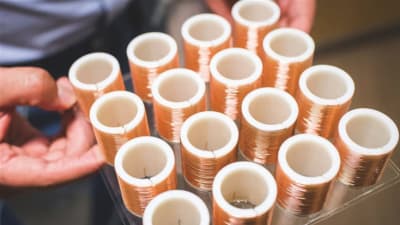
Briefs: Test & Measurement
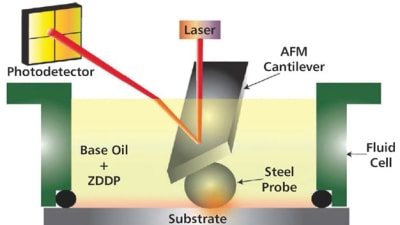
Different instruments are needed to study the interaction of contact surfaces at different length scales. Tribometers measure the coefficient of friction but they cannot...
Briefs: Materials
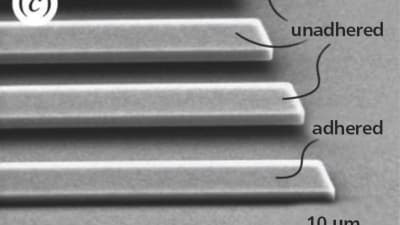
At the scale of bridges or buildings, the most important force that engineered structures need to deal with is gravity. But at the scale of microelectro-mechanical systems (MEMS) — devices like the...
Briefs: Electronics & Computers
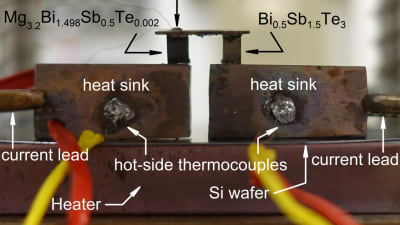
The widespread adoption of thermoelectric devices that can directly convert electricity into thermal energy for cooling and heating has been hindered, in part, by the lack of...
Briefs: Aerospace
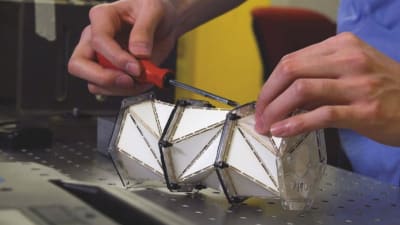
Landing is stressful on a rocket’s legs because they must handle the force from the impact with the landing pad. One way to combat this is to build legs out of materials that absorb some of the...
Briefs: Electronics & Computers
Some organic materials cannot be utilized similarly to silicon semiconductors in optoelectronics. Whether in solar cells, light-emitting diodes, or in transistors, what is important is the bandgap, i.e. the...
Briefs: Electronics & Computers
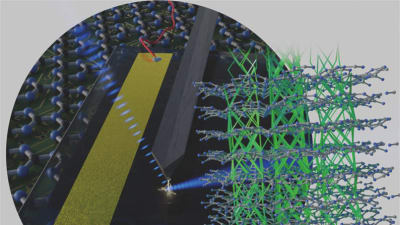
Recently discovered two-dimensional (2D) materials with superlative properties have the potential to advance semiconductors but creating 2D devices with both good electrical contacts and...

Briefs: Materials
Unlike water, liquid refrigerants and other fluids that have a low surface tension spread quickly into a sheet when they come into contact with a surface. For many industrial processes,...

Briefs: Materials
While different approaches have been used to create artificial muscles — including hydraulic systems, servomotors, shape-memory metals, and polymers that respond to stimuli — they all have limitations such as...

Briefs: Materials
An electrochemical sensing system that significantly improves the ability to rapidly and accurately detect heavy metals in biological and environmental samples was developed. Using a simple blood sample...
Briefs: Materials
A 3D-printed polymer-based foam structure was developed that responds to the force of a shock wave to act as a oneway switch, a long sought-after goal in shock research. The...

Briefs: Sensors/Data Acquisition
Graphene Field Effect Transistors for Radiation Detection (GFET-RS)
NASA Goddard Space Flight Center developed novel transistor technology based on a single graphene layer coupled to a radiation absorber substrate. Unlike conventional charge-sensing detectors, the GFET-RS utilizes the sensitive dependence of graphene conductance on local change of...
Top Stories
 Blog: Lighting

A Stretchable OLED that Can Maintain Most of Its Luminescence
 Blog: Energy

Batteries that Can Withstand the Cold
 INSIDER: Energy

Advancing All-Solid-State Batteries
 Quiz: Energy

 Blog: Physical Sciences

 Blog: Materials

Webcasts
 Upcoming Webinars: Test & Measurement

From Spreadsheets to Insights: Fast Data Analysis Without Complex...
 Upcoming Webinars: Electronics & Computers

Cooling a New Generation of Aerospace and Defense Embedded...
 Upcoming Webinars: Test & Measurement

Beyond AI-Copy-Paste Engineering: Advanced AI-Integration Success...
 Upcoming Webinars: Automotive

Battery Abuse Testing: Pushing to Failure
 Upcoming Webinars: Internet of Things

A FREE Two-Day Event Dedicated to Connected Mobility
 Upcoming Webinars: Test & Measurement

Choosing the Right N-Port Strategy: Multiport VNAs vs. Switch...