61
169
-1
5820
30
Briefs: Software
Automated Performance Characterization of DSN System Frequency Stability Using Spacecraft Tracking Data
This software provides an automated capability to measure and qualify the frequency stability performance of the Deep Space Network (DSN) ground system, using daily spacecraft tracking data. The results help to verify if the DSN performance is...
Briefs: Software
Web-Based Customizable Viewer for Mars Network Overflight Opportunities
This software displays a full summary of information regarding the overflight opportunities between any set of lander and orbiter pairs that the user has access to view. The information display can be customized, allowing the user to choose which fields to view/hide and filter.
Briefs: Manufacturing & Prototyping
Graphene Transparent Conductive Electrodes for Next- Generation Microshutter Arrays
Graphene is a single atomic layer of graphite. It is optically transparent and has high electron mobility, and thus has great potential to make transparent conductive electrodes. This invention contributes towards the development of graphene transparent conductive...
Briefs: Manufacturing & Prototyping
Fabrication of a Cryogenic Terahertz Emitter for Bolometer Focal Plane Calibrations
A fabrication process is reported for prototype emitters of THz radiation, which operate cryogenically, and should provide a fast, stable blackbody source suitable for characterization of THz devices. The fabrication has been demonstrated and, at the time of this...
Briefs: Manufacturing & Prototyping
Fabrication of an Absorber-Coupled MKID Detector
Absorber-coupled microwave kinetic inductance detector (MKID) arrays were developed for submillimeter and farinfrared astronomy. These sensors comprise arrays of lambda/2 stepped microwave impedance resonators patterned on a 1.5-mm-thick silicon membrane, which is optimized for optical coupling. The...
Briefs: Mechanical & Fluid Systems
Long-Life, Lightweight, Multi-Roller Traction Drives for Planetary Vehicle Surface Exploration
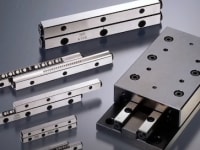
NASA’s initiative for Lunar and Martian exploration will require long lived, robust drive systems for manned vehicles that must operate in hostile environments. The operation of these mechanical drives will pose a problem because of the existing extreme...
Briefs: Electronics & Computers
Digital Architecture for a Trace Gas Sensor Platform
A digital architecture has been implemented for a trace gas sensor platform, as a companion to standard analog control electronics, which accommodates optical absorption whose fractional absorbance equivalent would result in excess error if assumed to be linear. In cases where the absorption...
Briefs: Physical Sciences
Gas Composition Sensing Using Carbon Nanotube Arrays
This innovation is a lightweight, small sensor for inert gases that consumes a relatively small amount of power and provides measurements that are as accurate as conventional approaches. The sensing approach is based on generating an electrical discharge and measuring the specific gas breakdown...
Briefs: Physical Sciences
Computational Ghost Imaging for Remote Sensing
This work relates to the generic problem of remote active imaging; that is, a source illuminates a target of interest and a receiver collects the scattered light off the target to obtain an image. Conventional imaging systems consist of an imaging lens and a high-resolution detector array [e.g., a CCD...
Briefs: Software
Dispersed Fringe Sensing Analysis — DFSA
Dispersed Fringe Sensing (DFS) is a technique for measuring and phasing segmented telescope mirrors using a dispersed broadband light image. DFS is capable of breaking the monochromatic light ambiguity, measuring ab solute piston errors between segments of large segmented primary mirrors to tens of...
Briefs: Information Technology
Model-Based Method for Sensor Validation
Fault detection, diagnosis, and prognosis are essential tasks in the operation of autonomous spacecraft, instruments, and in situ platforms. One of NASA’s key mission requirements is robust state estimation. Sensing, using a wide range of sensors and sensor fusion approaches, plays a central role in robust...
Briefs: Physical Sciences
Indium Tin Oxide Resistor-Based Nitric Oxide Microsensors
A sensitive resistor-based NO microsensor, with a wide detection range and a low detection limit, has been developed. Semiconductor microfabrication techniques were used to create a sensor that has a simple, robust structure with a sensing area of 1.10 × 0.99 mm. A Pt interdigitated...
Briefs: Physical Sciences
Sensor for Boundary Shear Stress in Fluid Flow
The formation of scour patterns at bridge piers is driven by the forces at the boundary of the water flow. In most experimental scour studies, indirect processes have been applied to estimate the shear stress using measured velocity profiles. The estimations are based on theoretical models and...
Briefs: Electronics & Computers
Qualification of Engineering Camera for Long-Duration Deep Space Missions
Qualification and verification of advanced electronic packaging and interconnect technologies, and various other types of hardware elements for the Mars Exploration Rover’s Spirit and Opportunity (MER)/Mars Science Laboratory (MSL) flight projects, has been performed to...
Briefs: RF & Microwave Electronics
Remotely Powered Reconfigurable Receiver for Extreme Environment Sensing Platforms
Wireless sensors connected in a local network offer revolutionary exploration capabilities, but the current solutions do not work in extreme environments of low temperatures (200K) and low to moderate radiation levels (<50 krad). These sensors (temperature,...
Briefs: Electronics & Computers
Bump Bonding Using Metal-Coated Carbon Nanotubes
Bump bonding hybridization techniques use arrays of indium bumps to electrically and mechanically join two chips together. Surface-tension issues limit bump sizes to roughly as wide as they are high. Pitches are limited to 50 microns with bumps only 8–14 microns high on each wafer. A new process...
Briefs: Software
'In Situ' Mosaic Brightness Correction
In situ missions typically have pointable, mast-mounted cameras, which are capable of taking panoramic mosaics comprised of many individual frames. These frames are mosaicked together. While the mosaic software applies radiometric correction to the images, in many cases brightness/contrast seams still exist...
Briefs: Software
Simplex GPS and InSAR Inversion Software
Changes in the shape of the Earth’s surface can be routinely measured with precisions better than centimeters. Processes below the surface often drive these changes and as a result, investigators require models with inversion methods to characterize the sources. Simplex inverts any combination of GPS...
Briefs: Software
Virtual Machine Language 2.1
VML (Virtual Machine Language) is an advanced computing environment that allows spacecraft to operate using mechanisms ranging from simple, timeoriented sequencing to advanced, multicomponent reactive systems.
Briefs: Software
Multi-Scale Three- Dimensional Variational Data Assimilation System for Coastal Ocean Prediction
A multi-scale three-dimensional variational data assimilation system (MS-3DVAR) has been formulated and the associated software system has been developed for improving high-resolution coastal ocean prediction. This system helps improve coastal ocean...
Briefs: Software
Pandora Operation and Analysis Software
Pandora Operation and Analysis Software controls the Pandora Sun- and sky-pointing optical head and built-in filter wheels (neutral density, UV bandpass, polarization filters, and opaque). The software also controls the attached spectrometer exposure time and thermoelectric cooler to maintain the spectrometer...
Briefs: Manufacturing & Prototyping
Processing of Nanosensors Using a Sacrificial Template Approach
A new microsensor fabrication approach has been demonstrated based upon the use of nanostructures as templates. The fundamental idea is that existing nanostructures, such as carbon nanotubes or biological structures, have a material structure that can be used advantageously in order to...
Briefs: Manufacturing & Prototyping
Fabrication of a Cryogenic Bias Filter for Ultrasensitive Focal Plane
A fabrication process has been developed for cryogenic in-line filtering for the bias and readout of ultrasensitive cryogenic bolometers for millimeter and submillimeter wavelengths. The design is a microstripline filter that cuts out, or strongly attenuates, frequencies (10–50...
Briefs: Materials
High-Temperature Shape Memory Polymers
Shape memory materials undergo physical conformation changes when exposed to an external stimulus, such as a change in temperature. Such materials have a permanent shape, but can be reshaped above a critical temperature and fixed into a temporary shape when cooled under stress to below the critical...
Briefs: Materials
Non-Toxic, Low-Freezing, Drop-In Replacement Heat Transfer Fluids
A non-toxic, non-flammable, low-freezing heat transfer fluid is being developed for drop-in replacement within current and future heat transfer loops currently using water or alcohol-based coolants. Numerous water-soluble compounds were down-selected and screened for toxicological,...
Briefs: Materials
Modular Flooring System
The modular flooring system (MFS) was developed to provide a portable, modular, durable carpeting solution for NASA’s Robotics Alliance Project’s (RAP) outreach efforts. It was also designed to improve and replace a modular flooring system that was too heavy for safe use and transportation. The MFS was developed for use...
Briefs: Materials
Materials That Enhance Efficiency and Radiation Resistance of Solar Cells
A thin layer (≈10 microns) of a novel “transparent” fluorescent material is applied to existing solar cells or modules to effectively block and convert UV light, or other lower solar response waveband of solar radiation, to visible or IR light that can be more...
Briefs: Mechanical & Fluid Systems
Static Gas-Charging Plug
A gas-charging plug can be easily analyzed for random vibration. The design features two steeped O-rings in a radial configuration at two different diameters, with a 0.050-in. (≈1.3-mm) diameter through-hole between the two O-rings. In the charging state, the top O-ring is engaged and sealing. The bottom O-ring outer...
Briefs: Mechanical & Fluid Systems
Low-Cost, Rugged High-Vacuum System
A need exists for miniaturized, rugged, low-cost high-vacuum systems. Recent advances in sensor technology have led to the development of very small mass spectrometer detectors as well as other analytical instruments such as scanning electron microscopes. However, the vacuum systems to support these sensors...
Top Stories
 Blog: Design

A Stretchable OLED that Can Maintain Most of Its Luminescence
 INSIDER: Design

Advancing All-Solid-State Batteries
 Blog: Power

My Opinion: We Need More Power Soon — Is Nuclear the Answer?
 Blog: Energy

Batteries that Can Withstand the Cold
 Quiz: Power

 Blog: Robotics, Automation & Control

Microscopic Swimming Machines that Can Sense, Respond to Surroundings
Webcasts
 On-Demand Webinars: Electronics & Computers

Advantages of Smart Power Distribution Unit Design for Automotive &...
 Upcoming Webinars: Unmanned Systems

Quiet, Please: NVH Improvement Opportunities in the Early Design...
 Upcoming Webinars: AR/AI

From Spreadsheets to Insights: Fast Data Analysis Without Complex...
 Upcoming Webinars: Defense

Cooling a New Generation of Aerospace and Defense Embedded...
 Upcoming Webinars: Software

Beyond AI-Copy-Paste Engineering: Advanced AI-Integration Success...
 Upcoming Webinars: Energy