-1
6480
30
Briefs: Information Technology
Collaborative Supervised Learning for Sensor Networks
Collaboration methods for distributed machine-learning algorithms involve the specification of communication protocols for the learners, which can query other learners and/or broadcast their findings preemptively. Each learner incorporates information from its neighbors into its own training...
Briefs: Physical Sciences
Onboard Nonlinear Engine Sensor and Component Fault Diagnosis and Isolation Scheme
A method detects and isolates in-flight sensor, actuator, and component faults for advanced propulsion systems. In sharp contrast to many conventional methods, which deal with either sensor fault or component fault, but not both, this method considers sensor fault,...
Briefs: Semiconductors & ICs
Interface Supports Multiple Broadcast Transceivers for Flight Applications
A wireless avionics interface provides a mechanism for managing multiple broadcast transceivers. This interface isolates the control logic required to support multiple transceivers so that the flight application does not have to manage wireless transceivers. All of the logic...
Briefs: Semiconductors & ICs
FPGA Sequencer for Radar Altimeter Applications
A sequencer for a radar altimeter provides accurate attitude information for a reliable soft landing of the Mars Science Laboratory (MSL). This is a field-programmable-gate-array (FPGA)-only implementation. A table loaded externally into the FPGA controls timing, processing, and decision structures....
Briefs: Semiconductors & ICs
SAD5 Stereo Correlation Line-Striping in an FPGA
High precision SAD5 stereo computations can be performed in an FPGA (field-programmable gate array) at much higher speeds than possible in a conventional CPU (central processing unit), but this uses large amounts of FPGA resources that scale with image size. Of the two key resources in an FPGA,...
Briefs: Semiconductors & ICs
Miniature Sapphire Acoustic Resonator — MSAR
A room temperature sapphire acoustics resonator incorporated into an oscillator represents a possible opportunity to improve on quartz ultrastable oscillator (USO) performance, which has been a staple for NASA missions since the inception of spaceflight. Where quartz technology is very mature and shows...
Briefs: Semiconductors & ICs
Process-Hardened, Multi-Analyte Sensor for Characterizing Rocket Plume Constituents
A multi-analyte sensor was developed that enables simultaneous detection of rocket engine combustion-product molecules in a launch-vehicle ground test stand. The sensor was developed using a pin-printing method by incorporating multiple sensor elements on a single...
Briefs: Software
Marsviewer 2008
Marsviewer 2008 is designed for quality control, browsing, and operational and science analysis of images and derived image products returned by spacecraft. This program allows all derived products (reduced data records, or RDRs) associated with each original image (experiment data record, or EDR) to be viewed in various ways,...
Briefs: Software
Mission Services Evolution Center Message Bus
The Goddard Mission Services Evolution Center (GMSEC) Message Bus is a robust, lightweight, fault-tolerant middleware implementation that supports all messaging capabilities of the GMSEC API, including publish/subscribe and request/reply. The Message Bus enables NASA to provide an open-source middleware...
Briefs: Software
Major Constituents Analysis for the Vehicle Cabin Atmosphere Monitor
Vehicle Cabin Atmosphere Monitor (VCAM) can provide a means for monitoring the air within enclosed environments such as the International Space Station, the Crew Exploration Vehicle (CEV), a Lunar habitat, or another vehicle traveling to Mars. Its miniature preconcentrator, gas...
Briefs: Software
Astronaut Health Participant Summary Application
The Longitudinal Study of Astronaut Health (LSAH) Participant Summary software captures data based on a custom information model designed to gather all relevant, discrete medical events for its study participants. This software provides a summarized view of the study participant’s entire medical...
Briefs: Software
Natural Language Interface for Safety Certification of Safety-Critical Software
Model-based design and automated code generation are being used increasingly at NASA. The trend is to move beyond simulation and prototyping to actual flight code, particularly in the guidance, navigation, and control domain. However, there are substantial obstacles to...
Briefs: Software
Adaption of the AMDIS Method to Flight Status on the VCAM Instrument
Software has been developed to function onboard the International Space Station (ISS) to help safeguard human health by detecting compounds of concern in the cabin atmosphere, both in identity and concentration. This software calibrates and processes a standard 2D dataset (mass...
Briefs: Manufacturing & Prototyping
Hybrid Composite Cryogenic Tank Structure
A hybrid lightweight composite tank has been created using specially designed materials and manufacturing processes. The tank is produced by using a hybrid structure consisting of at least two reinforced composite material systems. The inner composite layer comprises a distinct fiber and resin matrix...
Briefs: Manufacturing & Prototyping
Nanoscale Deformable Optics
Several missions and instruments in the conceptual design phase rely on the technique of interferometry to create detectable fringe patterns. The intimate emplacement of reflective material upon electron device cells based upon chalcogenide material technology permits high-speed, predictable deformation of the reflective...
Briefs: Manufacturing & Prototyping
Zinc Oxide Nanowire Interphase for Enhanced Lightweight Polymer Fiber Composites
The objective of this work was to increase the interfacial strength between aramid fiber and epoxy matrix. This was achieved by functionalizing the aramid fiber followed by growth of a layer of ZnO nanowires on the fiber surface such that when embedded into the...
Briefs: Manufacturing & Prototyping
Reliability-Based Design Optimization of a Composite Airframe Component
A stochastic optimization methodology (SDO) has been developed to design air-frame structural components made of metallic and composite materials. The design method accommodates uncertainties in load, strength, and material properties that are defined by distribution functions...
Briefs: Mechanical & Fluid Systems
Plasma Igniter for Reliable Ignition of Combustion in Rocket Engines
A plasma igniter has been developed for initiating combustion in liquid-propellant rocket engines. The device propels a hot, dense plasma jet, consisting of elemental fluorine and fluorine compounds, into the combustion chamber to ignite the cold propellant mixture. The igniter...
Briefs: Mechanical & Fluid Systems
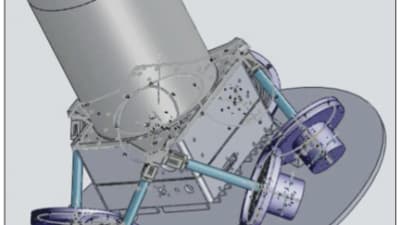
One of the major technical problems deep-space optical communication (DSOC) systems need to solve is the isolation of the optical terminal from vibrations produced by the spacecraft...
Briefs: Mechanical & Fluid Systems
Wire Test Grip Fixture
Wire-testing issues, such as the gripping strains imposed on the wire, play a critical role in obtaining clean data. In a standard test frame fitted with flat wedge grips, the gripping action alone creates stresses on the wire specimen that cause the wire to fail at the grip location. When conventional wire grip fixtures are...
Briefs: Materials
A plasma-enhanced chemical vapor deposition (PECVD) growth technique has been developed where the choice of starting substrate was found to...

Briefs: Materials
Nanoparticle/Polymer Nanocomposite Bond Coat or Coating
This innovation addresses the problem of coatings (meant to reduce gas permeation) applied to polymer matrix composites spalling off in service due to incompatibility with the polymer matrix. A bond coat/coating has been created that uses chemically functionalized nanoparticles (either clay or...
Briefs: Physical Sciences
Cryogenic Caging for Science Instrumentation
A method has been developed for caging science instrumentation to protect from pyro-shock and EDL (entry, descent, and landing) acceleration damage. Caging can be achieved by immersing the instrument (or its critical parts) in a liquid and solidifying the liquid by cooling. After the launch shock and/or...
Briefs: Physical Sciences
Wide-Range Neutron Detector for Space Nuclear Applications
A digital, wide-range, neutron detection (WRND) system in a compact, VME form factor monitors neutron activity within the core of a nuclear reactor across the reactor’s entire operating range, from 1.0 n/cm2/s up to 1010 n/cm2/s. This allows for a reduction in the complexity of...
Briefs: Physical Sciences
In Situ Guided Wave Structural Health Monitoring System
Aircraft engine rotating equipment operates at high temperatures and stresses. Noninvasive inspection of microcracks in those components poses a challenge for nondestructive evaluation. A low-cost, low-profile, high-temperature ultrasonic guided wave sensor was developed that detects cracks in...
Briefs: Physical Sciences
Multiplexed Energy Coupler for Rotating Equipment
A multiplexing antenna assembly can efficiently couple AC signal/energy into, or out of, rotating equipment. The unit only passes AC energy while blocking DC energy. Concentric tubes that are sliced into multiple pieces are assembled together so that, when a piece from an outer tube aligns well with...
Briefs: Physical Sciences
Attitude Estimation in Fractionated Spacecraft Cluster Systems
An attitude estimation was examined in fractioned free-flying spacecraft. Instead of a single, monolithic spacecraft, a fractionated free-flying spacecraft uses multiple spacecraft modules. These modules are connected only through wireless communication links and, potentially, wireless...
Briefs: Physical Sciences
Method and System for Temporal Filtering in Video Compression Systems
Three related innovations combine improved non-linear motion estimation, video coding, and video compression. The first system comprises a method in which side information is generated using an adaptive, non-linear motion model. This method enables extrapolating and interpolating...
Briefs: Physical Sciences
Apparatus for Measuring Total Emissivity of Small, Low-Emissivity Samples
An apparatus was developed for measuring total emissivity of small, lightweight, low-emissivity samples at low temperatures. The entire apparatus fits inside a small laboratory cryostat. Sample installation and removal are relatively quick, allowing for faster testing.
Top Stories
 Blog: Design

A Stretchable OLED that Can Maintain Most of Its Luminescence
 INSIDER: Design

Advancing All-Solid-State Batteries
 Blog: Power

My Opinion: We Need More Power Soon — Is Nuclear the Answer?
 Blog: Energy

Batteries that Can Withstand the Cold
 Quiz: Power

 Blog: Robotics, Automation & Control

Microscopic Swimming Machines that Can Sense, Respond to Surroundings
Webcasts
 On-Demand Webinars: Electronics & Computers

Advantages of Smart Power Distribution Unit Design for Automotive &...
 Upcoming Webinars: Unmanned Systems

Quiet, Please: NVH Improvement Opportunities in the Early Design...
 Upcoming Webinars: AR/AI

From Spreadsheets to Insights: Fast Data Analysis Without Complex...
 Upcoming Webinars: Defense

Cooling a New Generation of Aerospace and Defense Embedded...
 Upcoming Webinars: Software

Beyond AI-Copy-Paste Engineering: Advanced AI-Integration Success...
 Upcoming Webinars: Energy