Stories
45
0
0
30
Blog: Materials
An international collaboration has developed a flexible and stretchable OLED that could put the technology on track for new applications.

INSIDER: Lighting
Stanford researchers have developed a flexible material that can quickly change its surface texture and colors, offering potential applications in camouflage, art, robotics, and...

INSIDER: Photonics/Optics
Miniaturization ranks as the driving force behind the semiconductor industry. The tremendous gains in computer performance since the 1950s are largely due to the fact that ever smaller...

Blog: AR/AI
International research collaboration has unlocked a new approach that performs complex tensor computations using a single propagation of light. The result is single-shot tensor computing, achieved at the speed of light itself.

Blog: Photonics/Optics
Researchers have used the centuries-old idea of pinhole imaging to create a high-performance mid-infrared imaging system without lenses. The new camera can capture extremely clear pictures over a large range of distances and in low light, making it useful for situations that are challenging for traditional cameras.

INSIDER: Semiconductors & ICs
For more than 30 years, researchers have been trying to create small gears in order to construct micro-engines. But progress stalled at 0.1 millimeters, as it was not possible to build the...
Briefs: Photonics/Optics
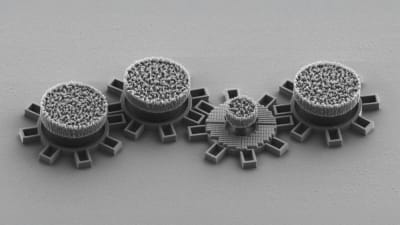
As fast as modern electronics have become, they could be much faster if their operations were based on light, rather than electricity. Fiber optic cables already transport information at the speed of light, but to do computations on that information without translating it back to electric signals will require a host of new optical components. Researchers have now developed such a device. Read on to learn more.
Briefs: Lighting
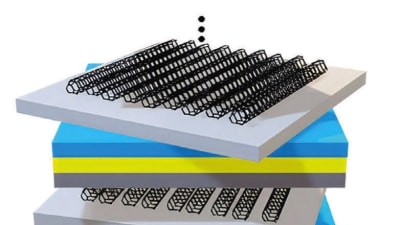
Engineers at NASA Langley Research Center have developed a cutting-edge thermal inspection technology that enhances defect detection on low-emissivity surfaces by eliminating false readings caused by infrared reflections. Read on to learn more.
Briefs: Lighting
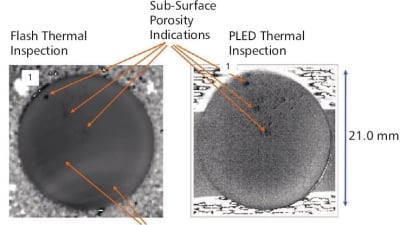
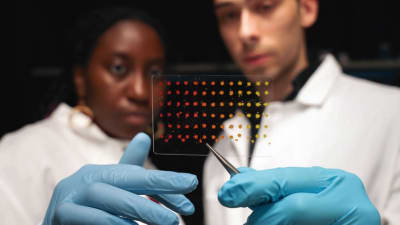
A new computer vision technique developed by MIT engineers significantly speeds up the characterization of newly synthesized electronic materials. The technique automatically analyzes images of printed semiconducting samples and quickly estimates two key electronic properties for each sample. Read on to learn more.
Blog: Data Acquisition
A new study introduces a novel way to reach a largely unstudied stretch of the atmosphere, between 30-60 miles above Earth’s surface, the mesosphere. Researchers have introduced a new way to explore it: lightweight flying structures that can float using nothing but sunlight.

Briefs: Materials
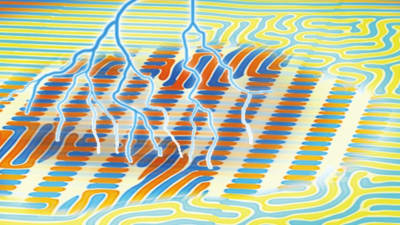
With this groundbreaking discovery of time-dependent changes in networked nanodomains, developers are on the path to building adaptive networks for information storage and processing. Read on to learn more.
Application Briefs: Photonics/Optics
Exploiting the “spatial” degree of freedom of light can mean many things. Read on to learn what they are and what the process can lead to.

Briefs: Materials
Researchers have designed and synthesized a unique material with controllable capabilities that make it promising for future electronics including cellphones and computers. Read on to learn more.
INSIDER: Photonics/Optics
Physicists in the Harvard John A. Paulson School of Engineering and Applied Sciences (SEAS) have created a compact laser that emits extremely bright, short pulses of light in a useful but...

Blog: Lighting
A research team has recently developed a neuromorphic exposure control system that revolutionizes machine vision under extreme lighting variations.

INSIDER: Imaging
The SPIE Photonics West 2025 technical conference and exhibition returns to San Francisco's Moscone Center, January 25 to 30, providing attendees the opportunity to learn...

Briefs: Software
A new type of organic light emitting diode (OLED) could replace bulky night vision goggles with lightweight glasses, making them cheaper and more practical for prolonged use, according to University of Michigan researchers. Read on to learn more.
Briefs: Lighting
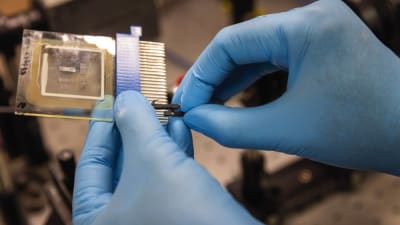
Now, a team from the Max Planck Institute for Polymer Research has developed a new material concept that could allow efficient blue OLEDs with a strongly simplified structure. Read on to learn more.

INSIDER: Photonics/Optics
A new type of OLED (organic light emitting diode) could replace bulky night vision goggles with lightweight glasses, making them cheaper and more practical for prolonged use, according to...
Briefs: Imaging
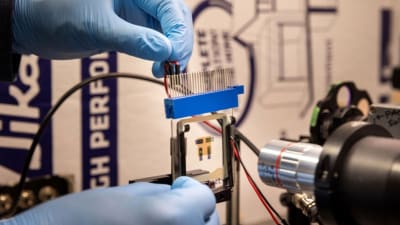
This innovative camera technology represents a significant advance in object detection, offering numerous potential applications across various industries. Read on to learn more.

Briefs: Photonics/Optics
Penn Engineers have developed a new chip that uses light waves, rather than electricity, to perform the complex math essential to training AI. The chip has the potential to radically accelerate the processing speed of computers while also reducing their energy consumption. Read on to learn more.

Quiz: Lighting
Office buildings use a significant portion of the world’s energy resources. Integrated building systems such as HVAC and lighting can significantly reduce that load. How much do you know about integrated building systems? Test your knowledge with this quiz.

INSIDER: Photonics/Optics
Think of all the information we get based on how an object interacts with wavelengths of light — also known as color. Color can tell us if food is safe to eat or if a piece of...

Articles: RF & Microwave Electronics
Astroparticle Physicist Dr. Rasha Abbasi, an Assistant Professor in the Department of Physics at Loyola University Chicago, works with the Telescope Array project. Located west of Delta, Utah, the project is an international collaboration between universities to observe high-energy cosmic rays. Abbasi and her team study how TGFs originate from the Earth’s atmosphere and propagate. In particular, the team hopes to answer key questions.

Products: Photonics/Optics
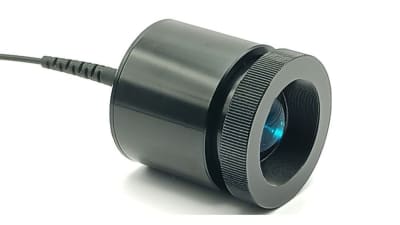
See the new products, including TRIOPTICS’ ATS alignment turning stations, VIAVI Solutions' expanded fiber optic test solutions portfolio, LumeDEL's fiberoptic collimating lenses, Teledyne FLIR's Neutrino LC OGI optical gas imaging camera module, and IDS' Sony sensor.
Briefs: Electronics & Computers
A research team led by Lawrence Berkeley National Laboratory (Berkeley Lab) has developed “supramolecular ink,” a new technology for use in OLED (organic light-emitting diode) displays or other electronic devices.

Briefs: Design
This advancement, one of the first of its kind, enables a useful new capability for a variety of applications, including improved prostheses, haptics for new modalities in augmented reality (AR), and thermally modulated therapeutics for applications such as pain management. The technology also has a variety of potential industrial and research applications.

Briefs: Photonics/Optics
Researchers at SEAS have uncovered hidden potential in metasurfaces and demonstrated optical devices that manipulate light’s polarization state with an unprecedented degree of control. Read on to learn more.

Top Stories
 Blog: Lighting

A Stretchable OLED that Can Maintain Most of Its Luminescence
 Blog: AR/AI

My Opinion: We Need More Power Soon — Is Nuclear the Answer?
 Quiz: Energy

 Blog: Robotics, Automation & Control
Aerial Microrobots That Can Match a Bumblebee's Speed
 Blog: Materials

Turning Edible Fungi into Organic Memristors
 Blog: Robotics, Automation & Control

Microscopic Swimming Machines that Can Sense, Respond to Surroundings
Webcasts
 On-Demand Webinars: Transportation

Hydrogen Engines Are Heating Up for Heavy Duty
 Upcoming Webinars: Electronics & Computers

Advantages of Smart Power Distribution Unit Design for Automotive...
 Upcoming Webinars: Transportation

Quiet, Please: NVH Improvement Opportunities in the Early Design...
 Upcoming Webinars: Test & Measurement

From Spreadsheets to Insights: Fast Data Analysis Without Complex...
 Upcoming Webinars: Energy

Battery Abuse Testing: Pushing to Failure
 Upcoming Webinars: Connectivity