Stories
0
1770
30
Blog: Sensors/Data Acquisition
The Industrial Internet of Things (IIoT) gave birth to the Internet of Things (IoT), but applications of the IoT are growing at an uneven pace due to real-world constraints beyond the capabilities of the technology.
Quiz: Motion Control
Cobots are robots designed to work alongside humans rather than in their own space on a broad range of tasks. So, how much do you know about cobots? Test your knowledge with this quiz.

Blog: AR/AI
The predictive system uses a small set of data from demographics and personal judgments such as aversion to risk or loss.

Podcasts: Manned Systems
Kurt Bruck, Division Manager, Neya Systems, is the guest on this episode of Season 2 of the Aerospace & Defense Technology podcast to discuss the company’s progress with the Army’s GEARS project.

Blog: Green Design & Manufacturing
A commonplace chemical used in water treatment facilities has been repurposed for large-scale energy storage in a new battery design by researchers at the DoE’s Pacific Northwest National Laboratory.
Podcasts: Medical
Exploring how AI algorithms analyze and interpret the data collected, leading to more accurate diagnostics and predictive insights.

Q&A: Sensors/Data Acquisition
Aditya Arun and his team from the Wireless Communication Sensing and Network Group (WCSNG) at the University of California San Diego have developed an asset localization system that uses wireless signals to track physical objects with centimeter-level accuracy in real time, and then generates a virtual representation of these objects.
Quiz: Internet of Things
The industrial internet of things (IIoT) is the result of an evolution of technology that started with the invention of the programmable logic controller (PLC) in 1968. It has blossomed in recent years with the incorporation of artificial intelligence and advanced networking protocols. How much do you think you know about the IIoT? Try this quiz to check your knowledge.

Podcasts: Design
Tim Stewart, Director of Business Development, Aitech, joins the Aerospace & Defense Technology podcast to discuss what artificial intelligence could provide for unmanned ground vehicles.

Podcasts: Sensors/Data Acquisition
Exploring advancements in wearable injector technology, examining how these devices are transforming the administration of medications, improving patient adherence, and enhancing the overall effectiveness of treatment plans.

Technology & Society: Green Design & Manufacturing
The detection would start on the ground via internet-connected sensors placed in CalFire-determined areas of danger. For reconnaissance missions, the team is building a rotorcraft equipped with navigation systems, sensors, and cameras.

Blog: Medical
A team of Georgia Tech researchers in Aaron Young’s lab has developed a universal approach to controlling robotic exoskeletons that requires no training, no calibration, and no adjustments to complicated algorithms. Instead, users can don the “exo” and go.

Quiz: Connectivity
How much do you know about the status of 6G wireless networking technology? Test your knowledge with this quiz.

Podcasts: Wearables
DNA-based biosensors offer a highly sensitive and specific approach for detecting a range of target molecules.

NASA Spinoff: Automotive
NASA’s invention inspired an innovative design for a better automobile disc brake that’s much lighter and drastically improves the braking performance.

Podcasts: Data Acquisition
The University of Michigan’s Automotive Research Center has a new five-year agreement with the U.S. Army for modeling, simulation, and digitally engineering the next generation of off-road autonomous vehicles.

5 Ws: Manufacturing & Prototyping
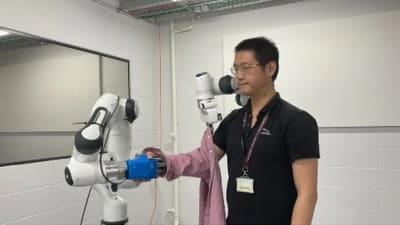
A bimanual dressing robot system developed at the University of York uses AI to mimic how caregivers assist humans in dressing.
Special Reports: Sensors/Data Acquisition
Optics & Photonics Innovations - April 2024
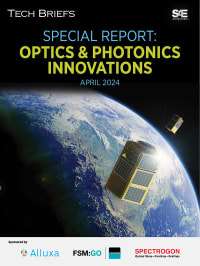
How to turn a mobile phone into a high–resolution microscope…hyperspectral imaging technology spots pipeline leaks from space…a MEMS solution to self–driving cars' LiDAR challenges. Read about...Products: Test & Measurement
See the product of the month: The IMS5420-TH white light interferometer from Micro-Epsilon. The IMS5420-TH can be used for undoped, doped, and highly doped SI wafers.

Articles: Electronics & Computers
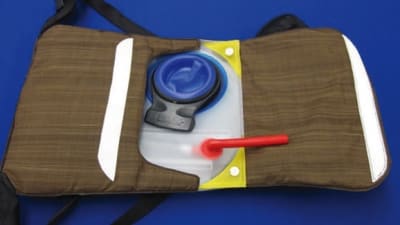
See the products of tomorrow, including: a new metamaterial that takes advantage of the non-reciprocal magnetoelectric (NME) effect; fully 3D-printed, three-dimensional solenoids; and a freeze-resistant hydration system.
Products: Manufacturing & Prototyping
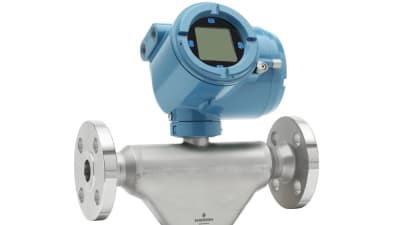
See what's new on the market, including: new TEMPUS™ technology from Renishaw, SPIROL's Series CL6000 Compression Limiters, binder-USA's protective caps, a breakthrough lithium coin cell holder from Keystone Electronics, and more.
Briefs: Robotics, Automation & Control
This new technology — developed by engineers at Delft University of Technology, Vrije Universiteit Amsterdam, and VSL, and which can achieve an accuracy of 10 centimeters — is important for the implementation of a range of location-based applications, such as automated vehicles, quantum communication, and next-generation mobile communication systems.

Briefs: Semiconductors & ICs
RMIT University’s Arnan Mitchell and University of Adelaide’s Dr. Andy Boes led an international team to review lithium niobate’s capabilities and potential applications in the journal Science. The team is working to make navigation systems that help rovers drive on the Moon — where GPS is unable to work — later this decade.

Briefs: RF & Microwave Electronics
Researchers at the University of Birmingham have developed a new type of high-performance “phase shifter” using a liquid gallium alloy — which varies the phase angle of microwave and millimeter-wave radio signals — for use in advanced phase array antenna systems.

Briefs: Electronics & Computers
MIT researchers have developed a quantum computing architecture that aims to enable extensible, high-fidelity communication between superconducting quantum processors.

Briefs: Design
Researchers at the Georgia Institute of Technology have developed low-cost, painless, and bloodless tattoos that can be self-administered and have many applications, from medical alerts to tracking neutered animals to cosmetics.

Briefs: Wearables
Taking inspiration from origami, MIT engineers have now designed a medical patch that can be folded around minimally invasive surgical tools and delivered through airways, intestines, and other narrow spaces, to patch up internal injuries.

Briefs: Medical
Researchers at Kennedy Space Center have developed a technology that generates plasma activated water in pH ranges that allow for the addition of nitrates and other nutrients to the water while maintaining a healthy pH for plants.
Briefs: Photonics/Optics
Usually developing slowly over time, many cases of glaucoma are only picked up during routine eye tests, by which time lasting damage may already have been caused. But this could change in the future as academics from the U.K. and Türkiye have developed a contact lens which can detect changes in eye pressure which signal possible glaucoma.

Top Stories
 Blog: Sensors/Data Acquisition

Going for Gold in Winter Olympic Curling
 Blog: Energy

Batteries that Can Withstand the Cold
 Blog: Lighting

A Stretchable OLED that Can Maintain Most of Its Luminescence
 INSIDER: Design

Advancing All-Solid-State Batteries
 Blog: Data Acquisition

 Blog: Materials

Webcasts
 On-Demand Webinars: Defense

Cooling a New Generation of Aerospace and Defense Embedded Computing...
 Upcoming Webinars: Software

Beyond AI-Copy-Paste Engineering: Advanced AI-Integration Success...
 Upcoming Webinars: Automotive

Battery Abuse Testing: Pushing to Failure
 Upcoming Webinars: Power

A FREE Two-Day Event Dedicated to Connected Mobility
 Upcoming Webinars: RF & Microwave Electronics

Choosing the Right N-Port Strategy: Multiport VNAs vs. Switch...
 Upcoming Webinars: AR/AI