Stories
0
1710
30
Blog: Medical
An international team has developed a "brain phantom," which was produced using a high-resolution 3D printing process.
INSIDER: Robotics, Automation & Control
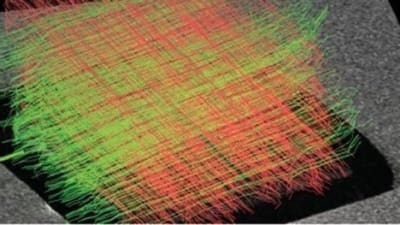
Our muscles are nature’s perfect actuators — devices that turn energy into motion. For their size, muscle fibers are more powerful and precise than most synthetic actuators. They...
INSIDER: Sensors/Data Acquisition
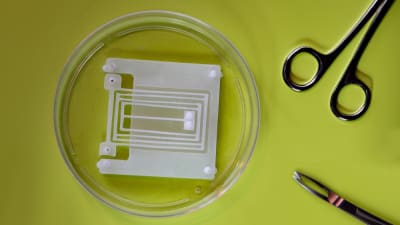
Jellyfish can't do much besides swim, sting, eat, and breed. They don't even have brains. Yet, these simple creatures can easily journey to the depths of the oceans in a way that humans,...

INSIDER: AR/AI
The idea of injecting microscopic robots into the bloodstream to heal the human body is not new. It’s also not science fiction.

Special Reports: Energy

Power Electronics - April 2024
This compendium of articles from the editors of Tech Briefs and Aerospace & Defense Technology magazines looks at the latest advances in power electronics and energy storage for applications ranging from...Special Reports: Sensors/Data Acquisition

Aerospace & Defense Sensing - April 2024
The world's first long‐range radio communications with an atomic quantum sensor…a sensor material 10x stronger than Kevlar…a microchip combining two Nobel Prize‐winning techniques to monitor the...Special Reports: Power

Electric Vehicles - April 2024
In this compendium of recent articles from the editors of Automotive Engineering and Battery & Electrification Technology, learn about the latest advances in solid‐state batteries, electric drivetrains, EV...Quiz: Medical
How much do you know about drug delivery and the systems used to deliver the drugs? Find out with this quiz.

Podcasts: Power
Rick Kewley, Vice President, Product Development and Advanced Engineering for GM Defense LLC, is the guest on this episode of the Aerospace & Defense Technology podcast to discuss some of the company's latest research and development on hybrid and electric-powered military vehicles.

Podcasts: Sensors/Data Acquisition
Exploring how innovations in wearables are making treatments more precise, portable, and patient-friendly than ever before.

Blog: Materials
A process of heating carbon nitride to the required degree of crystallinity, maximizing the functional properties of this material for photocatalysis.
Blog: Robotics, Automation & Control
The Industrial Internet of Things (IIoT) gave birth to the Internet of Things (IoT), but applications of the IoT are growing at an uneven pace due to real-world constraints beyond the capabilities of the technology.

Quiz: Software
Cobots are robots designed to work alongside humans rather than in their own space on a broad range of tasks. So, how much do you know about cobots? Test your knowledge with this quiz.
Blog: Medical
The predictive system uses a small set of data from demographics and personal judgments such as aversion to risk or loss.

Podcasts: Manned Systems
Kurt Bruck, Division Manager, Neya Systems, is the guest on this episode of Season 2 of the Aerospace & Defense Technology podcast to discuss the company’s progress with the Army’s GEARS project.

Blog: Energy
A commonplace chemical used in water treatment facilities has been repurposed for large-scale energy storage in a new battery design by researchers at the DoE’s Pacific Northwest National Laboratory.

Podcasts: Medical
Exploring how AI algorithms analyze and interpret the data collected, leading to more accurate diagnostics and predictive insights.

Q&A: Data Acquisition
Aditya Arun and his team from the Wireless Communication Sensing and Network Group (WCSNG) at the University of California San Diego have developed an asset localization system that uses wireless signals to track physical objects with centimeter-level accuracy in real time, and then generates a virtual representation of these objects.
Quiz: Internet of Things
The industrial internet of things (IIoT) is the result of an evolution of technology that started with the invention of the programmable logic controller (PLC) in 1968. It has blossomed in recent years with the incorporation of artificial intelligence and advanced networking protocols. How much do you think you know about the IIoT? Try this quiz to check your knowledge.

Podcasts: Manned Systems
Tim Stewart, Director of Business Development, Aitech, joins the Aerospace & Defense Technology podcast to discuss what artificial intelligence could provide for unmanned ground vehicles.

Podcasts: Wearables
Exploring advancements in wearable injector technology, examining how these devices are transforming the administration of medications, improving patient adherence, and enhancing the overall effectiveness of treatment plans.

Technology & Society: Unmanned Systems
The detection would start on the ground via internet-connected sensors placed in CalFire-determined areas of danger. For reconnaissance missions, the team is building a rotorcraft equipped with navigation systems, sensors, and cameras.

Blog: Medical
A team of Georgia Tech researchers in Aaron Young’s lab has developed a universal approach to controlling robotic exoskeletons that requires no training, no calibration, and no adjustments to complicated algorithms. Instead, users can don the “exo” and go.
Quiz: Communications
How much do you know about the status of 6G wireless networking technology? Test your knowledge with this quiz.

Podcasts: Wearables
DNA-based biosensors offer a highly sensitive and specific approach for detecting a range of target molecules.

NASA Spinoff: Automotive
NASA’s invention inspired an innovative design for a better automobile disc brake that’s much lighter and drastically improves the braking performance.

Podcasts: Unmanned Systems
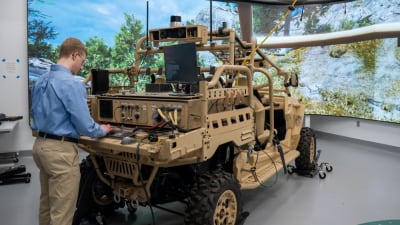
The University of Michigan’s Automotive Research Center has a new five-year agreement with the U.S. Army for modeling, simulation, and digitally engineering the next generation of off-road autonomous vehicles.
5 Ws: Robotics, Automation & Control
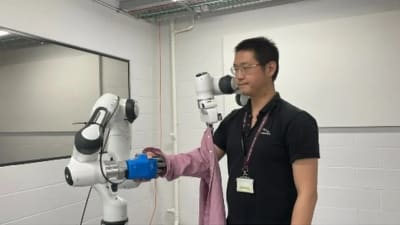
A bimanual dressing robot system developed at the University of York uses AI to mimic how caregivers assist humans in dressing.
Special Reports: Communications

Optics & Photonics Innovations - April 2024
How to turn a mobile phone into a high–resolution microscope…hyperspectral imaging technology spots pipeline leaks from space…a MEMS solution to self–driving cars' LiDAR challenges. Read about...Top Stories
 Blog: Power

My Opinion: We Need More Power Soon — Is Nuclear the Answer?
 Blog: AR/AI
Aerial Microrobots That Can Match a Bumblebee's Speed
 News: Energy

 Blog: Electronics & Computers

Turning Edible Fungi into Organic Memristors
 Blog: Robotics, Automation & Control

Microscopic Swimming Machines that Can Sense, Respond to Surroundings
 INSIDER: Sensors/Data Acquisition

Webcasts
 Upcoming Webinars: Power

Hydrogen Engines Are Heating Up for Heavy Duty
 Upcoming Webinars: Automotive

Advantages of Smart Power Distribution Unit Design for Automotive...
 Upcoming Webinars: Automotive

Quiet, Please: NVH Improvement Opportunities in the Early Design...
 Upcoming Webinars: Test & Measurement

From Spreadsheets to Insights: Fast Data Analysis Without Complex...
 Upcoming Webinars: Automotive

Battery Abuse Testing: Pushing to Failure
 Upcoming Webinars: Connectivity