

Monolithic microwave integrated-circuit (MMIC) amplifiers of a type now being developed for operation at frequencies of hundreds of gigahertz contain InP high- electron-mobility transistors (HEMTs) in a differential configuration. The differential configuration makes it possible to obtain gains greater than those of amplifiers having the single-ended configuration. To reduce losses associated with packaging, the MMIC chips are designed integrally with, and embedded in, waveguide packages, with the additional benefit that the packages are compact enough to fit into phased transmitting and/or receiving antenna arrays.
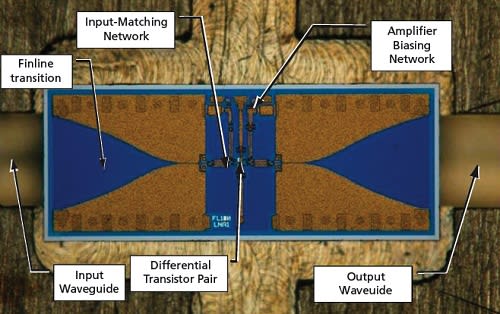
Differential configurations (which are inherently balanced) have been used to extend the upper limits of operating frequencies of complementary metal oxide/semiconductor (CMOS) amplifiers to the microwave range but, until now, have not been applied in millimeter-wave amplifier circuits. Baluns have traditionally been used to transform from single-ended to balanced configurations, but baluns tend to be lossy. Instead of baluns, finlines are used to effect this transformation in the present line of development. Finlines have been used extensively to drive millimeter-wave mixers in balanced configurations. In the present extension of the finline balancing concept, finline transitions are integrated onto the affected MMICs (see figure).
The differential configuration creates a virtual ground within each pair of InP HEMT gate fingers, eliminating the need for inductive vias to ground. Elimination of these vias greatly reduces parasitic components of current and the associated losses within an amplifier, thereby enabling more nearly complete utilization of the full performance of each transistor. The differential configuration offers the additional benefit of multiplying (relative to the single- ended configuration) the input and output impedances of each transistor by a factor of four, so that it is possible to use large transistors that would otherwise have prohibitively low impedances.
Yet another advantage afforded by the virtual ground of the differential configuration is elimination of the need for a ground plane and, hence, elimination of the need for back-side metallization of the MMIC chip. In turn, elimination of the back-side metallization simplifies fabrication, reduces parasitic capacitances, and enables mounting of the MMIC in the electric-field plane (“E-plane”) of a waveguide. E-plane mounting is consistent with (and essential for the utility of) the finline configuration, in which transmission lines lie on a dielectric sheet in the middle of a broad side of the waveguide.
E-plane mounting offers a combination of low loss and ease of assembly because no millimeter-wave wire bonds or transition substrates are required. Moreover, because there is no ground plane behind the MMIC, the impedance for the detrimental even (single-ended) mode is high, suppressing coupling to that mode. Still another advantage of E-plane mounting is that the fundamental waveguide mode is inherently differential, eliminating the need for a balun to excite the differential mode.
This work was done by Pekka Kangaslahti, Erich Schlecht, and Lorene Samoska of Caltech for NASA’s Jet Propulsion Laboratory.
In accordance with Public Law 96-517, the contractor has elected to retain title to this invention. Inquiries concerning rights for its commercial use should be addressed to:
Innovative Technology Assets Management
JPL
Mail Stop 202-233
4800 Oak Grove Drive
Pasadena, CA 91109-8099
(818) 354-2240
E-mail: This email address is being protected from spambots. You need JavaScript enabled to view it.
Refer to NPO-42857, volume and number of this NASA Tech Briefs issue, and the page number.
This Brief includes a Technical Support Package (TSP).
Differential InP HEMT MMIC Amplifiers Embedded in Waveguides
(reference NPO-42857) is currently available for download from the TSP library.
Don't have an account?
Overview
The document discusses advancements in Differential InP HEMT MMIC (Monolithic Microwave Integrated Circuit) amplifiers embedded in waveguides, developed under NASA's Jet Propulsion Laboratory (JPL). The primary objective of this project is to enhance millimeter wave instruments used in atmospheric, planetary, and astronomical observations by increasing the operating frequency of amplifiers up to 300 GHz, while also achieving lower noise figures and higher output power at 180 GHz.
A novel design topology has been introduced, which integrates the MMIC with its packaging to minimize packaging losses and enhance intrinsic gain. This is accomplished through a differential configuration that utilizes a virtual ground. The project has successfully designed single-stage MMICs for both 180 GHz and 260 GHz, and developed split block packages to mount these MMICs across waveguides. The initial test results for the 180 GHz low noise amplifier (LNA) indicate a gain increase of 6 dB and improved isolation when biased appropriately.
The document outlines the benefits of these advancements for NASA and JPL, emphasizing their application in various high-performance systems. The low noise amplifiers and power amplifiers developed will support receiver front ends for atmospheric sounders like GeoSTAR, local oscillator drivers for high-frequency heterodyne receivers in the SAFIR mission, and radar modules for planetary exploration instruments. Additionally, there is a specific need for 180 GHz linear multicarrier power amplifiers for the Mars Atmospheric Constellation Observatory (MACO) and future instruments requiring broadband amplifiers in the 180 to 280 GHz range.
The project leverages standard 0.07 µm InP HEMT technology from Northrop Grumman Space Technology, ensuring that the designs are both cutting-edge and feasible for practical applications. The document serves as a technical support package, providing insights into the research and technology developments that have broader technological, scientific, and commercial implications.
Overall, this work represents a significant step forward in the field of millimeter wave technology, with the potential to enhance the capabilities of various scientific instruments and contribute to advancements in space exploration and atmospheric studies.











