

A simple, inexpensive method for bonding solid objects exploits hydroxidecatalyzed hydration and dehydration to form silicatelike networks in thin surface and interfacial layers between the objects. (Silicatelike networks are chemical-bond networks similar to, but looser than, those of bulk silica). The method can be practiced at room temperature or over a wide range of temperatures.
The method was developed especially to enable the formation of precise, reliable bonds between precise optical components. The bonds thus formed exhibit the precision and transparency of bonds formed by the conventional optical-contact method and the strength and reliability of high-temperature frit bonds. The method also lends itself to numerous non-optical applications in which there are requirements for precise bonds and/or requirements for bonds, whether precise or imprecise, that can reliably withstand severe environmental conditions. Categories of such non-optical applications include forming composite materials, coating substrates, forming laminate structures, and preparing objects of defined geometry and composition.
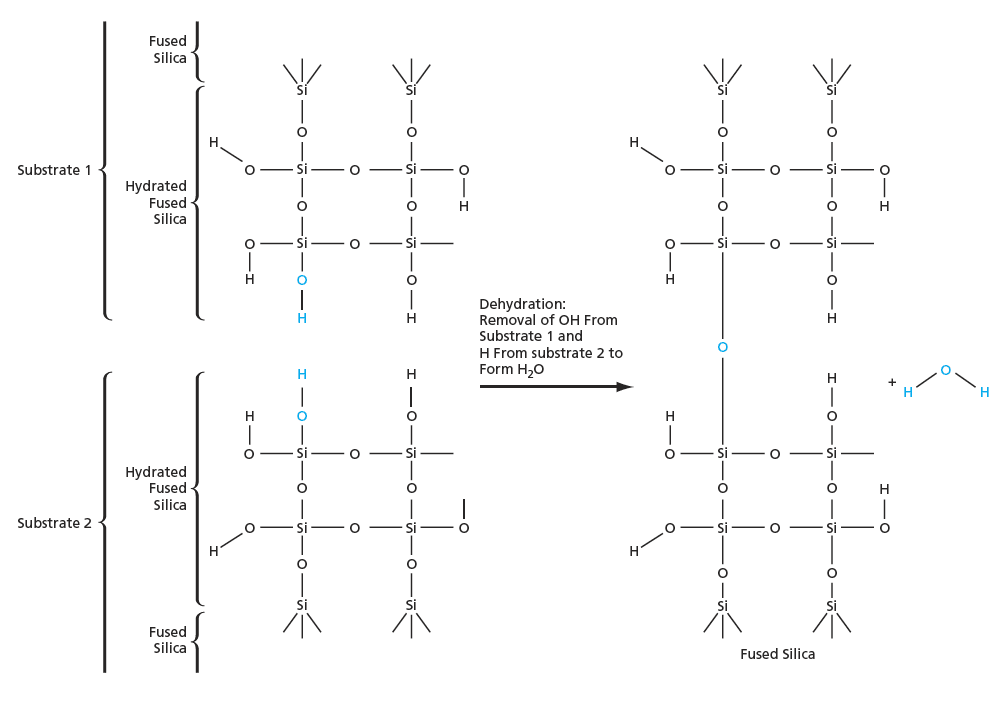
In this method, a silicatelike network that bonds two substrates (see figure) can be formed either by a bonding material alone or by the bonding material together with material from either or both of the substrates. In preparation for bonding, the mating surfaces of the substrates should be cleaned to render them maximally hydrophilic or at least minimally hydrophobic. Typically, an aqueous hydroxide bonding solution is dispensed and allowed to flow between the mating surfaces by capillary action. If at least one of the substrates can form a silicatelike network and if the surface figures of the substrates match with sufficient precision, then a suitable bonding solution would be one that contains a suitable concentration of hydroxide ions but substantially or completely lacks silicate material. If neither substrate material can form a silicatelike network through hydroxide catalysis or if the degree of mismatch between the surface figures of the substrates is such that silicatelike network cannot be formed at a sufficient rate, then a silicate material should be included in the bonding solution.
The solution acts to form a bond within a settling time, during the early part of which one can separate and/or move the substrates to align them more precisely. Regardless of whether substrates to be bonded are capable of forming silicatelike networks or have precisely matching surface figures, the settling time can be tailored via the concentrations of hydroxide ions and silicate material in the bonding solution. For example, for bonding silica-based materials, the settling time can be tailored between about 40 minutes at one extreme of composition (hydroxide but no silica) and tens of seconds at the other extreme of composition (silica with a smaller proportion of hydroxide).
If the surface figures of the substrates do not match precisely, bonding could be improved by including a filling material in the bonding solution. The filling material could be in the form of particles, foam, and/or a liquid. The filling material facilitates bridging of gaps between the substrate surfaces. Preferably, the filling material should include at least one ingredient that can be hydrated to have exposed hydroxyl groups and that can be chemically linked, by hydroxide catalysis, to a silicatelike network. The silicatelike network could be generated in situ from the filling material and/or substrate material, or could be originally present in the bonding material.
This work was done by Dz-Hung Gwo of Stanford University for Marshall Space Flight Center. For more information, contact Sammy Nabors, MSFC Commercialization Assistance Lead, at











