

The report "A Validated All-Pressure Fluid Drop Model and Lewis Number Effects for a Binary Mixture" presents one in a series of theoretical and computational studies of the subcritical and subpercritical behaviors of a drop of fluid and, in particular, a drop of heptane surrounded by nitrogen The study is based on a fluid-drop model in which, among other things, the differences between subcritical and supercritical behaviors are identified with length scales. It is shown that in the subcritical regime and for a large rate of evaporation from the drop, there exists a mass0fraction "Film layer" immediately below the drop surface and the solution of the model equations has a convective-diffusive character. In the supercritical regime, there is no material surface to follow and this introduces an indeterminancy in the boundary conditions. To resolve the indeterminancy, one must follow an arbitrary boundary, which, in this case, is that of the initial fluid drop. The solution has then a purely diffusive character, and from this solution, one calculates the location of the highest density gradient, which location is identified with the optically observable boundary. It is also shown that the classical calculation of the Lewis number gives qualitatively erroneous results at supercritical conditions, but that an effective Lewis number previously defined gives qualitatively correct estimates of the length scales for heat and mass transfer at all pressures.
This work was done by Josette Bellan and Kenneth Harstad of Caltech for NASA's Jet Propulsion Laboratory. To obtain a copy of the report, access the Technical Support Package (TSP) free on-line at www.nasatech.com/tsp under the Physical Sciences category.
NPO-20702
This Brief includes a Technical Support Package (TSP).
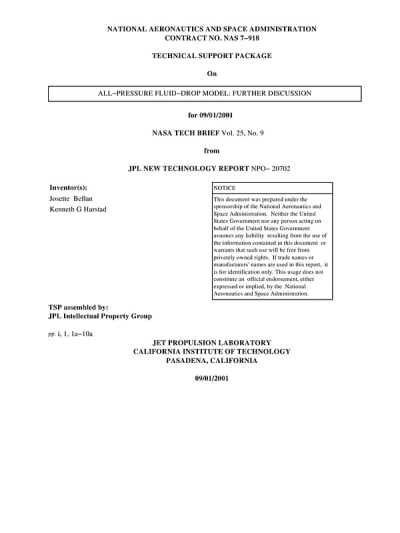
Validated Model of a Fluid Drop for All Pressures
(reference NPO-20702) is currently available for download from the TSP library.
Don't have an account?
Overview
The document appears to be a technical report related to research conducted at the Jet Propulsion Laboratory (JPL) under NASA's contract. While specific details about the content of the report are not provided in the pages referenced, it emphasizes the importance of clarity and specificity in presenting research findings, particularly in sections addressing novelty, problems, and solutions.
The report likely discusses a novel model developed to address specific challenges in fluid dynamics, particularly focusing on the behavior of fluid drops under varying conditions. It may explore the interactions of fluids, such as heptane in nitrogen, in both subcritical and supercritical states, highlighting the unique characteristics and behaviors that emerge in these conditions. The document suggests that the research aims to improve understanding of heat transfer and fluid behavior, which could have implications for various applications, including aerospace engineering and other fields where fluid dynamics play a critical role.
Additionally, the report includes a disclaimer regarding the mention of specific commercial products or services, clarifying that such references do not imply endorsement by the U.S. Government or JPL. This is a standard practice in technical documents to maintain objectivity and neutrality.
Overall, the document serves as a technical resource that outlines the methodology and findings of the research, contributing to the broader field of fluid dynamics and potentially offering solutions to existing problems in the area. The emphasis on thorough documentation and the possibility of attaching published papers indicates a commitment to rigorous scientific communication and dissemination of knowledge within the scientific community.
In summary, while specific details about the findings and methodologies are not available in the provided pages, the document reflects a structured approach to presenting research on fluid dynamics, with a focus on clarity, novelty, and practical solutions to complex problems.











