

-1
420
30
Briefs: Nanotechnology
Researchers have designed a way to levitate and propel objects using only light by creating specific nanoscale patterning on the objects' surfaces. The work could be a step toward developing a spacecraft that could reach the nearest planet outside of our solar system in 20 years, powered and accelerated only by light. Read on to learn more.

Briefs: Photonics/Optics
Researchers have created visible lasers of very pure colors from near-ultraviolet to near-infrared that fit on a fingertip. The colors of the lasers can be precisely tuned and extremely fast — up to 267 petahertz per second, which is critical for applications such as quantum optics. Read on to learn more.

Briefs: Sensors/Data Acquisition
A Bristol-led team of physicists has found a way to operate mass manufacturable photonic sensors at the quantum limit. This breakthrough paves the way for practical applications such as monitoring greenhouse gases and cancer detection. Read on to learn more.

Briefs: Energy
NASA engineers have developed a new approach to mitigating unwanted motion in floating structures. Ideally suited to applications including offshore wind energy platforms and barges, the innovation uses water ballast as a motion damping fluid.

Briefs: Sensors/Data Acquisition
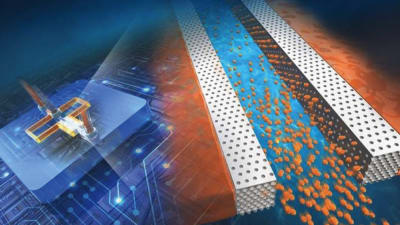
Researchers have introduced a microfluidic system that utilizes porous “inverse colloidal crystal” structures to dramatically improve the efficiency of microdroplet generation. Read on to learn more about it.
Briefs: Materials
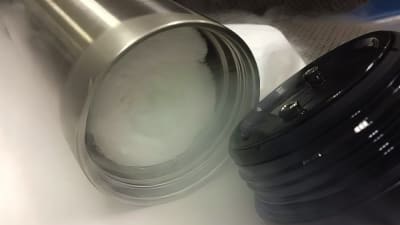
NASA’s Cryogenic Flux Capacitor capitalizes on the energy storage capacity of liquefied gases. By exploiting a unique attribute of nano-porous materials, aerogel in this case, fluid commodities such as oxygen, hydrogen, methane, etc. can be stored in a molecular surface-adsorbed state. Read on to learn more.
Briefs: Physical Sciences
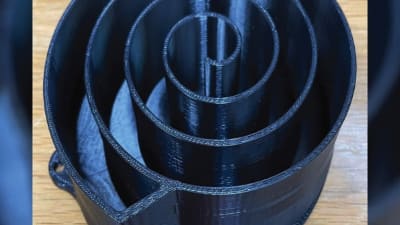
NASA Kennedy Space Center engineers developed a Cryogenic Oxygen Storage Module to store oxygen in solid-state form and deliver it as a gas to an end-use environmental control and/or life support system. Read on to learn more about it.
Briefs: Materials
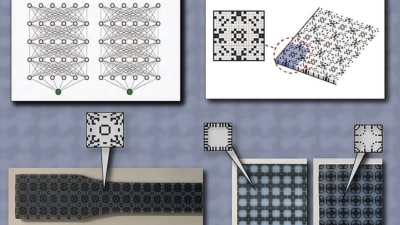
A team at MIT has moved beyond traditional trial-and-error methods to create materials with extraordinary performance through computational design. Their new system integrates physical experiments, physics-based simulations, and neural networks to navigate the discrepancies often found between theoretical models and practical results. Read on to learn more.
Articles: Imaging
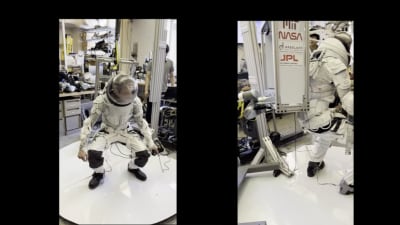
Watch this video to learn more about three new robotic technologies: A soft robot developed at NC State University; a pair of wearable robotic limbs developed by MIT engineers; and a camera inspired by the human eye developed at the University of Maryland.
Application Briefs: Robotics, Automation & Control
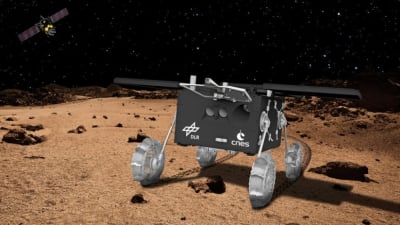
On the JAXA Martian Moons mission, gyro sensors from Silicon Sensing on the rover vehicle will explore the larger moon, Phobos, collecting vital surface samples.
News: Manufacturing & Prototyping
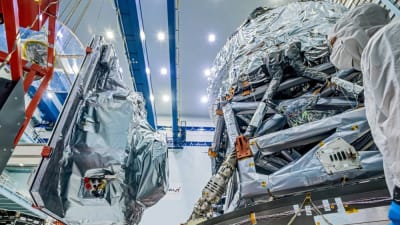
In this video, we provide an overview of the Nancy Grace Roman Space Telescope’s mission, capabilities and timeline to launch.
Q&A: Medical
Mohammad Habibur (Habib) Rahman, Director of the BioRobotics Laboratory at the University of Wisconsin-Milwaukee, and his team have been developing a portable, assistive robotic arm that therapists can use to assess and treat patients whether or not they are not in the same location.

NASA Spinoff: Sensors/Data Acquisition
NASA’s advancements in materials research for ion thrusters enabled Orbion Space Technology to bring high-efficiency ion thrusters to the commercial satellite industry.

5 Ws: Robotics, Automation & Control
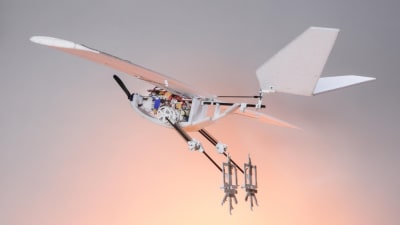
EPFL researchers have built RAVEN, a drone that can walk, hop, and jump into flight with the aid of birdlike legs.
Articles: Manufacturing & Prototyping
In optical manufacturing, precision polishing is vital to achieving the required flatness, surface quality, and angular precision that many applications demand. Traditionally, single-sided polishing has been the go-to method, particularly for complex components where one-sided control is critical. Read on to learn more about double-sided polishing.

Application Briefs: Materials
Defense applications, in particular, are always tasked with the balancing act that optimizes size, weight, power, and cost (SWaP-C) efficiencies when specifying new equipment. The challenge is how to balance beneficial trade-offs for optimal performance. Read on to learn more.

Application Briefs: Photonics/Optics
Today, companies are building small satellite constellations with tens to hundreds of units, far exceeding the scale of traditional space operations. Read on to learn more.

Briefs: Photonics/Optics
Researchers have made it possible to expand tissue twentyfold in a single step. This simple, inexpensive method could pave the way for nearly any biology lab to perform nanoscale imaging. Read on to learn more.

Briefs: AR/AI
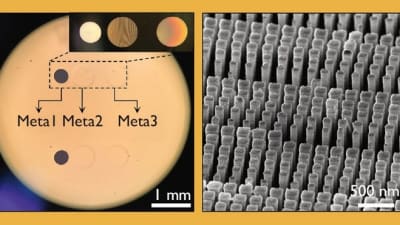
Researchers have developed an optical design technology that dramatically reduces the volume of cameras with a folded lens system utilizing “metasurfaces,” a next-generation nano-optical device. Read on to learn more.
Briefs: Semiconductors & ICs
Researchers have designed a spiral ladder-inspired tool that allows precision control of light direction and polarization to control the direction of the emitted beam and the polarization of the light, while using a precisely engineered resonance of the structure. Read on to learn more.

Briefs: Imaging
A team from the University of Barcelona and the Universitat Oberta de Catalunya has designed a methodology that facilitates the recognition of QR codes in these physical environments, where reading is more complicated. Read on to learn more.

Briefs: Software
Researchers have successfully developed a wide-bandwidth, low-polarization semiconductor optical amplifier based on tensile-strained quantum wells. The study, published in the journal Sensors, presents a significant advancement in optical communication technology, addressing the growing demand for higher bandwidth and lower polarization sensitivity. Read on to learn more.

Products: Imaging
See the new products, including TRIOPTICS' compact and retrofittable solution for processing laser diodes on the ATS 100 alignment turning station; TRUMPF's VCSELs and photodiodes; Edmund Optics’ TECHSPEC® UV Fused Silica Plano-Convex (PCX) Lenses MgF2 Coated feature precision specifications; Imperx' two new Cheetah cameras: the CXP-C1941 and the SFP-C1941; and more.

Articles: AR/AI
Scientists from MIT and elsewhere have demonstrated a fully integrated photonic processor that can perform all the key computations of a deep neural network optically on a chip. Read on to learn more about it.

Articles: Photonics/Optics
When it launches no later than May 2027, the NASA Nancy Grace Roman Space Telescope will serve as a powerful eye on deep space, capturing images of billions of distant galaxies and exploring the mysteries of dark matter, supernovae and other cosmic phenomena. Read on to learn about what it takes to make it a success.

Articles: Aerospace
All aerospace industry sectors have embraced artificial intelligence and machine learning to improve practical and urgent concerns. AI has become fundamental in the management of safety, part design, inspection processes, maintenance, repair, and overhaul (MRO), and fuel efficiency. Read on to learn more about it.

Articles: AR/AI
Artificial intelligence will be a key tool going forward in achieving results, offering the ability to more rapidly design, prototype, and implement changes and solutions through superior data analytics abilities and improved human-machine interactions. Read on to learn more.

Articles: Robotics, Automation & Control
Accelerating progress in AI is redefining what is possible with industrial robotics, enhancing everything from robots’ ability to grip, pick and place as well as their ability to map and navigate through dynamic environments. Read on to learn more about what this means.

Articles: Energy
Engineers at NASA used modeling and simulation with experimental testing to analyze the next generation of compressor designs that get the job done more quietly, with fewer maintenance needs, and at lower fabrication cost. Read on to learn more.
Top Stories
 Blog: Lighting

A Stretchable OLED that Can Maintain Most of Its Luminescence
 Blog: Energy

Batteries that Can Withstand the Cold
 INSIDER: Energy

Advancing All-Solid-State Batteries
 Quiz: Energy

 Blog: Physical Sciences

 Blog: Materials

Webcasts
 Upcoming Webinars: Test & Measurement

From Spreadsheets to Insights: Fast Data Analysis Without Complex...
 Upcoming Webinars: Electronics & Computers

Cooling a New Generation of Aerospace and Defense Embedded...
 Upcoming Webinars: Test & Measurement

Beyond AI-Copy-Paste Engineering: Advanced AI-Integration Success...
 Upcoming Webinars: Automotive

Battery Abuse Testing: Pushing to Failure
 Upcoming Webinars: Internet of Things

A FREE Two-Day Event Dedicated to Connected Mobility
 Upcoming Webinars: Test & Measurement

Choosing the Right N-Port Strategy: Multiport VNAs vs. Switch...