-1
1140
30
INSIDER: Materials
Researchers from the University of Houston have demonstrated “giant flexoelectricity” in soft elastomers that could improve robot movement range and make self-powered pacemakers a real possibility....

Question of the Week: Sensors/Data Acquisition
Will Mobile Radar Replace the Stethoscope?
Our June issue of Tech Briefs highlighted a radar system that enables touch-free monitoring of heart sounds. A significant advantage offered by radar, according to the system’s inventors, is the fact that the values are recorded digitally and are thus not subjective, allowing human error to be...
Blog: Manufacturing & Prototyping
Researchers at the University of Pittsburgh Swanson School of Engineering used a Computational Fluid Dynamics model to find ways to decrease cost and increase usage of cooler surfaces.

Blog: Materials
By introducing nanoparticles into ordinary cement, Northwestern University researchers have formed a smarter, more durable, and highly functional building material.

Question of the Week: Energy
Will Better Sensors Lead to Greater Adoption of Hydrogen Power?
One of the final hurdles to hydrogen power is securing a safe method for spotting hydrogen leaks. A sensor, featured in the June issue of Sensor Technology, has a greater sensitivity than other detectors.
INSIDER: Sensors/Data Acquisition
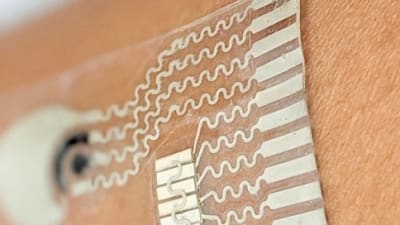
Engineers at the University of California San Diego have developed a soft, stretchy skin patch that can be worn on the neck to continuously track blood pressure and heart...
INSIDER: Electronics & Computers
After the optical frequency comb made its debut as a ruler for light, spinoffs followed, including the “astrocomb” to measure starlight and a radar-like comb system to detect...

INSIDER: Nanotechnology
Atomically thin materials are a promising alternative to silicon-based transistors; now researchers can connect them more efficiently to other chip elements.

INSIDER: Sensors/Data Acquisition
Physicists from the University of Sussex have developed an extremely thin, large-area semiconductor surface source of terahertz, composed of just a few...

Blog: Software
The Prediction Model for Flashover, or P-Flash, estimates where flashover explosions could occur.

INSIDER: Materials
A sustainable, powerful micro-supercapacitor may be on the horizon. Until now, these high-capacity, fast-charging energy storage devices have been limited by the...

INSIDER: Sensors/Data Acquisition
North Carolina State University engineers continue to improve the efficiency of a flexible device worn on the wrist that harvests heat energy from the human body to monitor health.

INSIDER: Electronics & Computers
Scientists at the U.S. Department of Energy’s Pacific Northwest National Laboratory (Richland, WA) have shown that low-cost organic compounds hold promise for...

INSIDER: Energy
A collaboration led by Cornell University (Ithaca, NY) used X-ray nanoimaging to gain an unprecedented view into solid-state electrolytes, revealing previously undetected crystal...

Question of the Week: Electronics & Computers
Will Recyclable Electronics Catch On?
Our June issue of Tech Briefs features a completely recyclable transistor from Duke University. The fully functional semiconductor is made out of three carbon-based inks that can be easily printed onto paper or other flexible, environmentally friendly surfaces.
Blog: Sensors/Data Acquisition
The technology uses tactile sensing to identify objects underground.

Blog: Sensors/Data Acquisition
A "self-aware," self-powering material can be used in heart stents, bridges, and even space.

Question of the Week: Energy
Will Rectennas Reduce Our Need for Batteries?
Rectennas act a bit like your car antenna. Instead of picking up radio waves, however, the tiny optical devices absorb light and convert it into power. The rectenna featured in today’s top story, generated half a nanowatt – a small amount of power that its inventors hope to increase.
Blog: Sensors/Data Acquisition
NC State researchers have made what they believe to be the smallest state-of-the-art RFID chip: a device measuring 125 micrometers (μm) by 245μm.
Blog: RF & Microwave Electronics
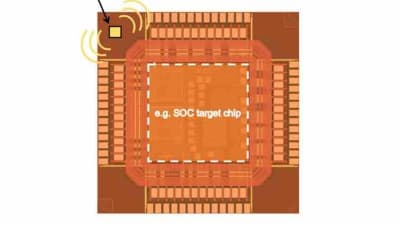
Researchers from CU Boulder gave their optical "rectennas" a ghost-like way to turn wasted heat into power.
INSIDER: Robotics, Automation & Control
As part of the Artemis program, NASA is planning to send its first mobile robot to the Moon in late 2023 in search of ice and other resources on and below the lunar surface. Data from the Volatiles...

Question of the Week: Energy
Will 'Zero-Impact' Planes Take Off?
Our May issue of Tech Briefs highlighted a hybrid-electric aircraft design from MIT that, according to its creators, could reduce global nitrogen oxide (NOx) emissions by 95 percent.
Blog: Automotive
A reader asks: "What are the main challenges in simulating powertrain systems? What do we struggle to model now?"

Blog: Materials
A better aerogel features a kind of biological scaffold made from a surprising ingredient found in nature: seaweed.

Question of the Week: Materials
Will Metal-Free Batteries Catch On?
Our lead story today highlighted a metal-free battery that degrades on demand. While a cobalt-less battery has its sustainability benefits, more work will need to be done for the Texas A&M-developed technology to compete with the lithium-ion standard.
Blog: Materials
A team from Texas A&M developed a battery that's metal-free and replaces cobalt with organic, recyclable materials.

Blog: Robotics, Automation & Control
Computer scientists at UC San Diego developed a navigation system that will allow robots to better negotiate busy environments in a hospital

Question of the Week: Materials
Will ‘Living Materials’ Catch On?
Our lead story today highlighted the possible applications for a "living material" made from microalgae and cellulose.
INSIDER: Robotics, Automation & Control
NASA’s Ingenuity Mars Helicopter has a new mission. Having proven that powered, controlled flight is possible on the Red Planet, the Ingenuity experiment will soon embark on a new operations demonstration...

Top Stories
 Blog: Lighting

A Stretchable OLED that Can Maintain Most of Its Luminescence
 Blog: Energy

Batteries that Can Withstand the Cold
 INSIDER: Energy

Advancing All-Solid-State Batteries
 Blog: Power

My Opinion: We Need More Power Soon — Is Nuclear the Answer?
 Quiz: Power

 Blog: Data Acquisition

Webcasts
 Upcoming Webinars: Test & Measurement

From Spreadsheets to Insights: Fast Data Analysis Without Complex...
 Upcoming Webinars: Aerospace

Cooling a New Generation of Aerospace and Defense Embedded...
 Upcoming Webinars: Sensors/Data Acquisition

Beyond AI-Copy-Paste Engineering: Advanced AI-Integration Success...
 Upcoming Webinars: Energy

Battery Abuse Testing: Pushing to Failure
 Upcoming Webinars: Power

A FREE Two-Day Event Dedicated to Connected Mobility
 Upcoming Webinars: RF & Microwave Electronics

Choosing the Right N-Port Strategy: Multiport VNAs vs. Switch...