8,33,42,44,45,47,52,54,68
-1
360
30
Briefs: Electronics & Computers
Researchers have demonstrated an energy-efficient method for transferring larger quantities of data over the fiber-optic cables that connect the nodes. This new technology improves on previous attempts to transmit multiple signals simultaneously over the same fiber-optic cables.

Briefs: Photonics/Optics
A team of researchers led by electrical engineer Marko Lončar at SEAS has developed a method for building a highly efficient integrated isolator that’s seamlessly incorporated into an optical chip made of lithium niobate.

Briefs: Imaging
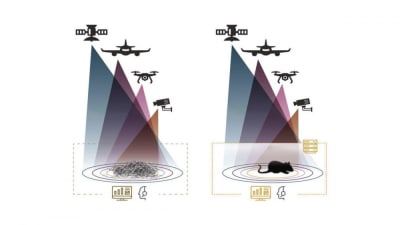
A new patented software system can find the curves of motion in streaming video and images from satellites, drones, and far-range security cameras and turn them into signals to find and track moving objects as small as one pixel.
Briefs: Electronics & Computers
MIT researchers have developed a quantum computing architecture that aims to enable extensible, high-fidelity communication between superconducting quantum processors.

Briefs: Electronics & Computers
While there may still be times when proprietary or serial communications are useful, the wide availability and low cost of high-performance industrial-specific devices and installation media are making industrial Ethernet the best approach for future-proofing applications and operating most efficiently.

Briefs: Electronics & Computers
Making Satellite, Ground Communication More Effective
Rensselaer Polytechnic Institute’s Moussa N’Gom has devised a method to make communications between satellites and the ground more effective — regardless of the weather.
Briefs: Electronics & Computers
A new paper on wireless connectivity from researchers at the lab of Dinesh Bharadia, an affiliate of the UC San Diego Qualcomm Institute (QI), introduces a new technique for increasing access to the 5G-and-beyond millimeter wave (mmWave) network.

Briefs: Communications
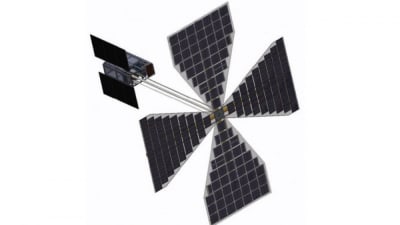
NASA's newly developed antenna is lightweight (at or below 2 grams), low volume (at or below 1.2 cm3), and low stowage thickness (approx. 0.7 mm), all while delivering high performance (at or above 10 dBi gain).
Briefs: IoMT
The technology exploits the inherently passive nature of RFID to approximate the services provided by traditional active Internet of Things (IoT) protocols like ZigBee and Bluetooth.

Briefs: IoMT
Innovators at NASA Johnson Space Center have developed a quarter-wavelength RFID slot antenna that provides polarization diversity and employs dual resonances, but in a form factor that is much smaller than other RFID antennas that provide similar functionality.

Briefs: Energy
A team has designed a new blueprint for solid-state batteries that are less dependent on specific chemical elements, particularly critical metals that are challenging to source due to supply chain issues. Their work could advance solid-state batteries that are efficient and affordable.

Briefs: Materials
Drawing inspiration from how spiders spin silk to make webs, a team of researchers has developed an innovative method of producing soft fibers that possess three key properties (strong, stretchable, and electrically conductive), and at the same time can be easily reused to produce new fibers.

Briefs: Lighting
Researchers have developed a colloidal synthesis method for alkaline earth chalcogenides. This method allows them to control the size of the nanocrystals in the material.

Briefs: Energy
An international research collaboration led by UCLA has developed a way to use perovskite in solar cells while protecting it from the conditions that cause it to deteriorate.

Briefs: Energy
New Lithium-Ion Battery Cathode Offers Higher Stability
In a new study, a research team led by the University of California, Irvine, created and analyzed a material for a Li-ion cathode that uses no cobalt and is instead rich in nickel.
Briefs: Energy
Researchers have fabricated a novel device that could dramatically boost the conversion of heat into electricity. If perfected, the technology could help recoup some of the recoverable heat energy that is wasted in the U.S. at a rate of about $100 billion each year.

Briefs: Power
An Electric Vehicle Battery for All Seasons
Many EV owners worry about how effective their battery will be in very cold weather. To address that problem, a team of scientists developed a fluorine-containing electrolyte that performs well even in sub-zero temperatures.
Briefs: Power
Researchers at Penn State University have achieved a breakthrough in electric vehicle (EV) battery design to enable a 10-minute charge time for a typical EV battery.

Briefs: Photonics/Optics
A team at Delft University of Technology has built a new technology on a microchip by combining two Nobel Prize-winning techniques for the first time. This microchip could measure distances in materials at high precision — e.g., underwater or for medical imaging.

Briefs: Manufacturing & Prototyping
A Penn State-led team of researchers have created a new process to fabricate large perovskite devices that is more cost- and time-effective than previously possible — and may accelerate future materials discovery.
Briefs: Energy
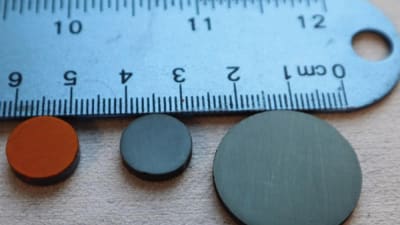
A team of researchers is using aluminum foil to create batteries with higher energy density and greater stability. The team’s new battery system could enable EVs to run longer on a single charge and would be cheaper to manufacture – all while having a positive impact on the environment.

Briefs: Power
Scientists at Rice University’s George R. Brown School of Engineering have developed a readily scalable method to optimize prelithiation, a process that helps mitigate lithium loss and improves battery life cycles by coating silicon anodes with stabilized lithium metal particles.

Briefs: Energy
Grasping objects is a problem that is easy for a human, but challenging for a robot. Researchers designed a soft, 3D-printed robotic hand that cannot independently move its fingers but can still carry out a range of complex movements.

Briefs: AR/AI
Armed with 5G network technology, AI, and edge computing resources, a pilot project under development at Naval Air Station Whidbey Island aims to create an optimized refueling system designed to boost readiness for military aircraft.

Briefs: AR/AI
Researchers from MIT’s Computer Science and Artificial Intelligence Laboratory (CSAIL) have introduced a method for robust flight navigation agents to master vision-based fly-to-target tasks in intricate, unfamiliar environments.
Briefs: Manned Systems
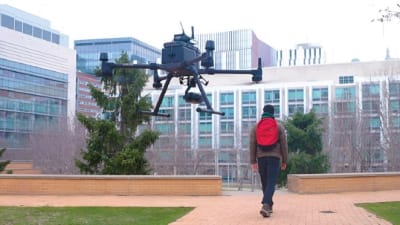
Researchers at Chalmers University of Technology have developed a propeller design optimization method that paves the way for quiet, efficient electric aviation.

Briefs: Manufacturing & Prototyping
There’s still more to explore with REFLEX, but this process could open new possibilities for new materials and microstructures across fields from electronics to optics to biomedical engineering.

Briefs: Photonics/Optics
A novel nanostructure produces uniquely shaped light.

Briefs: Imaging
A wavelength of visible light is about 1,000 times larger than an electron, so the way the two affect each other is limited by that disparity. Now, researchers have come up with a way to make...

Top Stories
 Blog: Lighting

A Stretchable OLED that Can Maintain Most of Its Luminescence
 Blog: Energy

Batteries that Can Withstand the Cold
 INSIDER: Energy

Advancing All-Solid-State Batteries
 Blog: Power

My Opinion: We Need More Power Soon — Is Nuclear the Answer?
 Quiz: Power

 Blog: Data Acquisition

Webcasts
 Upcoming Webinars: Test & Measurement

From Spreadsheets to Insights: Fast Data Analysis Without Complex...
 Upcoming Webinars: Defense

Cooling a New Generation of Aerospace and Defense Embedded...
 Upcoming Webinars: AR/AI

Beyond AI-Copy-Paste Engineering: Advanced AI-Integration Success...
 Upcoming Webinars: Automotive

Battery Abuse Testing: Pushing to Failure
 Upcoming Webinars: Connectivity

A FREE Two-Day Event Dedicated to Connected Mobility
 Upcoming Webinars: RF & Microwave Electronics

Choosing the Right N-Port Strategy: Multiport VNAs vs. Switch...