8,33,42,44,45,47,52,54,68
-1
3810
30
Briefs: Information Technology
Virtual Satellite
Virtual Satellite (VirtualSat) is a computer program that creates an environment that facilitates the development, verification, and validation of flight software for a single spacecraft or for multiple spacecraft flying in formation. In this environment, enhanced functionality and autonomy of navigation, guidance, and control...
Briefs: Information Technology
Small-Body Extensions for the Satellite Orbit Analysis Program (SOAP)
An extension to the SOAP software allows users to work with tri-axial ellipsoid-based representations of planetary bodies, primarily for working with small, natural satellites, asteroids, and comets. SOAP is a widely used tool for the visualization and analysis of space missions....
Briefs: Information Technology
Scripting Module for the Satellite Orbit Analysis Program (SOAP)
This add-on module to the SOAP software can perform changes to simulation objects based on the occurrence of specific conditions. This allows the software to encompass simulation response of scheduled or physical events. Users can manipulate objects in the simulation environment under...
Briefs: Information Technology
Core Technical Capability Laboratory Management System
The Core Technical Capability Lab - oratory Management System (CTCLMS) consists of dynamically generated Web pages used to access a database containing detailed CTC lab data with the software hosted on a server that allows users to have remote access. Users log into the system with their KSC...
Briefs: Information Technology
MRO SOW Daily Script
The MRO SOW daily script (wherein "MRO" signifies "Mars Reconnaissance Orbiter" and "SOW" signifies "sequence systems engineer of the week") is a computer program that automates portions of the MRO daily SOW procedure, which includes checking file-system sizes and automated sequence processor (ASP) log files. The MRO SOW daily...
Briefs: Information Technology
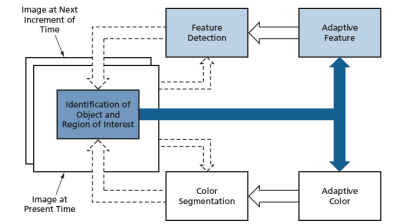
An improved adaptive method of processing image data in an artificial neural network has been developed to enable automated, real-time recognition of possibly moving objects under...
Briefs: Information Technology
Root Source Analysis/ValuStream™ — a Methodology for Identifying and Managing Risks
Root Source Analysis (RoSA) is a systems-engineering methodology that has been developed at NASA over the past five years. It is designed to reduce costs, schedule, and technical risks by systematically examining critical assumptions and the state of the...
Briefs: Information Technology
Ensemble: an Architecture for Mission-Operations Software
"Ensemble" is the name of an open architecture for, and a methodology for the development of, spacecraft mission-operations software. Ensemble is also potentially applicable to the development of non-spacecraft mission-operations-type software.
Briefs: Electronics & Computers
The Interplanetary Overlay Networking Protocol Accelerator
A document describes the Inter - planetary Overlay Networking Protocol Accelerator (IONAC) — an electronic apparatus, now under development, for relaying data at high rates in spacecraft and interplanetary radio-communication systems utilizing a delay-tolerant networking protocol. The...
Briefs: Electronics & Computers
Power amplifiers comprising InP-based high-electron-mobility transistors (HEMTs) in coplanar-waveguide (CPW) circuits designed for operation at frequencies of hundreds of gigahertz, and a...

Briefs: Semiconductors & ICs
The world’s first silicon-based complementary metal oxide/semi-conductor (CMOS) integrated-circuit voltage-controlled oscillator (VCO) operating in a frequency range around 324 GHz...

Briefs: Electronics & Computers
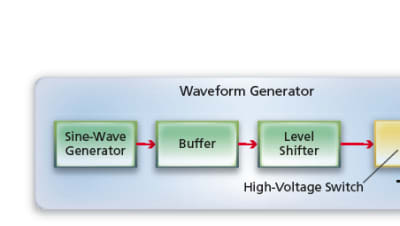
The shapes of waveforms generated by commercially available analytical separation devices, such as some types of mass spectrometers and differential mobility spectrometers are, in general, inadequate...
Briefs: Electronics & Computers
Group-III Nitride Field Emitters
Field-emission devices (cold cathodes) having low electron affinities can be fabricated through lattice- mismatched epitaxial growth of nitrides of elements from group III of the periodic table. Field emission of electrons from solid surfaces is typically utilized in vacuum microelectronic devices, including some...
Briefs: Electronics & Computers
An improved broadband planar magic-T junction that incorporates microstrip/slotline transitions has been developed. In comparison with a prior broadband magic-T junction incorporating...

Briefs: Electronics & Computers
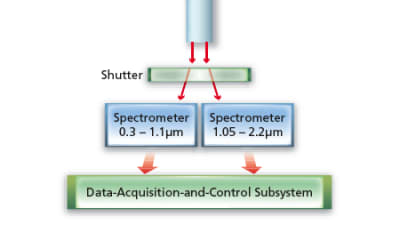
A system that comprises optical and electronic subsystems has been developed as an infrastructure for a spectroradiometer that measures time- dependent spectral radiance of the daylight sky,...
Briefs: Software
Toward Better Modeling of Supercritical Turbulent Mixing
A study was done as part of an effort to develop computational models representing turbulent mixing under thermodynamic supercritical (here, high pressure) conditions. The question was whether the large-eddy simulation (LES) approach, developed previously for atmospheric-pressure...
Briefs: Information Technology
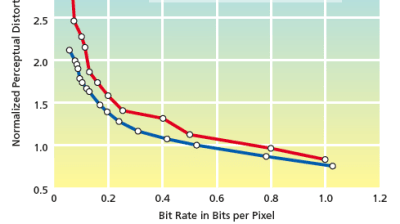
An alternative approach has been devised for encoding image data in compliance with JPEG 2000, the most recent still-image data- compression standard of the Joint Photographic Experts Group....
Briefs: Information Technology
An intelligent integrated health management system (IIHMS) incorporates major improvements over prior such systems. The particular IIHMS is implemented for any system defined as a...

Briefs: Aerospace
Delay Banking for Managing Air Traffic
Delay banking has been invented to enhance air-traffic management in a way that would increase the degree of fairness in assigning arrival, departure, and en-route delays and trajectory deviations to aircraft impacted by congestion in the national airspace system. In delay banking, an aircraft operator...
Briefs: Information Technology
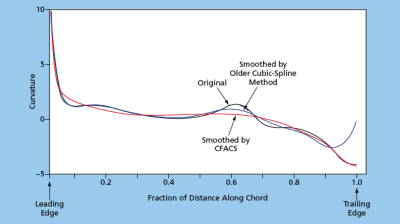
Constrained fitting for airfoil curvature smoothing (CFACS) is a spline-based method of interpolating airfoil surface coordinates (and, concomitantly, airfoil thicknesses) between specified discrete...
Briefs: Test & Measurement
Reducing Spaceborne-Doppler-Radar Rainfall-Velocity Error
A combined frequency- time (CFT) spectral moment estimation technique has been devised for calculating rainfall velocity from measurement data acquired by a nadir-looking spaceborne Doppler weather radar system. Prior spectral moment estimation techniques used for this purpose are based...
Briefs: Software
The propagation of shear (S) and compression (P) waves within the Earth represents a critically important phenomenon for geologists. For many years, geologists have developed...

Briefs: Software
Increasing the temperature at which jet aircraft engines operate would significantly improve thrust and fuel efficiency with reduced emissions. However, current engines operate...

Briefs: Software
Keuka Studios designs and manufactures custom architectural iron work and cable railings for commercial and home use. Keuka Studios first designs a product in CAD, CNC machines it to shape, and then...
Briefs: Manufacturing & Prototyping
Displaying CFD Solution Parameters on Arbitrary Cut Planes
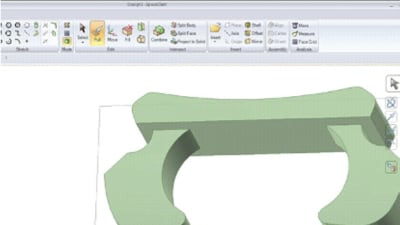
USMC6 is a Fortran 90 computer program for post-processing in support of visualization of flows simulated by computational fluid dynamics (CFD). The name "USMC6" is partly an abbreviation of "TetrUSS — USM3D Solution Cutter," reflecting its origin as a post-processor for use with USM3D...
Briefs: Software
Flow Solver for Incompressible 2-D Drive Cavity
This software solves the Navier- Stokes equations for the incompressible driven cavity flow problem. The code uses second-order finite differencing on a staggered grid using the Chorin projection method. The resulting intermediate Poisson equation is efficiently solved using the fast Fourier...
Briefs: Software
Flow Solver for Incompressible Rectangular Domains
This is an extension of the Flow Solver for Incompressible 2-D Drive Cavity software described in the preceding article. It solves the Navier- Stokes equations for incompressible flow using finite differencing on a uniform, staggered grid. There is a runtime choice of either central differencing or...
Briefs: Software
Simulating Avionics Upgrades to the Space Shuttles
Cockpit Avionics Prototyping Environment (CAPE) is a computer program that simulates the functions of proposed upgraded avionics for a space shuttle. In CAPE, pre-existing space-shuttle-simulation programs are merged with a commercial-off-the-shelf (COTS) display-development program, yielding a...
Briefs: Software
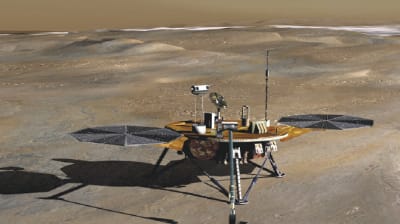
A computer program called "phxlrsim" simulates the behavior of the radar system used as an altimeter and velocimeter during the entry, descent, and landing phases of the Phoenix lander spacecraft....
Top Stories
 Blog: Lighting

A Stretchable OLED that Can Maintain Most of Its Luminescence
 Blog: Energy

Batteries that Can Withstand the Cold
 INSIDER: Energy

Advancing All-Solid-State Batteries
 Blog: Power

My Opinion: We Need More Power Soon — Is Nuclear the Answer?
 Quiz: Power

 Blog: Data Acquisition

Webcasts
 Upcoming Webinars: Test & Measurement

From Spreadsheets to Insights: Fast Data Analysis Without Complex...
 Upcoming Webinars: Defense

Cooling a New Generation of Aerospace and Defense Embedded...
 Upcoming Webinars: AR/AI

Beyond AI-Copy-Paste Engineering: Advanced AI-Integration Success...
 Upcoming Webinars: Automotive

Battery Abuse Testing: Pushing to Failure
 Upcoming Webinars: Connectivity

A FREE Two-Day Event Dedicated to Connected Mobility
 Upcoming Webinars: RF & Microwave Electronics

Choosing the Right N-Port Strategy: Multiport VNAs vs. Switch...