36,38
-1
270
30
Briefs: Energy
An Electric Vehicle Battery for All Seasons
Many EV owners worry about how effective their battery will be in very cold weather. To address that problem, a team of scientists developed a fluorine-containing electrolyte that performs well even in sub-zero temperatures.
Briefs: Photonics/Optics
A team at Delft University of Technology has built a new technology on a microchip by combining two Nobel Prize-winning techniques for the first time. This microchip could measure distances in materials at high precision — e.g., underwater or for medical imaging.

Briefs: Manufacturing & Prototyping
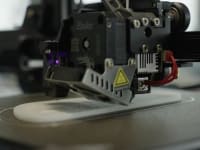
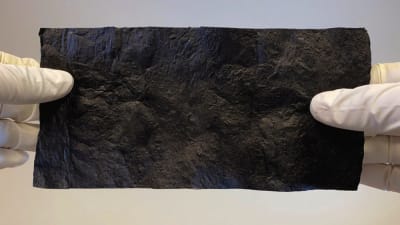
Researchers in the Lyding Group at the University of Illinois Urbana-Champaign have discovered an efficient, sustainable method for 3D-printing single-walled carbon nanotube films, a versatile, durable material that can transform how we explore space, engineer aircraft, and wear electronic technology.
Briefs: Energy
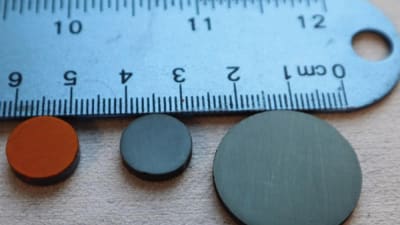
A Penn State-led team of researchers have created a new process to fabricate large perovskite devices that is more cost- and time-effective than previously possible — and may accelerate future materials discovery.
Briefs: Photonics/Optics
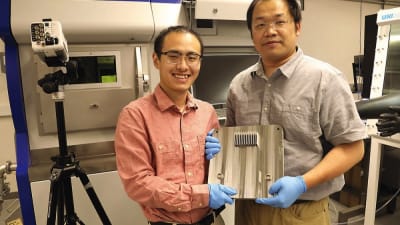
A research team has made new discoveries that can expand additive manufacturing in industries that rely on strong metal parts, including aerospace.
Briefs: Manufacturing & Prototyping
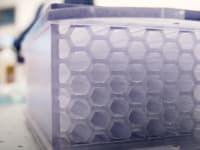
Researchers have created a new technology to assemble matter in 3D. Their concept uses multiple acoustic holograms to generate pressure fields with which solid particles, gel beads, and even biological cells can be printed.

Briefs: Green Design & Manufacturing
A team of researchers is using aluminum foil to create batteries with higher energy density and greater stability. The team’s new battery system could enable EVs to run longer on a single charge and would be cheaper to manufacture – all while having a positive impact on the environment.

Briefs: Materials
Scientists at Rice University’s George R. Brown School of Engineering have developed a readily scalable method to optimize prelithiation, a process that helps mitigate lithium loss and improves battery life cycles by coating silicon anodes with stabilized lithium metal particles.

Briefs: Robotics, Automation & Control
Grasping objects is a problem that is easy for a human, but challenging for a robot. Researchers designed a soft, 3D-printed robotic hand that cannot independently move its fingers but can still carry out a range of complex movements.

Briefs: Robotics, Automation & Control
Looking to give robots a more nimble, human-like touch, MIT engineers have now developed a gripper that grasps by reflex. Rather than start from scratch after a failed attempt, the robot adapts in the moment.

Briefs: Packaging & Sterilization
Next-generation sutures can deliver drugs, prevent infections, and monitor wounds.
Briefs: AR/AI
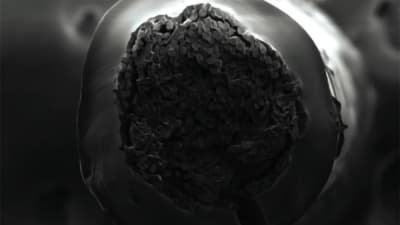
A new smart material is activated by both heat and electricity, making it the first ever to respond to two different stimuli. The work paves the way for a wide variety of potential applications, including clothing that warms up while you walk.

Briefs: Materials
Bending 2D Nanomaterial Could Benefit Future Technologies
Rice University’s Boris Yakobson and collaborators uncovered a property of ferroelectric 2D materials that could be exploited as a feature in future devices.
Briefs: Materials
There’s still more to explore with REFLEX, but this process could open new possibilities for new materials and microstructures across fields from electronics to optics to biomedical engineering.

Briefs: Materials
An international team of scientists is developing an inkable nanomaterial that they say could one day become a spray-on electronic component for ultra-thin, lightweight, and bendable displays and devices.

Briefs: Robotics, Automation & Control
Researchers have demonstrated a caterpillar-like soft robot that can move forward, backward, and even dip under narrow spaces. Its movement is driven by a novel pattern of silver nanowires.

Briefs: Lighting
A wavelength of visible light is about 1,000 times larger than an electron, so the way the two affect each other is limited by that disparity. Now, researchers have come up with a way to make...

Briefs: Photonics/Optics
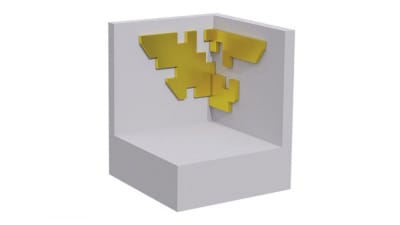
3D nanometer-scale metamaterial structures hold promise for advanced optical isolators.
Briefs: Materials
Researchers have employed a novel technique to investigate and modulate electric double layer dynamics at the solid/solid electrolyte interface.

Briefs: Energy
Researchers at Texas A&M University have discovered a 1,000 percent difference in the storage capacity of metal-free, water-based battery electrodes.

Briefs: Power
TU Wien has developed an oxygen-ion battery that has some important advantages. Although it does not allow for quite as high energy densities as the Li-ion battery, its storage capacity does not decrease irrevocably over time.

Briefs: Materials
Researchers at Lawrence Berkeley National Laboratory (Berkeley Lab) have developed a conductive polymer coating – called HOS-PFM – that could enable longer lasting, more powerful lithium-ion batteries for electric vehicles.

Briefs: Mechanical & Fluid Systems
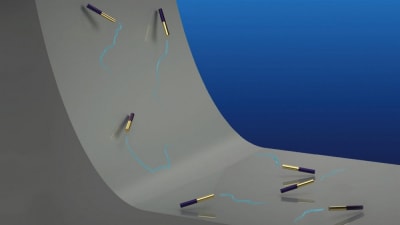
The tiny motors mimic how rock climbers navigate inclines.
Briefs: Mechanical & Fluid Systems
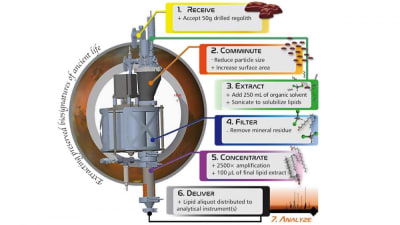
NASA Ames Research Center has developed a novel technology that provides an autonomous, miniaturized fluidic system for lipid analysis.
Briefs: Test & Measurement
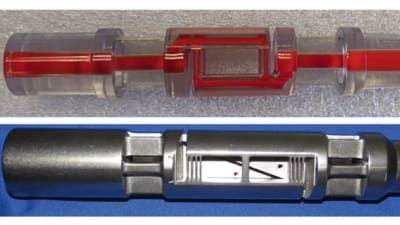
To enable key aerospace R&D applications, NASA’s Langley Research Center has developed a single-piece flow-through transducer design capable of measuring all six components adding in the Axial force measurement.
Briefs: Materials
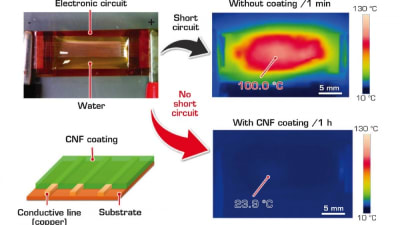
The cellulose nanofiber coating counters bending damage and retains electrode function under water.
Briefs: Power
A research team at Hokkaido University has developed the first solid-state electrochemical thermal transistor. It's more stable than, and just as effective as, current liquid-state thermal transistors.

Briefs: Materials
Magnets generate invisible fields that attract certain materials. Far more important to our everyday lives, magnets also can store data in computers. Exploiting the direction of the magnetic field, microscopic bar magnets each can store one bit of memory as a zero or a one — the language of computers.

Briefs: Materials
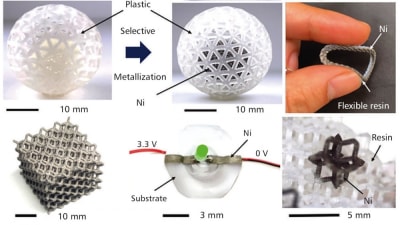
Researchers from Japan and Singapore have developed a new 3D-printing process for the fabrication of 3D metal–plastic composite structures with complex shapes.
Top Stories
 Blog: Lighting

A Stretchable OLED that Can Maintain Most of Its Luminescence
 Blog: Energy

Batteries that Can Withstand the Cold
 INSIDER: Energy

Advancing All-Solid-State Batteries
 Quiz: Energy

 Blog: Physical Sciences

 Blog: Materials

Webcasts
 Upcoming Webinars: Test & Measurement

From Spreadsheets to Insights: Fast Data Analysis Without Complex...
 Upcoming Webinars: Electronics & Computers

Cooling a New Generation of Aerospace and Defense Embedded...
 Upcoming Webinars: Test & Measurement

Beyond AI-Copy-Paste Engineering: Advanced AI-Integration Success...
 Upcoming Webinars: Automotive

Battery Abuse Testing: Pushing to Failure
 Upcoming Webinars: Internet of Things

A FREE Two-Day Event Dedicated to Connected Mobility
 Upcoming Webinars: Test & Measurement

Choosing the Right N-Port Strategy: Multiport VNAs vs. Switch...