36,38
-1
150
30
Briefs: Semiconductors & ICs
A research team from Kyushu University, in collaboration with Japanese company Nitto Denko, has developed a tape that can be used to stick 2D materials to many different surfaces, in an easy and user-friendly way.

Briefs: Electronics & Computers
Innovators have developed a method and apparatus to multiplex Radio Frequency Identification (RFID) signals efficiently. The resulting Hyper-Distributed RFID Antenna (HYDRA) system enhances distribution of the RFID reader signal, providing improved coverage for large areas as well as for small, fixed regions requiring a high density of reader antennas.

Briefs: Sensors/Data Acquisition
Because it requires no battery that must be recharged or replaced, and because it requires no special wiring, such a sensor could be embedded in a hard-to-reach place, like inside the inner workings of a ship’s engine. There, it could automatically gather data on the machine’s power consumption and operations for long periods of time.

Briefs: Energy
Researchers have found ways to develop soft OECTs for wearable pressure sensors. They first experimented with a solid type of gating substance: a charged, gelatinous substance called an ionic hydrogel. Read on to learn more.
Briefs: Electronics & Computers
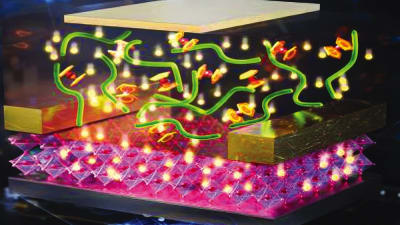
Microelectronics face a key challenge because of their small size. To avoid overheating, microelectronics need to consume only a fraction of the electricity of conventional electronics while still operating at peak performance. Researchers have achieved a breakthrough that could allow for a new kind of microelectronic material to do just that.
Briefs: Electronics & Computers
Modern PLC+HMI platforms have overcome weaknesses of older devices and now provide a top-performing and space-optimized option for designers to implement control and visualization for a variety of diverse applications.

Briefs: Manufacturing & Prototyping
The improved method for fabricating battery electrodes may lead to high-performance batteries that would enable more energy-efficient EVs, as well as such benefits as enhancing power grid storage, according to Hongtao Sun, Assistant Professor of Industrial and Manufacturing Engineering at Penn State.

Briefs: Green Design & Manufacturing
Researchers at the Department of Energy’s Oak Ridge National Laboratory have improved on approaches that dissolve a battery in a liquid solution in order to reduce the amount of hazardous chemicals used in the process.

Briefs: Medical
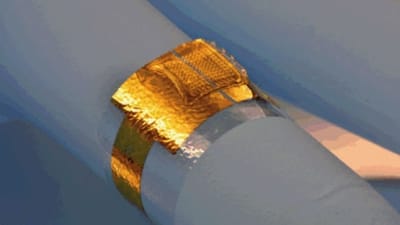
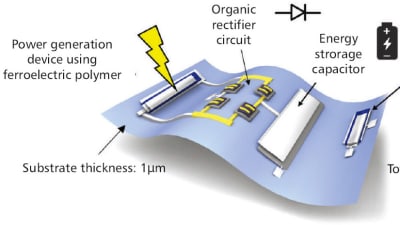
An international team of researchers from Japan and Austria has invented new ultraflexible patches with a ferroelectric polymer that can not only sense a patient’s pulse and blood pressure, but also power themselves from normal movements. The key was starting with a substrate just 1-μm thick.
Briefs: Power
Modine Targets Off-Highway EVs with ‘Plug-and-Play’ BTMS
Deutronic is not alone in developing and integrating thermal-management solutions to meet the specific demands of off-highway EVs. Modine, for example, in 2023 launched a new edition of its EVantage battery thermal-management system with a liquid-cooled condenser (L-CON BTMS). Read on to learn more.
Briefs: Photonics/Optics
A new approach has allowed researchers at Aalto University to design a kind of metamaterial that has so far been beyond the reach of existing technologies. Unlike natural materials, metamaterials and metasurfaces can be tailored to have specific electromagnetic properties, which means scientists can create materials with features desirable for industrial applications.
Briefs: Lighting Technology
Glow Sticks: From Parties to Detecting Biothreats for the Navy
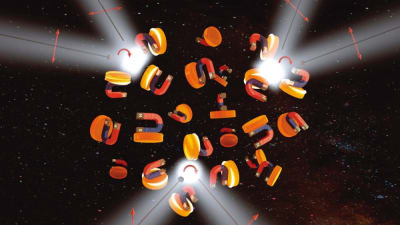
Remember that party where you were swinging glow sticks above your head or wearing them as necklaces? Fun times, right? Science times, too. Turns out those fun party favors are now being used by a University of Houston researcher to identify emerging biothreats for the United States...
Briefs: Materials
Diamond Maker Technology Simulates Alien Geology in Laboratories
Innovators at NASA Johnson Space Center have developed a novel, double capsule control system that allows for high temperature and high-pressure geologic research to be performed in a contained environment relevant to a broad array of materials.
Briefs: Manufacturing & Prototyping
The advance, detailed in a paper published recently in the journal Physica Scripta, could enable more efficient compact fusion reactors that are easier to repair and maintain.

Briefs: Electronics & Computers
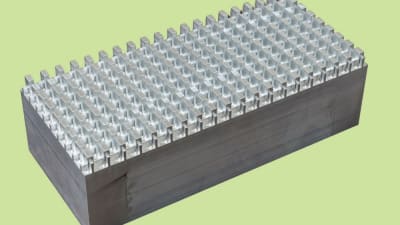
A team of scientists has successfully created a new synthetic metamaterial with 4D capabilities, including the ability to control energy waves on the surface of a solid material. These waves, called mechanical surface waves, are fundamental to how vibrations travel along the surface of solid materials.
Briefs: Manufacturing & Prototyping
To aid the development of gel-like materials, MIT and Harvard University researchers have created a set of computational models to predict the material’s structure and mechanical properties, as well as functional performance outcomes.

Briefs: Manufacturing & Prototyping
A durable, copper-based coating developed by a team at Dartmouth University can be integrated into fabric to create responsive, reusable materials such as protective equipment, environmental sensors, and smart filters.

Briefs: Materials
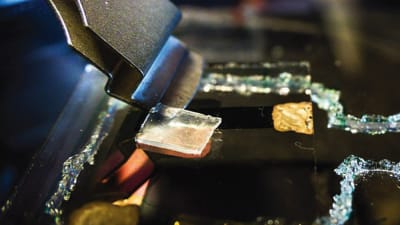
Researchers have developed a sensor that, similar to human skin, can sense temperature variation that originates from the touch of a warm object as well as the heat from solar radiation. The sensor combines pyroelectric and thermoelectric effects with a nano-optical phenomenon.
Briefs: Sensors/Data Acquisition
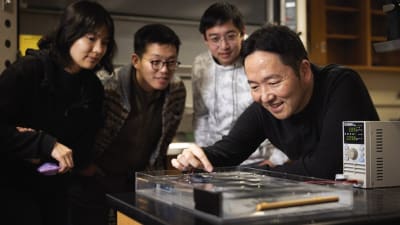
In a new study, engineers from Korea and the United States have developed a wearable, stretchy patch that could help to bridge the divide between people and machines — and with benefits for the health of humans around the world. In lab experiments, the researchers showed that humans could use these devices to operate robotic exoskeletons more efficiently.

Briefs: Medical
NASA’s Johnson Space Center is offering an innovative freeze-resistant hydration system for licensing. The technology substantially improves on existing hydration systems because it prevents water from freezing in the tubing, container, and mouthpiece, even in the harshest conditions on Earth.

Briefs: Materials
Researchers at the U.S. Department of Energy’s (DOE) Brookhaven National Laboratory and Columbia University have developed a way to convert carbon dioxide (CO2), a potent greenhouse gas, into carbon nanofibers, materials with a wide range of unique properties and many potential long-term uses.

Briefs: Materials
The atom-by-atom approach to MOF design enabled by AI will allow scientists to have what Argonne Senior Scientist and Data Science and Learning Division Director Ian Foster called a “wider lens” on these kinds of porous structures.

Briefs: Materials
A research paper by scientists at the University of Coimbra proposed a soft robotic hand comprising soft actuator cores and an exoskeleton, featuring a multimaterial design aided by finite element analysis to define the hand geometry and promote finger’s bendability.

Briefs: Energy
When it comes to making batteries that last longer, a team of researchers including engineers at Brown University and Idaho National Laboratory believes the key might be in how things get clean — specifically how soap works in this process.

Briefs: Materials
Many electric vehicles are powered by batteries that contain cobalt — a metal that carries high financial, environmental, and social costs. MIT researchers have now designed a battery material that could offer a more sustainable way to power electric cars. The new lithium-ion (Li-ion) battery includes a cathode based on organic materials, instead of cobalt or nickel (another metal often used in Li-ion batteries).

Briefs: Energy
Researchers at the U.S. Department of Energy’s Argonne National Laboratory have invented and patented a new cathode material that replaces lithium ions with sodium and would be significantly cheaper.

Briefs: Energy
New Solid-State Battery Design Charges in Minutes
Researchers from the Harvard John A. Paulson School of Engineering and Applied Sciences have developed a new lithium metal battery that can be charged and discharged at least 6,000 times — more than any other pouch battery cell — and can be recharged in a matter of minutes.
Briefs: Green Design & Manufacturing
Inspired by a small and slow snail, scientists have developed a robot prototype that may one day scoop up microplastics from the surfaces of oceans, seas, and lakes.
Briefs: Robotics, Automation & Control
Robots and cameras of the future could be made of liquid crystals, thanks to a new discovery that significantly expands the potential of the chemicals already common in computer displays and digital watches. The findings are a simple and inexpensive way to manipulate the molecular properties of liquid crystals with light exposure.

Top Stories
 Blog: Lighting

A Stretchable OLED that Can Maintain Most of Its Luminescence
 Blog: Energy

Batteries that Can Withstand the Cold
 INSIDER: Energy

Advancing All-Solid-State Batteries
 Quiz: Energy

 Blog: Physical Sciences

 Blog: Materials

Webcasts
 Upcoming Webinars: Test & Measurement

From Spreadsheets to Insights: Fast Data Analysis Without Complex...
 Upcoming Webinars: Electronics & Computers

Cooling a New Generation of Aerospace and Defense Embedded...
 Upcoming Webinars: Test & Measurement

Beyond AI-Copy-Paste Engineering: Advanced AI-Integration Success...
 Upcoming Webinars: Automotive

Battery Abuse Testing: Pushing to Failure
 Upcoming Webinars: Internet of Things

A FREE Two-Day Event Dedicated to Connected Mobility
 Upcoming Webinars: Test & Measurement

Choosing the Right N-Port Strategy: Multiport VNAs vs. Switch...