36,38
-1
450
30
Briefs: Materials
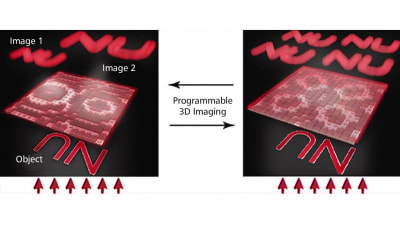
Researchers have developed tiny optical elements from metal nanoparticles and a polymer that could replace traditional refractive lenses to realize portable imaging systems and...
Briefs: Energy
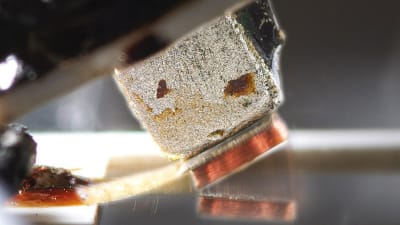
Researchers have developed technology to produce next-generation composite glass for lighting LEDs and smartphone, television, and computer screens. The technology was a step forward in perovskite...

Briefs: Photonics/Optics
Optical limiting — a manner of telecom switching without the use of electronics — is an all-optical method that could improve the speed and capacity of Internet communications. A...

Briefs: Transportation
A new composition of germanosili-cate glass created by adding zinc oxide has properties good for lens applications. The new family of zinc germanosilicate glass has a high refractive index comparable to...

Briefs: Power
Decreasing Anode Corrosion in Metal-Air Batteries
Metal-air batteries can be used in a variety of applications ranging from range extenders for electric vehicles to emergency power systems. Metal-sea-water batteries are primarily used for underwater applications ranging from torpedoes to underwater unmanned vehicles. A team of researchers at the...
Briefs: Power
Wearable electronic components incorporated directly into fabrics have been developed that could be used for flexible circuits, healthcare monitoring, energy conversion, and other applications. Graphene...

Briefs: Energy
Many technical processes only use part of the energy consumed. The remaining fraction leaves the system in the form of waste heat. Frequently, this heat is released into the...
Briefs: Materials
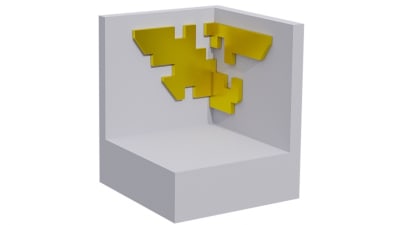
3D nanometer-scale metamaterial structures hold promise for advanced optical isolators.
Briefs: Sensors/Data Acquisition
These materials can detect when they are damaged, take the necessary steps to temporarily heal themselves, and then resume work.

Briefs: Motion Control
A new study challenges the conventional approach to designing soft robotics and metamaterials by utilizing the power of computer algorithms.

Briefs: Energy
A hybrid method enables 3D printing of self-powered wearable devices.

Briefs: Materials
Metamaterials that manipulate microwave energy can be fabricated using low-cost inkjet printing.

Briefs: Electronics & Computers
This method prints 3D structures made of metal and plastic, paving the way for 3D electronics.

Briefs: Manufacturing & Prototyping
This method fabricates 3D nanostructures for electronics, manufacturing, and healthcare.

Briefs: Manufacturing & Prototyping
Surgeons can use the heart model as a tool for planning and practice.

Briefs: Manufacturing & Prototyping
Making one kilometer of a two-lane road would use up about three million masks.

Briefs: Manufacturing & Prototyping
The battery is smaller than a traditional lithium-ion battery due to the elimination of dendrites.

Briefs: Manufacturing & Prototyping
The material enables lithium-ion batteries to be safely recharged within minutes for thousands of cycles.
Briefs: Energy
The flexible, washable microgrid uses the human body to sustainably power small electronics.

Briefs: Semiconductors & ICs
The material improves connectivity while maintaining recyclability and low cost.

Briefs: Sensors/Data Acquisition
A reversible polymer changes color when it senses a material is about to fail.

Briefs: Sensors/Data Acquisition
The Slinky-like sensor survives washing machines, cars, and hammers.

Briefs: Wearables
The device ultimately should be able to provide accurate signals from a person who is walking, running, or climbing stairs.

Briefs: Nanotechnology
Applications include detection of chemical and biological agents as well as dangerous gases from vehicle emissions.

Briefs: Photonics/Optics
3D micro-printing was used to develop this small, flexible scope for looking inside blood vessels.

Briefs: Materials
By electrically stimulating nerves, this therapy can reduce epileptic seizures and soothe chronic pain without the use of conventional drugs like opioids.

Briefs: Sensors/Data Acquisition
Potential applications for a graphene atomic-level sensor include detecting COVID, ALS, and cancer.

Briefs: Medical
The device combines with body power to treat tendon disease and damage, and sports injuries.

Briefs: Imaging
The advance could accelerate engineers’ design process by eliminating the need to solve complex equations.

Top Stories
 Blog: Lighting

A Stretchable OLED that Can Maintain Most of Its Luminescence
 Blog: Energy

Batteries that Can Withstand the Cold
 INSIDER: Energy

Advancing All-Solid-State Batteries
 Quiz: Energy

 Blog: Physical Sciences

 Blog: Materials

Webcasts
 Upcoming Webinars: Test & Measurement

From Spreadsheets to Insights: Fast Data Analysis Without Complex...
 Upcoming Webinars: Electronics & Computers

Cooling a New Generation of Aerospace and Defense Embedded...
 Upcoming Webinars: Test & Measurement

Beyond AI-Copy-Paste Engineering: Advanced AI-Integration Success...
 Upcoming Webinars: Automotive

Battery Abuse Testing: Pushing to Failure
 Upcoming Webinars: Internet of Things

A FREE Two-Day Event Dedicated to Connected Mobility
 Upcoming Webinars: Test & Measurement

Choosing the Right N-Port Strategy: Multiport VNAs vs. Switch...