39,49,73
-1
840
30
Briefs: Mechanical & Fluid Systems
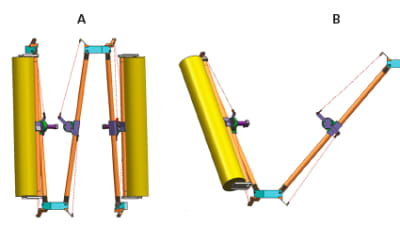
Solar sail technology depends heavily on the total surface area of the sail. In other words, minimizing mass and volume of its support structure is the main objective, particularly...
Briefs: Mechanical & Fluid Systems
Cantera Integration with T-MATS
The Toolbox for the Modeling and Analysis of Thermodynamic Systems (TMATS) software package is a library of building blocks that can be assembled to represent any thermodynamic system in the Simulink® (MathWorks, Inc.) environment. These elements, along with a Newton Raphson solver (also provided as part of the...
Briefs: Mechanical & Fluid Systems
Rocket Sled Parachute Design Verification
Historically, parachutes have been load-tested by various methods including release from an aircraft, deploying in a wind tunnel, dragging through water, and shooting out of an air cannon. Each type of testing has its own advantages and drawbacks. Due to the loading mechanics particular to parachutes...
Briefs: Aerospace
Reynolds-Averaged Navier-Stokes Integration for Shock Noise (RISN)
Reynolds-averaged Navier-Stokes (RANS) Integration for Shock- Noise (RISN) is a computer program that evaluates acoustic analogies to predict jet noise. Jet noise is due to turbulence from the chaotic flow within the exhaust of a rocket or air-breathing jet engine. The source of jet...
Briefs: Propulsion
Regeneratively Cooled Porous Media Jacket
A non-toxic nitrous oxide fuel blend (NOFB) monopropellant with a high adiabatic flame temperature reaching and probably exceeding 3,450 K and a very high thermal decomposition limit (>390 °C) is under development. To design an optimal rocket engine that can handle the high adiabatic temperature during...
Briefs: Propulsion
Multi-Pulse Motor (MPM) Designed for Use with Electric Solid Propellants
The multi-pulse motor is a solid-propellant rocket motor that is able to produce a number of pulses for various thrust levels (5 to 30 pulses and thrusts between 0.25 and 1.5 N, depending on electric power delivery system) and can be turned on and off through the application...
Briefs: Propulsion
Adaptive Augmenting Control
Adaptive augmenting control (AAC) is a forward gain, multiplicative adaptive algorithm for launch vehicle flight control that meets three summary-level design objectives: Do no harm — return to baseline control design when not needed; respond to errors in the ability of the vehicle to track commands to increase...
Briefs: Mechanical & Fluid Systems
NEO Hunter Seeker Micro-Spacecraft and Mission Concept
The area of research known as “Planetary Defense” is largely concerned with identifying and tracking asteroids that could impact Earth. The vast majority of asteroids that pose such a risk are known as “Near Earth Asteroids/Objects” or NEAs and NEOs. Some of them are unknown,...
Briefs: Mechanical & Fluid Systems
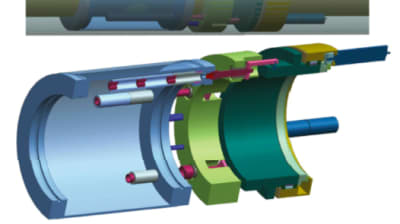
Multipath, multistage, erosion-resistant flow control valves have been developed that can sustain the extremely high pressure of deep oil wells. Fitting in the restricted...
Briefs: Mechanical & Fluid Systems
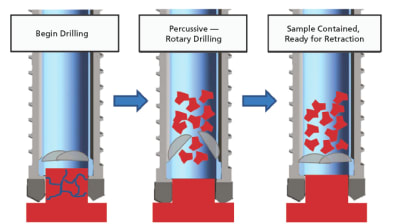
The current coring bit and percussive drilling style works very well for strong rocks; however, when coring into weak, crumbling rock, the core tends to break apart and simply fall...
Briefs: Mechanical & Fluid Systems
Piezoelectric-Actuated Cryogenic Thermodynamic Vent Valve
Cryogenic fluid control valves require actuation that controls the geometric position of the orifice in a thermally stable manner. Traditional actuator devices may have various materials used in their construction that have varying CTEs (coefficients of thermal expansion) and therefore may...
Briefs: Mechanical & Fluid Systems
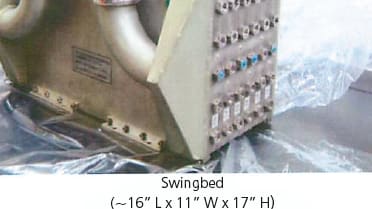
The amine swingbed was in development for incorporation into Orion’s environmental control and life support system to remove metabolic carbon dioxide and humidity from the crew atmosphere. The compact, low-power...
Briefs: Mechanical & Fluid Systems
Decelerator System Simulation (DSS)
The Crew Exploration Vehicle Parachute Assembly System (CPAS) project conducts computer simulations to verify that requirements on flight performance, parachute loads, and terminal rate of descent are met. The objective of this work was to obtain a high-fidelity simulation of Orion crew capsule flight test...
Briefs: Mechanical & Fluid Systems
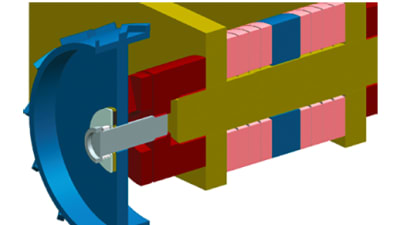
A novel, miniature, low-mass vehicle has been created that is driven by piezoelectric stacks and a resonance structure. Preliminary tests on similar mechanisms that are used to transmit...
Briefs: Mechanical & Fluid Systems
The probe and its mounting fixture are critical parts of the health monitoring of steam pipes. A high-temperature, piezoelectric transducer generates and receives ultrasonic waves,...

Briefs: Mechanical & Fluid Systems
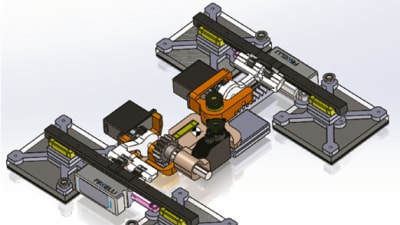
Inspection of the International Space Station and other manmade objects in space is difficult because of the microgravity environment. Robots are a promising approach...
Briefs: Mechanical & Fluid Systems
During any winding or unwinding action, a tether may experience unexpected changes in tension. For example, the load being wound could become stuck and stop moving,...

Briefs: Mechanical & Fluid Systems
Aluminum Gas Tungsten Arc Orbital Tube Welding
JPL has been hand-welding aluminum tubing for decades in support of flight programs and ground support equipment, including thermal plates and shrouds. This hand-welding process is time-consuming, cumbersome, difficult, and unreliable in terms of repeatability and success, which leads to leaks, rework,...
Briefs: Mechanical & Fluid Systems
Use of Eccentric Bushings to Precision-Locate Multiple Parts on a Large Mating Structure
Cups/cones are being used to provide a shear load transfer capability on a large separation interface that uses multiple discreet retention and release (R&R) devices (such as frangible nuts, separation nuts, separation bolts, etc.). To both provide good...
Briefs: Mechanical & Fluid Systems
There is a need for large mirrors that can be launched to various bodies in the solar system in a packed form and unfolded to provide the required dimensions. The solution to...

Briefs: Mechanical & Fluid Systems
Six-Degree-of-Freedom Control With Only Eight Thrusters
Typical spacecraft thruster configurations are often unable to provide full six-degree-of-freedom control and may have unwanted interaction between their attitude control and trajectory control functions, have undesirably high instantaneous electrical power demands, and use more thrusters than...
Briefs: Mechanical & Fluid Systems
Precise Direct Control of Pressure or Vacuum Using a Digitally Controlled Actuator
A closed/semi-open pressure or vacuum system uses an electric screw mechanical actuator that can be digitally controlled and monitored, and which receives feedback directly from an external or internal source. This innovation can adjust for media temperature changes,...
Briefs: Mechanical & Fluid Systems
Irreversible Entropy Production Rate in High-Pressure Turbulent Reactive Flows
To model high-pressure reactive flows, the most promising methodology is large eddy simulation (LES) in which one solves the large scales of the problem and models the small scales. There is currently no guidance as to the relative importance of small scales originating...
Briefs: Mechanical & Fluid Systems
Piezoelectric Actuator for a 2-inch Isolation Cryogenic Valve
This project is focused on the development of a high-force, high-speed piezoelectric actuator for control of a 2-inch (≈5-cm) isolation valve application in a cryogenic vacuum environment. The piezo motor actuators on the two cryogenic isolation valves were successfully tested at NASA...
Briefs: Mechanical & Fluid Systems
Torque Plug Actuator Design for Sample Return Sample Tubes
During the transportation of any sample material, it is important to ensure that no damage or contamination of the sample occurs while in transit. This concept is extremely important within the sample caching rover sample return architecture. Adequately sealing the sample tubes is important...
Briefs: Mechanical & Fluid Systems
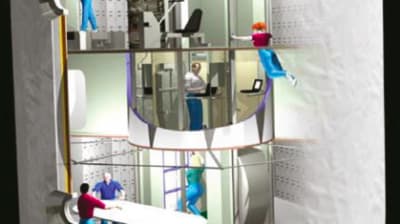
A method was developed that allows water recycling, air treatment, thermal control, and solid residuals treatment and recycle to be removed from the usable habitat volume...
Briefs: Mechanical & Fluid Systems
Novel Feedthrough for Instrumentation Lead Wires
This invention is a method and design for the conveyance of instrumentation lead wires from one pressure boundary to another pressure boundary in cryogenic process systems. Such a device or article is commonly referred to as a feedthrough. The novelty of the present invention is the extreme...
Briefs: Mechanical & Fluid Systems
Pneumatic Conveying of Lunar Regolith Simulant
Planetary regolith (dust) is an aggregation of various minerals and different particle sizes. Collection, storage, processing, and disposal of this material are very challenging in the harsh planetary environment. Extraterrestrial operations involving In-Situ Resource Utilization (ISRU) require...
Briefs: Mechanical & Fluid Systems
Researchers at NASA’s Armstrong Flight Research Center have developed an innovative antenna-mounting platform that addresses an unmet need in the unmanned...

Top Stories
 Blog: Lighting

A Stretchable OLED that Can Maintain Most of Its Luminescence
 Blog: Energy

Batteries that Can Withstand the Cold
 INSIDER: Energy

Advancing All-Solid-State Batteries
 Quiz: Energy

 Blog: Physical Sciences

 Blog: Materials

Webcasts
 Upcoming Webinars: Test & Measurement

From Spreadsheets to Insights: Fast Data Analysis Without Complex...
 Upcoming Webinars: Electronics & Computers

Cooling a New Generation of Aerospace and Defense Embedded...
 Upcoming Webinars: Test & Measurement

Beyond AI-Copy-Paste Engineering: Advanced AI-Integration Success...
 Upcoming Webinars: Automotive

Battery Abuse Testing: Pushing to Failure
 Upcoming Webinars: Internet of Things

A FREE Two-Day Event Dedicated to Connected Mobility
 Upcoming Webinars: Test & Measurement

Choosing the Right N-Port Strategy: Multiport VNAs vs. Switch...