
Stories
38
0
3030
30
Briefs: Materials
Fuel-Cell Electrolytes Based on Organosilica Hybrid Proton Conductors
A new membrane composite material that combines an organosilica proton conductor with perfluorinated Nafion material to achieve good proton conductivity and high-temperature performance for membranes used for fuel cells in stationary, transportation, and portable applications has...
Briefs: Materials
Efforts are underway to develop inexpensive, low-power electronic sensors, based on single-walled carbon nanotubes (SWCNTs), for measuring part-per-million and part-per-billion of selected...

Briefs: Materials
An alternative to the conventional approach to synthesis of polyimides involves the use of single monomers that are amenable to photopolymerization. Heretofore, the synthesis of polyimides has involved...

Briefs: Materials
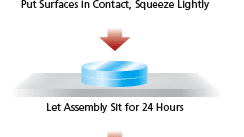
A process for hydroxide-assisted bonding has been developed as a means of joining optical components made of ultra-low-expansion (ULE) glass, while maintaining sufficiently precise...
Briefs: Materials
Optimized Carbonate and Ester-Based Li-Ion Electrolytes
To maintain high conductivity in low temperatures, electrolyte co-solvents have been designed to have a high dielectric constant, low viscosity, adequate coordination behavior, and appropriate liquid ranges and salt solubilities. Electrolytes that contain ester-based co-solvents in large...
Blog: Nanotechnology
Carbon Nanotube Interconnects
Nanotechnology has taken another significant step toward someday revolutionizing the computer industry. Researchers at Rensselaer Polytechnic Institute recently used Rensselaer’s Computational Center for Nanotechnology Innovations, the world’s most powerful university-based supercomputer, to measure the...
Briefs: Materials
LiCoPO4 has been found to be a promising active cathode material for high-energy-density, thin-film, rechargeable electrochemical power cells. The potential of the charge/discharge plateau of a...

Briefs: Materials
Work output is comparable to conventional SMA alloys but with transition temperatures significantly exceeding those of conventional materials.
Compositions and production processes have been...

Articles: Materials
Minimally Invasive Surgery (MIS) is a new class of surgical procedures in which the operation is performed with surgical instruments inserted through small incisions in the...

Briefs: Materials
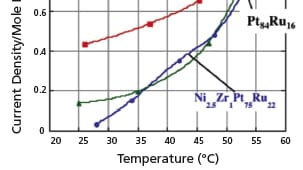
Combinatorial experiments have led to the discovery that a nanophase alloy of Pt, Ru, Ni, and Zr is effective as an anode catalyst material for direct methanol fuel cells. This...
Briefs: Materials
Atomization of a molten mixture of BaF2 and CaF2 has been found to be superior to crushing of bulk solid BaF2- CaF2 as a means of producing eutectic BaF2-CaF2 powder for use as an...

Briefs: Materials
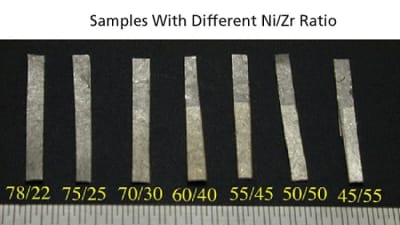
Nanophase nickel- zirconium alloys have been investigated for use as electrically conductive coatings and catalyst supports in fuel cells. Heretofore, noble metals have been used because they...
Briefs: Materials
Pellets made of a high-surface-area composite of silica and titania have shown promise as means of removing elemental mercury from flue gases. With further technical development...

Briefs: Materials
Lightweight Tanks for Storing Liquefied Natural Gas
Single-walled, jacketed aluminum tanks have been conceived for storing liquefied natural gas (LNG) in LNG-fueled motor vehicles. Heretofore, double- wall steel tanks with vacuum between the inner and outer walls have been used for storing LNG. In comparison with the vacuum-insulated steel tanks,...
Briefs: Materials
Hybrid Wound Filaments for Greater Resistance to Impacts
The immediately preceding article includes an example in which a composite overwrap on a pressure vessel contains wound filaments made of a hybrid of high-strength carbon fibers and poly(phenylene benzobisoxazole) [PBO] fibers. This hybrid material is chosen in an effort to increase the...
Briefs: Materials
Making High-Tensile-Strength Amalgam Components
Structural components made of amalgams can be made to have tensile strengths much greater than previously known to be possible. Amalgams, perhaps best known for their use in dental fillings, have several useful attributes, including room- temperature fabrication, corrosion resistance, dimensional...
Briefs: Materials
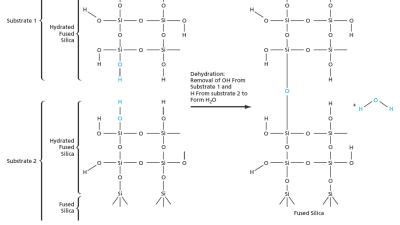
A simple, inexpensive method for bonding solid objects exploits hydroxidecatalyzed hydration and dehydration to form silicatelike networks in thin surface and interfacial layers between...
Blog: Power
Techs of the Week
A high-temperature ceramics-based composite exhibits superior heat and oxidation resistance and frictional properties. The material comprises a dense carbon-fiber-reinforced SiC-infiltrated composite or a dense SiC-infiltrated composite with granular carbon dispersed. It shows excellent machineability and frictional properties....
Blog: Sensors/Data Acquisition
Smog Chemical Detector
Scientists at the U.S. Department of Energy's Brookhaven National Laboratory have developed a tool to quantitatively measure elusive atmospheric chemicals that play a key role in forming photochemical smog. The device measures atmospheric hydroperoxyl radicals - short-lived, highly reactive intermediates involved in forming...
Briefs: Materials
CHEM-Based Self-Deploying Planetary Storage Tanks
A document proposes self-deploying storage tanks, based on the cold elastic hibernated memory (CHEM) concept, to be used on remote planets. The CHEM concept, described in previous NASA Tech Briefs articles, involves the use of open-cell shape-memory-polymer (SMP) foam sandwich structures to make...
Briefs: Materials
Sequestration of Single-Walled Carbon Nanotubes in a Polymer
Sequestration of single-walled carbon nanotubes (SWCNs) in a suitably chosen polymer is under investigation as a means of promoting the dissolution of the nanotubes into epoxies. The purpose of this investigation is to make it possible to utilize SWCNs as the reinforcing fibers in strong,...
Briefs: Materials
Foam Core Shielding for Spacecraft
A foam core shield (FCS) system is now being developed to supplant multilayer insulation (MLI) systems heretofore installed on spacecraft for thermal management and protection against meteoroid impacts. A typical FCS system consists of a core sandwiched between a face sheet and a back sheet. The core can consist...
Briefs: Materials
Modeling software is generally used to show the fields and flows that are impossible to see with the eye or instruments. A group of researchers has done just the opposite:...

Blog: Materials
Steel-Strength Plastic
University of Michigan researchers have created a composite plastic that's as strong as steel but lighter and transparent. The composite plastic is made of layers of clay nanosheets and a water-soluble, glue-like polymer. UM engineering professor Nicholas Kotov and others have solved a problem that has confounded engineers...
Blog: Semiconductors & ICs
Pushing Measurement to the Edge
Researchers from the National Institute of Standards and Technology (NIST), IBM, and the Massachusetts Institute of Technology, have pushed the measurement of thin films to the edge to produce the first data on how the edges of metallic thin films contribute to their magnetic properties. The results may impact the...
Blog: Materials
Small Strength
Researchers at Rensselaer Polytechnic Institute have developed a new technique for identifying and repairing small, potentially dangerous cracks in aircraft wings and other structures made from polymer composites. By infusing a polymer with electrically conductive carbon nanotubes, and then monitoring the structure's electrical...
Briefs: Materials
Strong, Lightweight, Porous Materials
A new class of strong, lightweight, porous materials has been invented as an outgrowth of an effort to develop reinforced silica aerogels. The new material, called X-Aerogel is less hygroscopic, but no less porous and of similar density to the corresponding unmodified aerogels. However, the property that sets...
Briefs: Materials
Nanowicks are dense mats of nanoscale fibers that are expected to enable the development of a variety of novel capillary pumps, filters, and fluidic control devices. Nanowicks make it possible obtain a variety of novel effects,...

Briefs: Materials
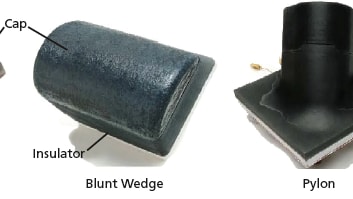
TUFROC (Toughened Uni-piece Fibrous Reinforced Oxidation- resistant Composite) has been developed as a new thermal protection system (TPS) material for wing leading edge and nose cap...
Top Stories
 Blog: Robotics, Automation & Control

Aerial Microrobots That Can Match a Bumblebee's Speed
 Blog: Electronics & Computers

Turning Edible Fungi into Organic Memristors
 Blog: Manufacturing & Prototyping

Revolutionizing the Production of Semiconductor Chips
 News: Energy

 INSIDER: Electronics & Computers

World’s Smallest Programmable, Autonomous Robots
 INSIDER: Manufacturing & Prototyping

Webcasts
 On-Demand Webinars: Power

E/E Architecture Redefined: Building Smarter, Safer, and Scalable Vehicles
 Upcoming Webinars: Energy

Hydrogen Engines Are Heating Up for Heavy Duty
 Upcoming Webinars: Electronics & Computers

Advantages of Smart Power Distribution Unit Design for Automotive...
 Upcoming Webinars: Automotive

Quiet, Please: NVH Improvement Opportunities in the Early Design...
 Upcoming Webinars: Power

A FREE Two-Day Event Dedicated to Connected Mobility
 Podcasts: Defense

How Sift's Unified Observability Platform Accelerates Drone Innovation