
Stories
38
0
2970
30
Blog: Semiconductors & ICs
Stretchable Electronics
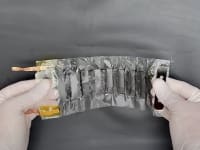
A design for bendable electronic devices produces parts that can be wrapped around complex shapes, without reducing electronic function. The technology is based on semiconductor nanomaterials that offer high stretchability and large twistability. Potential uses include electronic devices for eye cameras, smart surgical...
Techs for License: Materials
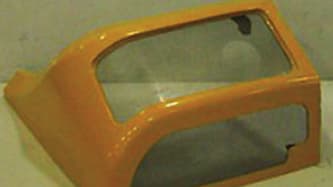
Tooless Engineered Composite (TEC) is a patent-pending process that incorporates the benefits of a thermoformed plastic composite product and the strength of fiberglass reinforcement. This...
Briefs: Materials
Gadolinia-doped ceria, or GDC, (Gd0.4Ce0.6O2–δ, where the value of δ in this material varies, depending on the temperature and oxygen concentration in the atmosphere in which it is...

Briefs: Unmanned Systems
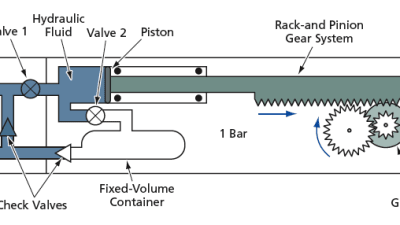
A proposed system for exploiting the ocean thermal gradient to generate power would be based on the thawing-expansion/ freezing-contraction behavior of a wax or perhaps another suitable phase-change...
Blog: Materials
Secrets of Superconductivity
Researchers at the National Institute of Standards and Technology (NIST) are decoding the mysterious mechanisms behind high-temperature superconductors that industry hopes will be used in next-generation systems for storing, distributing, and using electricity. At temperatures approaching absolute zero, many materials...
Briefs: Electronics & Computers
The crew activity analyzer (CAA) is a system of electronic hardware and software for automatically identifying patterns of group activity among crew members working together in an office, cockpit, workshop, laboratory, or...

Techs for License: Materials
Anti-Reflective Coating for Films
Able to withstand abrasion even with steel wool, these antireflective coating formulations for display applications offer high durability and reflectivity that ranges from 1.2% down to 0.5%. Reducing ambient light reflectance significantly improves image clarity on LCD and PDP displays and rearprojection...
Briefs: Materials
Oxide Fiber Cathode Materials for Rechargeable Lithium Cells
LiCoO2 and LiNiO2 fibers have been investigated as alternatives to LiCoO2 and LiNiO2 powders used as lithium-intercalation compounds in cathodes of rechargeable lithium-ion electrochemical cells. In making such a cathode, LiCoO2 or LiNiO2 powder is mixed with a binder [e.g.,...
Briefs: Materials
Electrocatalytic Reduction of Carbon Dioxide to Methane
A room-temperature electrocatalytic process that effects the overall chemical reaction CO2 + 2H2O → CH4 + 2O2 has been investigated as a means of removing carbon dioxide from air and restoring oxygen to the air. The process was originally intended for use in a spacecraft life-support system,...
Briefs: Materials
Progress Toward Making Epoxy/Carbon-Nanotube Composites
A modicum of progress has been made in an effort to exploit single-walled carbon nanotubes as fibers in epoxy-matrix/fiber composite materials. Two main obstacles to such use of carbon nanotubes are the following: (1) bare nanotubes are not soluble in epoxy resins and so they tend to...
Briefs: Materials
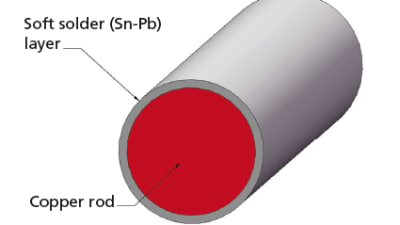
A heterogeneous material construction has been devised for sensing coils of super-conducting quantum interference device (SQUID) magnetometers that are subject to a combination of...
Briefs: Materials
Predicting Properties of Unidirectional-Nanofiber Composites
A theory for predicting mechanical, thermal, electrical, and other properties of unidirectional-nanofiber/matrix composite materials is based on the prior theory of micromechanics of composite materials. In the development of the present theory, the prior theory of micromechanics was...
Blog: Materials
Cold Steel for a Hot Application
Researchers at Oak Ridge National Laboratory and the U.S. ITER Project Office have developed a new cast stainless steel that is 70 percent stronger than comparable steel and is being evaluated for use in the huge shield modules required by the ITER fusion device. ITER is a multibillion-dollar international research...
Briefs: Materials
Improved crucibles consisting mainly of metal-reinforced ceramic ampules have been developed for use in experiments in which material specimens are heated in the crucibles to various high temperatures,...

Briefs: Materials
Adjustable Membrane Mirrors Incorporating G-Elastomers
Lightweight, flexible, large-aperture mirrors of a type being developed for use in outer space have unimorph structures that enable precise adjustment of their surface figures. A mirror of this type includes a reflective membrane layer bonded with an electrostrictive grafted elastomer...
Briefs: Materials
High-Temperature Crystal-Growth Cartridge Tubes Made by VPS
Cartridge tubes for use in a crystal-growth furnace at temperatures as high as 1,600°C have been fabricated by vacuum plasma spraying (VPS). These cartridges consist mainly of an alloy of 60 weight percent molybdenum with 40 weight percent rhenium, made from molybdenum powder coated...
Briefs: Materials
Hall-Effect Thruster Utilizing Bismuth as Propellant
A laboratory-model Hall-effect spacecraft thruster was developed that utilizes bismuth as the propellant. Xenon was used in most prior Hall-effect thrusters. Bismuth is an attractive alternative because it has a larger atomic mass, a larger electron- impact- ionization cross-section, and is...
Briefs: Materials
Applying an electric current to specially coated glass results in radiant heat energy. This process creates a transparent heating element with near- uniform surface temperatures. Manufacturing the...

Briefs: Materials
Method of Cross-Linking Aerogels Using a One-Pot Reaction Scheme
A document discusses a new, simplified method for cross-linking silica and other oxide aerogels, with a polymeric material to increase strength of such materials without adversely affecting porosity or low density. The usual process is long and arduous, requiring multiple washing and...
Blog: Photonics/Optics
Chemical Weapon Detecting Compound
A light-transmitting compound called (A)ZrPSe 6, where A can be potassium, rubidium, or cesium, has a difficult chemical structure that does not crystallize well. Scientists from the Argonne National Laboratory and Northwestern University were able to determine the structure of the compound using the uniquely...
Briefs: Materials
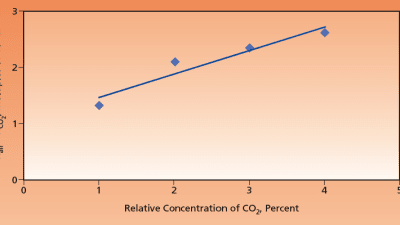
Nanocrystalline tin oxide (SnO2) doped with copper oxide (CuO) has been found to be useful as an electrical-resistance sensory material for measuring the concentration of carbon...
Briefs: Materials
Coating Reduces Ice Adhesion
The Shuttle Ice Liberation Coating (SILC) has been developed to reduce the adhesion of ice to surfaces on the space shuttle. SILC, when coated on a surface (foam, metal, epoxy primer, polymer surfaces), will reduce the adhesion of ice by as much as 90 percent as compared to the corresponding uncoated surface. This...
Briefs: Materials
This innovation blends the merits of multifoil insulation (MFI) with aerogel-based insulation to develop a highly versatile, ultra-low thermally conductive material called hybrid multifoil aerogel...

Blog: Physical Sciences
Nano 50 Awards at the NNEC
The sixth annual National Nanoengineering Conference returns to Boston this year on November 12-13 at the Boston Colonnade Hotel, featuring the fourth annual Nano 50 Awards, recognizing top 50 technologies, innovators, and products that have significantly impacted the development of nanotechnology.
This year's...
Briefs: Materials
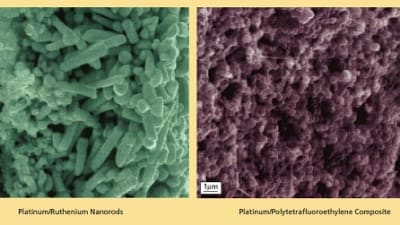
Nano-engineered catalysts, and a method of fabricating them, have been developed in a continuing effort to improve the performances of direct methanol fuel cells as candidate power...
Briefs: Materials
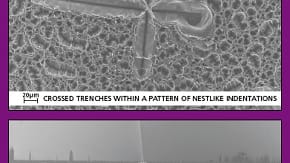
Capillography (from the Latin capillus, “hair”, and the Greek graphein, “to write”) is a recently conceived technique for forming mats of nanofibers into useful patterns. The concept was inspired by...
Briefs: Electronics & Computers
Group-III Nitride Field Emitters
Field-emission devices (cold cathodes) having low electron affinities can be fabricated through lattice- mismatched epitaxial growth of nitrides of elements from group III of the periodic table. Field emission of electrons from solid surfaces is typically utilized in vacuum microelectronic devices, including some...
Briefs: Test & Measurement
A method of making more-complex molecules from simpler ones has emerged as a by-product of an experimental study in outer-space atom/ surface collision physics. The...

Briefs: Materials
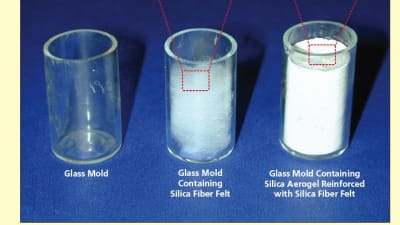
A family of aerogel-matrix composite materials having thermal-stability and mechanical-integrity properties better than those of neat aerogels has been developed. Aerogels are known to be excellent...
Top Stories
 Blog: Robotics, Automation & Control

Aerial Microrobots That Can Match a Bumblebee's Speed
 Blog: Electronics & Computers

Turning Edible Fungi into Organic Memristors
 Blog: Manufacturing & Prototyping

Revolutionizing the Production of Semiconductor Chips
 News: Energy

 INSIDER: Electronics & Computers

World’s Smallest Programmable, Autonomous Robots
 INSIDER: Manufacturing & Prototyping

Webcasts
 On-Demand Webinars: Power

E/E Architecture Redefined: Building Smarter, Safer, and Scalable Vehicles
 Upcoming Webinars: Energy

Hydrogen Engines Are Heating Up for Heavy Duty
 Upcoming Webinars: Electronics & Computers

Advantages of Smart Power Distribution Unit Design for Automotive...
 Upcoming Webinars: Automotive

Quiet, Please: NVH Improvement Opportunities in the Early Design...
 Upcoming Webinars: Power

A FREE Two-Day Event Dedicated to Connected Mobility
 Podcasts: Defense

How Sift's Unified Observability Platform Accelerates Drone Innovation