
Stories
38
0
570
30
Briefs: Energy
New Lithium-Ion Battery Cathode Offers Higher Stability
In a new study, a research team led by the University of California, Irvine, created and analyzed a material for a Li-ion cathode that uses no cobalt and is instead rich in nickel.
Briefs: Energy
An international research collaboration led by UCLA has developed a way to use perovskite in solar cells while protecting it from the conditions that cause it to deteriorate.

Briefs: Semiconductors & ICs
Researchers have developed a colloidal synthesis method for alkaline earth chalcogenides. This method allows them to control the size of the nanocrystals in the material.

Briefs: Materials
Drawing inspiration from how spiders spin silk to make webs, a team of researchers has developed an innovative method of producing soft fibers that possess three key properties (strong, stretchable, and electrically conductive), and at the same time can be easily reused to produce new fibers.
Briefs: Mechanical & Fluid Systems
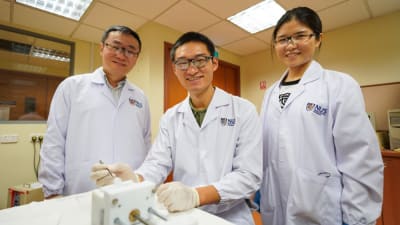
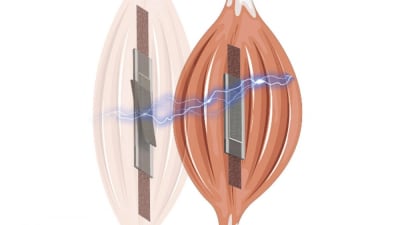
Taking inspiration from nature, a team of researchers at Queen Mary’s School of Engineering and Materials Science has successfully created an artificial muscle that seamlessly transitions between soft and hard states while also possessing the remarkable ability to sense forces and deformations.
Briefs: Energy
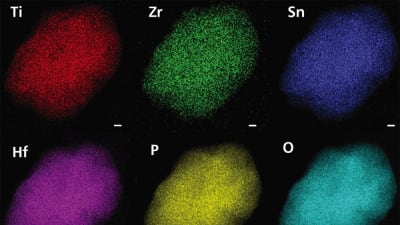
A team has designed a new blueprint for solid-state batteries that are less dependent on specific chemical elements, particularly critical metals that are challenging to source due to supply chain issues. Their work could advance solid-state batteries that are efficient and affordable.
Articles: Photonics/Optics
Efficient and complete chamber cleaning processes are critical for the success of CVD/ALD processes.

Briefs: Photonics/Optics
A team of researchers led by electrical engineer Marko Lončar at SEAS has developed a method for building a highly efficient integrated isolator that’s seamlessly incorporated into an optical chip made of lithium niobate.

Application Briefs: Materials
Given its effectiveness pretreating metal surfaces, industrial laser systems are increasingly being used in manufacturing facilities. The systems can be integrated into automated inline processing lines, or technicians can use mobile handheld units.

Briefs: Power
Two of humanity’s most ubiquitous historical materials, cement, and carbon black may form the basis for a novel, low-cost energy storage system, according to a new study by MIT researchers.

Briefs: Materials
A team Led by Worcester Polytechnic Institute (WPI) researcher Yan Wang has developed a solvent-free process to manufacture Li-ion battery electrodes that are greener, cheaper, and charge faster than electrodes currently on the market.
Briefs: Energy
A Calcium Rechargeable Battery with Long Cycle Life
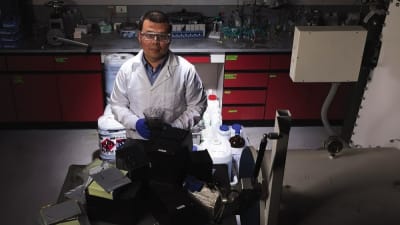
A research group has developed a prototype calcium (Ca) metal rechargeable battery capable of 500 cycles of repeated charge-discharge – the benchmark for practical use.
Briefs: Manufacturing & Prototyping
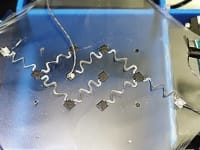
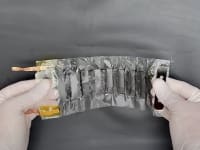
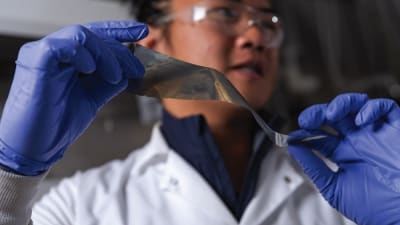
The future of wearable technology just got a big boost thanks to a team of University of Houston researchers who designed, developed, and delivered a successful prototype of a fully stretchable fabric-based lithium-ion (Li-ion) battery.

Briefs: Materials
Scientists at Rice University’s George R. Brown School of Engineering have developed a readily scalable method to optimize prelithiation, a process that helps mitigate lithium loss and improves battery life cycles by coating silicon anodes with stabilized lithium metal particles.

Briefs: Green Design & Manufacturing
A team of researchers is using aluminum foil to create batteries with higher energy density and greater stability. The team’s new battery system could enable EVs to run longer on a single charge and would be cheaper to manufacture – all while having a positive impact on the environment.
Articles: Energy
PFIB-SEM is a valuable technique that neatly complements other analytical and imaging methods, providing high-resolution 2D and 3D information for larger areas, as compared to traditional gallium FIB-SEM.

Blog: Materials
A new potential path toward greener ways to make chemicals: By adapting hydrogen fuel cell technologies, which are already used to power some EVs, laptops, and cell phones.

INSIDER: Robotics, Automation & Control
New soft-bodied robots that can be controlled by a simple magnetic field are well suited to work in confined spaces. The robots, formed from rubbery magnetic spirals, can be programmed to walk, crawl,...

INSIDER: Electronics & Computers
The Big Data revolution has strained the capabilities of state-of-the-art electronic hardware, challenging engineers to rethink almost every aspect of the microchip. With ever...

Podcasts: Design
A hemostatic gel technology that rapidly controls bleeding could transform wound care.
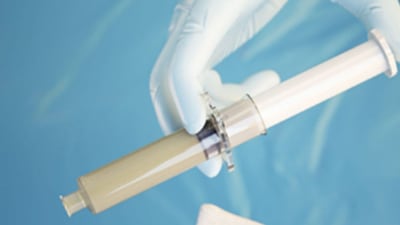
Blog: Wearables
Researchers developed a prototype for the Li-ion battery, which could lead to stretchy electronics or even clothes that monitor health.

INSIDER: Materials
A new type of ferroelectric polymer that is exceptionally good at converting electrical energy into mechanical strain holds promise as a high-performance motion controller or...

Q&A: Materials
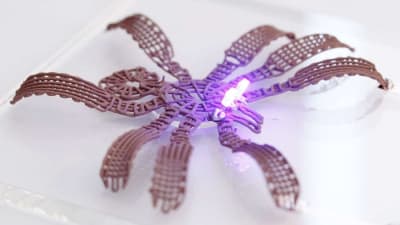
Professor Michael Dickey, of North Carolina State University, and his team have developed a unique process that allows you to print 3D metal objects that have good electric and thermal conductivity as well as good structural properties.
Special Reports: Medical

Medical Manufacturing & Outsourcing - August 2023
New 3D printing technique is a game-changer for medical device testing…automated 3D scanning speeds part inspection…how to eliminate PCB static in medical electronics. Read about these and...Briefs: Photonics/Optics
3D nanometer-scale metamaterial structures hold promise for advanced optical isolators.

Briefs: Lighting
A wavelength of visible light is about 1,000 times larger than an electron, so the way the two affect each other is limited by that disparity. Now, researchers have come up with a way to make...

Briefs: Robotics, Automation & Control
Researchers have demonstrated a caterpillar-like soft robot that can move forward, backward, and even dip under narrow spaces. Its movement is driven by a novel pattern of silver nanowires.

Briefs: Manufacturing & Prototyping
An international team of scientists is developing an inkable nanomaterial that they say could one day become a spray-on electronic component for ultra-thin, lightweight, and bendable displays and devices.
Briefs: Materials
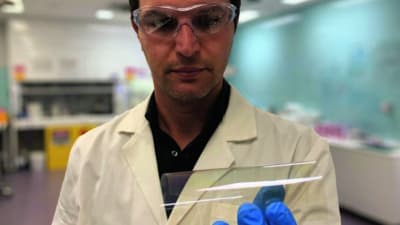
There’s still more to explore with REFLEX, but this process could open new possibilities for new materials and microstructures across fields from electronics to optics to biomedical engineering.

Top Stories
 Blog: Robotics, Automation & Control

Aerial Microrobots That Can Match a Bumblebee's Speed
 Blog: Electronics & Computers

Turning Edible Fungi into Organic Memristors
 Blog: Manufacturing & Prototyping

Revolutionizing the Production of Semiconductor Chips
 News: Energy

 INSIDER: Electronics & Computers

World’s Smallest Programmable, Autonomous Robots
 INSIDER: Manufacturing & Prototyping

Webcasts
 On-Demand Webinars: Power

E/E Architecture Redefined: Building Smarter, Safer, and Scalable Vehicles
 Upcoming Webinars: Energy

Hydrogen Engines Are Heating Up for Heavy Duty
 Upcoming Webinars: Electronics & Computers

Advantages of Smart Power Distribution Unit Design for Automotive...
 Upcoming Webinars: Automotive

Quiet, Please: NVH Improvement Opportunities in the Early Design...
 Upcoming Webinars: Power

A FREE Two-Day Event Dedicated to Connected Mobility
 Podcasts: Defense

How Sift's Unified Observability Platform Accelerates Drone Innovation