Stories
39
0
1440
30
Briefs: Mechanical & Fluid Systems
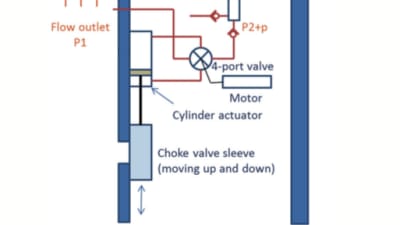
Various applications exist where high-pressure valves are required, but the problem for control of such valves lies in that they have to move against a strong...
Briefs: Mechanical & Fluid Systems
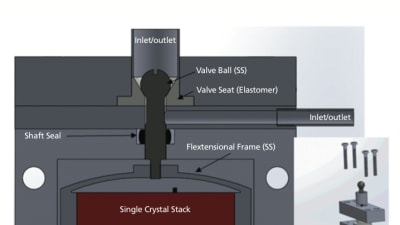
A lake and shore sampling and sample distribution system was developed for a Titan lake environment (93.7 K, in liquid hydrocarbons). The Titan Lake and Shore Sampler (TLASS) would enable the chemical analysis of...
INSIDER: Motion Control
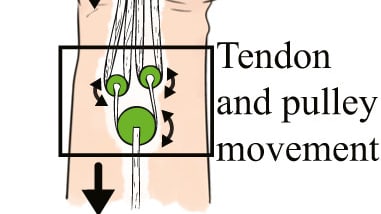
Engineers at Oregon State University have developed and successfully demonstrated a simple pulley mechanism to improve hand function after surgery. The device is one of the first instruments...
Briefs: Mechanical & Fluid Systems
Powder Handling Device for Analytical Instruments
A new technology provides for automated sample handling and movement of coarse-grained powder or other solid materials to enable analysis by a robotic or totally automated computer system. Currently, many analytical instruments require a powder sample to control the shape and/or volume of the...
Briefs: Mechanical & Fluid Systems
Method for Improved Gun-Drilled Cold Plate Fabrication and Inspection
A method was developed for obtaining proper fluid distribution through parallel gun-drilled passages and for being able to inspect the actual drilled passages to guarantee that the designed minimum wall thickness is not violated. This invention uses one feature that addresses...
Briefs: Mechanical & Fluid Systems
Nitrous Oxide Ethane-Ethylene Engine
The Nitrous Oxide Ethylene-Ethane (NEE) engine uses nitrous oxide as an autogenously pressurizing oxidizer, and a mixture of ethane and ethylene is used in the same manner as fuel. Initially, the ethane and ethylene mixture has the same vapor pressure as the nitrous oxide. By using the autogenous pressurization...
Briefs: Mechanical & Fluid Systems
Technology for a Comet Sample Return Mission Version 2
A standoff sample collection system would be capable of quickly obtaining a sample from environments as varied as comets, asteroids, and permanently shadowed craters on the Moon from vehicles ranging from traditional planetary spacecraft to platforms such as hovering rotorcraft or balloons at...
Briefs: Mechanical & Fluid Systems
Novel Catalytic Reactor System for CO₂ Reduction via Sabatier Process
A novel, short-contact-time Microlith Sabatier reactor system for CO2 reduction offers a significant advance in support of manned spaceflight. Compared to the current and prospective alternatives (including microchannels), the reactor is much smaller and lighter, more energy...
Briefs: Mechanical & Fluid Systems
Hovercraft Landing System
A concept for recovering reusable spacecraft or capsules, or reusable rocket boosters, has them land on an airbag-based, cushioned platform positioned on a highly maneuverable hovercraft. This landing method would have performance advantages over conventional approaches to reusability by placing most of the landing...
News: Mechanical & Fluid Systems
Untethered Soft Robot Walks Through Flames
Developers from Harvard’s School of Engineering and Applied Sciences and the Wyss Institute for Biologically Inspired Engineering have produced the first untethered soft robot — a quadruped that can stand up and walk away from its designers.
The researchers were able to scale up earlier soft-robot...
Briefs: Mechanical & Fluid Systems
Predicting turbulent flowfield and pressure drop in complex internal flows, such as valves, pumps, and turbines, is of great interest in many areas of...

Briefs: Mechanical & Fluid Systems
Visual International Space Station Configuration Viewing Tool
Communicating the current International Space Station (ISS) configuration and also potential ISS configurations is a necessity during ISS trade studies and Ops Con development. Often, multiple configuration options will need to be communicated. Doing so without a means of displaying an...
Briefs: Software
Evolutionary Mission Trajectory Generator
The Evolutionary Mission Trajectory Generator (EMTG) is a global trajectory optimization tool for designing interplanetary missions that perform multiple flybys and either low-thrust or high-thrust propulsive maneuvers on the way to destinations in the solar system. Some targets, such as Mars and Venus, are...
Briefs: Mechanical & Fluid Systems
Shipping Foam Designer Software
An easy-to-use design tool was developed in response to a large number of documented cases of critical (flight and ground) hardware failing after experiencing drops during commercial shipment. By entering the mass of the hardware to be protected, and the drop height, the software helps the user select the type and...
Briefs: Mechanical & Fluid Systems
Design Environment for Multi-Fidelity and Multi-Disciplinary Components
Many of the most challenging aspects of propulsion system development are related to the prediction of interacting effects among fluid loads, thermal loads, and structural deflection. A typical design practice might ignore the interaction between the physical phenomena where...
Briefs: Mechanical & Fluid Systems
Aerodynamic control surfaces, with excessive free-play, can cause limit cycle oscillations (LCO), a sustained vibration of constant amplitude. The LCO is caused by a...

Briefs: Mechanical & Fluid Systems
Algorithm Enhancements to Powered Descent Guidance Software
The Powered Descent Guidance (PDG) software provides a computationally efficient guidance algorithm for powered descent that ensures satisfaction of the governing dynamics, along with adherence to physical control and state constraints, such as avoid the surface, limit thrust magnitude and...
Briefs: Mechanical & Fluid Systems
Development of an Analytical Parameterized Linear Lateral Dynamic Model for an Aerobot Airship
Saturn’s moon Titan is of high interest for in situ study due to its many intriguing features. This moon has a dense atmosphere; rough, icy terrain; and low surface winds that make it the ideal place to send a controlled aerial robotic platform, such as...
Briefs: Mechanical & Fluid Systems
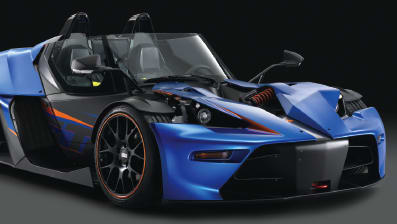
The use of composites is rapidly growing across many industries, fostering the need for new design, analysis, and optimization technologies. Every industry feels increasing pressure to launch breakthrough...
Briefs: Mechanical & Fluid Systems
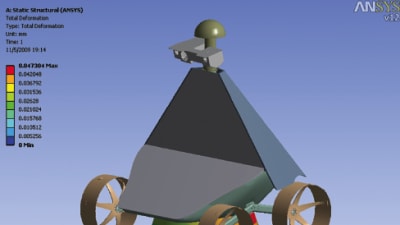
Equipment for space exploration is almost impossible to test on Earth. Testing is expensive and cannot replicate the conditions of launch, cruise, landing, and travel across a planetary surface. As...
Briefs: Mechanical & Fluid Systems
Fluid Disconnect Cooling Technique
The purpose of this innovation is to simulate the space temperature environment onto a fluid disconnect. This environment is to be maintained for a long period of time (48 hours) at a controlled temperature [6 ±2 °F(≈–14.4 ±1.1 °C)] to determine if temperature is causing leakage through the disconnect.
Briefs: Mechanical & Fluid Systems
Locomotion of Amorphous Surface Robots
The proposed techniques rely on three principal concepts: (1) controlling the polarity of electromagnets, (2) circulating fluid through a compartmentalized bladder, and (3) expanding and deflating polymers. These designs would allow amorphous robots to move across a surface without conventional wheels or legs....
Briefs: Mechanical & Fluid Systems
Machine vibration often originates with rotating driveline components such as rotors, gears, bearings, and fans. Such vibration is the source of unwanted noise and can be destructive to the machine. The vibration ring is a...

Briefs: Mechanical & Fluid Systems
Turbo-Brayton Converter for Fission Surface Power Applications
Producing electric power for space applications is challenging. Although short-term missions can use batteries or fuel cells, these sources are not practical for durations longer than one month. Photovoltaics become less attractive as the distance from the Sun increases, and they are...
Briefs: Mechanical & Fluid Systems
Rocket Vent Design With Variable Flow Control and Rain Protection
This innovation is a rocket purge vent design that can control and balance flow across multiple vents and across very large gas flow ranges while keeping water or other undesirable gases from entering into the vented space. When changing purge rates, this device adapts to the...
Briefs: Mechanical & Fluid Systems
Fail-Safe Accumulator for Internal Active Thermal Control Loops
Spacecraft internal active thermal control systems (ATCSs) typically use water or a water mixture as their working fluid. A gas-charged bellows accumulator pressurizes the system and provides liquid inventory control. If only a single internal ATCS loop is used, the accumulator...
Briefs: Mechanical & Fluid Systems
Very few industries are as affected by strict test standards as the automotive sector. Nearly every automobile component (engine parts, accelerators, clutches,...

News: RF & Microwave Electronics
Researchers Develop Solar Technologies, Origami-Style
As a high school student at a study program in Japan, Brian Trease would fold wrappers from fast-food cheeseburgers into cranes. He loved discovering different origami techniques in library books.Today, Trease, a mechanical engineer at NASA’s Jet Propulsion Laboratory in Pasadena, California,...
News: Aerospace
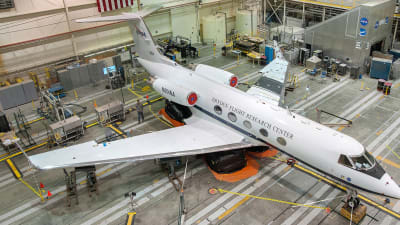
NASA Armstrong Flight Research Center’s Flight Loads Laboratory completed structural evaluations on a modified Gulfstream G-III aircraft that will serve as a test bed for the Adaptive...
Top Stories
 Blog: Lighting

A Stretchable OLED that Can Maintain Most of Its Luminescence
 INSIDER: Design

Advancing All-Solid-State Batteries
 Blog: Energy

Batteries that Can Withstand the Cold
 Blog: AR/AI

My Opinion: We Need More Power Soon — Is Nuclear the Answer?
 News: Power

 Blog: Aerospace

Webcasts
 On-Demand Webinars: Transportation

Quiet, Please: NVH Improvement Opportunities in the Early Design Cycle
 Upcoming Webinars: Test & Measurement

From Spreadsheets to Insights: Fast Data Analysis Without Complex...
 Upcoming Webinars: Aerospace

Cooling a New Generation of Aerospace and Defense Embedded...
 Upcoming Webinars: AR/AI

Beyond AI-Copy-Paste Engineering: Advanced AI-Integration Success...
 Upcoming Webinars: Energy

Battery Abuse Testing: Pushing to Failure
 Upcoming Webinars: Power