Stories
6,36,37,43,46,48,50,56,58,59,60
7,8,36,110,131,134,135,138,139,141,142,144,145,151,152,201,202
-1
480
30
Briefs: RF & Microwave Electronics
Incorporating a vision-based navigation method, NASA Ames has developed a novel Alternative Position, Navigation, and Timing (APNT) solution for AAM aircraft in environments where GPS is not available. Read on to learn more about it.

Briefs: Propulsion
A novel micropropulsion system was developed for nanosatellite applications using a liquid-fed pulsed-plasma thruster. It uses a liquid propellant for a Lorentz-force pulsed-plasma accelerator and an extended lifetime ignition system driven by nanosecond-long pulses. Read on to learn more.

Briefs: Aerospace
Over the past year, the DoD has awarded funding to hypersonics research led by University of Central Florida Mechanical and Aerospace Engineering Professor Kareem Ahmed to support the advancements he’s making in the technology. The support is a testament to the progress UCF has made in the field. Read on to learn more about these advances.

Briefs: Software
To address scalable control of orbital dynamics, NASA Ames Research Center has patented Swarm Orbital Dynamics Advisor (SODA) — a solution that accepts high-level configuration commands and provides the orbital maneuvers needed to achieve the desired type of swarm relative motion. Read on to learn more.

Briefs: Green Design & Manufacturing
A research team from the University of Waterloo’s Laboratory for Emerging Energy Research is looking into processing lunar regolith, the Moon’s top layer of soil and dust, into usable materials for life support, energy generation, and construction. This includes investigating the use of defunct satellite material as a fuel source when mixed with lunar regolith. Read on to learn more.
Briefs: Photonics/Optics
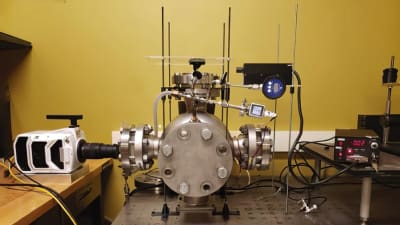
In a paper published in the journal Nature Nanotechnology, a team of Caltech engineers reports building a metasurface patterned with miniscule tunable antennas capable of reflecting an incoming beam of optical light to create many sidebands, or channels, of different optical frequencies. Read on to learn more.

Briefs: Wearables
Purdue University engineers have developed a method to transform existing cloth items into battery-free wearables resistant to laundering. These smart clothes are powered wirelessly through a flexible, silk-based coil sewn on the textile. Read on to learn more.

Briefs: Materials
Potential Solvents for Building on Moon and Mars
Researchers have taken the first steps toward finding liquid solvents that may someday help extract critical building materials from lunar and Martian rock dust, an important piece in making long-term space travel possible. Read on to learn more.
Application Briefs: Aerospace
The aerospace industry is in an era of profound innovation. Airplanes and air travel are transforming in response to the needs of the global economy, necessitating the building of aircraft at an accelerated pace. Enter NWI. With over 50 years of long-bed machining expertise, NWI is a contract manufacturer of complex structural components, sub-assemblies, and complete major assemblies of wing structures. Read on to learn more.

Articles: Manned Systems
See the products of tomorrow, including a 3D microwave antenna, smart CCTV systems trained to spot blockages in urban waterways, and a full-scale prototype for six telescopes that will enable, in the next decade, the space-based detection of gravitational waves.

Videos of the Month: Electronics & Computers
See the videos of the month, including one on Michigan Engineering racing its 17th solar car, Astrum, across the Australian Outback; one on how NASA’s Europa Clipper — a 7,000-pound spacecraft — was packed and shipped from the agency’s Jet Propulsion Laboratory in Southern California to Kennedy Space Center in Florida; one on the MIT Media Lab’s Space Exploration Initiative; and one on leveraging precision growth to convert plants into biodegradable electronic devices.

Articles: Materials
Weight is among the most critical factors behind component choice when it comes to aerospace applications. Being among the bulkiest of components, connectors and cables need to embrace the latest scientific advances in order to reduce weight and enhance performance, fuel efficiency, and overall system reliability. This article outlines the recent advances enabling lighter connectors for aircraft, satellites, and drones.

Special Reports: Sensors/Data Acquisition
Robotics - November 2024
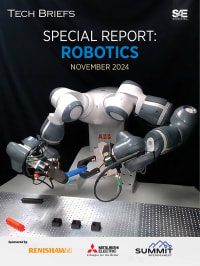
Read about the latest breakthroughs in robots for space exploration, healthcare, factory automation, hazardous waste cleanup, and more in this collection of articles from the editors of Tech Briefs, Medical Design...Blog: Electronics & Computers
Researchers at Tampere University have developed the world’s first soft touchpad that can sense the force, area, and location of contact without electricity. The device utilizes pneumatic channels, enabling its use in environments such as MRI machines and other conditions that are unsuitable for electronic devices.

Special Reports: Green Design & Manufacturing

Medical Manufacturing & Outsourcing - November 2024
Unlocking the power of data for pharma manufacturing…solving testing challenges in medical device packaging…personalizing medications on a 3D printer. Read about these and other advances...Quiz: Propulsion
How much do you know about how hydrogen-powered aircraft work and the companies that are researching and developing hydrogen-powered aircraft programs? Find out with this quiz.
INSIDER: Medical
Researchers at the German Primate Center, Leibniz Institute for Primate Research in Göttingen, have developed a novel training protocol for brain-computer interfaces in a...

INSIDER: Propulsion
A peek through an optical microscope reveals a hidden universe teeming with life. Nature has devised ingenious methods for micro-organisms to navigate their viscous...

Products: Medical
2024 Product of the Year
Each month, our editors choose a Product of the Month that has exceptional technical merit and practical value for our design engineering readers. Those 11 products are the nominees for the 2024 Tech Briefs Readers’ Choice Product of the Year. You’re invited to cast your vote for the one product among the 11 listed in this article that you feel was the most important new product introduced to the engineering community in 2024.
Blog: Defense
The Create the Future Design Contest has helped bring out the best technologies for the future throughout its 22-year run. The annual contest had the finalists in each of the seven categories pitch their ideas to a team of judges, who would then choose the Grand Prize winner. Read on to learn who won.

Q&A: Aerospace
Professor Animashree (Anima) Anandkumar and her team at The California Institute of Technology (Caltech) have developed a control strategy for unmanned aerial vehicles (UAVs) that uses reinforcement learning to adaptively learn how turbulent wind can change over time and then uses that knowledge to control the UAV based on what it is experiencing.

Tech Talks: Medical

A properly designed and executed wear study can be a powerful tool when selecting an adhesive for a medical device — an adhesive that enhances device effectiveness and durability, and...
Podcasts: AR/AI
U.S. Army leadership discusses how the Army wants to use AI and ML for processing, exploitation, and dissemination.

NASA Spinoff: Manufacturing & Prototyping
The new possibility of 3D-printed aluminum engine parts will mean significant savings for NASA in terms of time, money, and, most importantly, the weight of future spacecraft. Elementum 3D Inc., a partner on the project, is now bringing the benefits of that technology to its customers.
Podcasts: Defense
Michael Amori, CEO and co-founder of Virtualitics, is the guest on this episode of the Aerospace & Defense Technology podcast to explain how the Air Force is using Integrated Readiness Optimization for weapons sustainment.
Briefs: Green Design & Manufacturing
Researchers have developed a new way to map water on land in the tropics. Called the UC Berkeley Random Walk Algorithm WaterMask, this advanced monitoring technology uses L-band microwaves from the Cyclone Global Navigation Satellite System to “see” water hidden beneath visual barriers, like tree canopies and clouds. Read on to learn more.

Application Briefs: Medical
A team of researchers from Rice University has introduced 50-nm gas-filled protein nanostructures derived from genetically engineered gas vesicles(GVs) that are referred to as 50 nmGVs. Read on to learn more.

Articles: Energy
The Department of Energy has given the green light for construction to begin on a high-energy upgrade that will further boost the performance of the Linac Coherent Light Source (LCLS), the world’s most powerful X-ray free-electron laser (XFEL) at the DOE’s SLAC National Accelerator Laboratory. Read on to learn more about it.

Videos of the Month: Robotics, Automation & Control
See the videos of the month, including one on a humanoid robot that can effortlessly learn and perform a variety of expressive movements all while maintaining a steady gait on diverse terrains; one on Picotaur, the first legged robot of its size to run, turn, push loads, and climb miniature stairs; one on the DoD’s All Domain Test Range; and one on using generative AI and cutting-edge scene-mapping technology to elevate robots from simple tools to being capable of providing aid in disaster and battlefield scenarios.

Top Stories
 Blog: Power

My Opinion: We Need More Power Soon — Is Nuclear the Answer?
 Blog: AR/AI
Aerial Microrobots That Can Match a Bumblebee's Speed
 News: Energy

 Blog: Electronics & Computers

Turning Edible Fungi into Organic Memristors
 Blog: Robotics, Automation & Control

Microscopic Swimming Machines that Can Sense, Respond to Surroundings
 INSIDER: Sensors/Data Acquisition

Webcasts
 Upcoming Webinars: Energy

Hydrogen Engines Are Heating Up for Heavy Duty
 Upcoming Webinars: Transportation

Advantages of Smart Power Distribution Unit Design for Automotive...
 Upcoming Webinars: Automotive

Quiet, Please: NVH Improvement Opportunities in the Early Design...
 Upcoming Webinars: Test & Measurement

From Spreadsheets to Insights: Fast Data Analysis Without Complex...
 Upcoming Webinars: Power

Battery Abuse Testing: Pushing to Failure
 Upcoming Webinars: Internet of Things