Topics

Health, Medicine, & Biotechnology

Technology & Society: Robotics, Automation & Control
At-Home Robotic Rehabilitation
subscribe to newsletter
Each week get the latest tech briefs & key industry topics… delivered to your inbox!

Latest Briefs & News

43
-1
0
30
Special Reports: Connectivity
Document cover
Designing The Future Of Safe Electronics - January 2026
Cybersecurity for tomorrow's software‐defined vehicles…designing reliable fast chargers for next‐gen wearable devices…selecting the right sensor for smart systems. Read about these...

White Papers: Sensors/Data Acquisition
Document cover
Calculating Liquid Flow Through Orifices — A Technical Guide
For the broad array of industrial applications concerned with liquid flow control, extremely accurate, repeatable results are necessary to successful operation. To achieve such...

White Papers: Medical
Document cover
The Role of Linear Actuators in the Miniaturization of Medical Equipment
The medical industry is constantly growing, which has led to stricter requirements for medical equipment. Installation space is one particular area where designers and...

INSIDER: Electronics & Computers
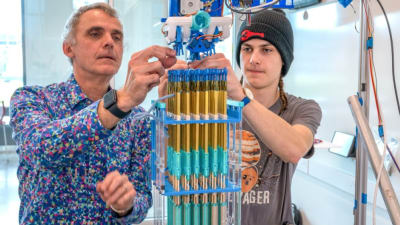
The phrase ‘liquid metal’ may bring to mind something hazardous, like mercury or molten steel. But in the Laboratory of Photonic Materials and Fiber Devices (FIMAP) in EPFL’s School of...
Feature Image
Podcasts: Medical
The challenges and opportunities in developing greener drug delivery solutions without compromising performance and safety.
Feature Image
Briefs: Test & Measurement
A collaborative multidisciplinary team of researchers from the Perelman School of Medicine at the University of Pennsylvania and the Tandon School of Engineering at New York University has developed a miniature device that could transform how blood cancer treatments are tested and tailored for patients. Read on to learn more.
Feature Image
Briefs: Medical
Researchers from RMIT University have developed a wearable wound monitoring device with integrated sensors that could reduce infection risks by minimizing the need for frequent physical contact. Read on to learn more about it.
Feature Image
Briefs: Medical
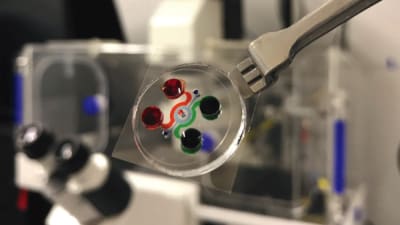
NASA Johnson Space Center has developed the Micro-Organ Device (MOD) platform technology that serves as a drug screening system with human or animal cell micro-organs to supplement and reduce animal studies while potentially increasing the success of clinical trials. Read on to learn more.
Feature Image
Briefs: Manufacturing & Prototyping
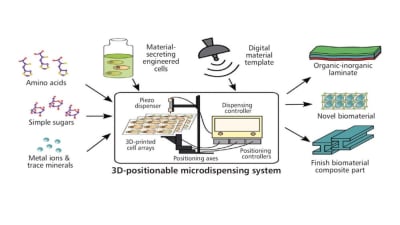
NASA has developed a novel approach for macroscale biomaterial production by combining synthetic biology with 3D printing. This innovation provides modern design and fabrication techniques for custom-designed organic or organic-inorganic composite biomaterials produced from limited resources. Read on to learn more.
Feature Image
Special Reports: Materials
Document cover
Medical Manufacturing & Outsourcing - November 2025
Spider silk spins new life into nerve repair…3D‐printed implants help repair spinal cord injuries…plasma pen transforms adhesion in medical device manufacturing. Read about these and...

Podcasts: Medical
Targeted intra-arterial delivery platforms bathe cancer directly in therapy while limiting systemic toxicity.
Feature Image
White Papers: Materials
Document cover
How Parylene Crushes Sterilization, Friction & FDA Hurdles
Discover how thin-film Parylene conformal coatings safeguard medical devices with unmatched biocompatibility, reliability, and performance under extreme conditions. In this insightful...

INSIDER: Medical
A new prototype of a knitting machine creates solid, knitted shapes, adding stitches in any direction — forward, backward, and diagonal — so users can construct a wide variety of shapes and add...
Feature Image
INSIDER: Robotics, Automation & Control
Researchers from UMass Amherst are working to define the primary mathematical components of running. Compared to walking, much less is understood about...
Feature Image
On-Demand Webinars: Communications
Feature Image
The future is wireless and the future of medical devices even more so. From wearable medical technologies — which now come with embedded Bluetooth, wireless...
Podcasts: Medical
First Ascent’s platform enables pharmaceutical partners to test drug candidates against live cancer cells.
Feature Image
Podcasts: Green Design & Manufacturing
New materials are enabling the production of medical devices that are stronger, more flexible, and more sustainable.
Feature Image
Technology & Society: Imaging
A wearable device, a-Heal, designed at the University of California, Santa Cruz, aims to expedite the entire healing process. It uses a tiny camera and AI to detect the stage of healing and deliver treatment in the form of medication or an electric field.
Feature Image
Podcasts: Robotics, Automation & Control
AI-driven quality control, predictive maintenance, and process optimization are improving efficiency and reducing costs in medical manufacturing.
Feature Image
Blog: Design
The 23rd annual Create the Future Design Contest was held November 7 in New York City. Read on to find out who took home the $25,000 grand prize!
Feature Image
White Papers: Materials
Document cover
Strategies to Prevent Costly Medical Device Recalls
Medical device recalls are increasing, creating serious risks for patients and manufacturers.

INSIDER: Medical
Berkeley alumni Todd Roberts (MEng’20 ME) and Owen Kent (B.A.’17 Film) have shown how an idea can turn into a product that makes a difference. The pair first developed Reflex,...
Feature Image
INSIDER: Design
Researchers have developed a soft robotic skin that enables vine robots a few millimeters wide to navigate convoluted paths and fragile environments. To accomplish...
Feature Image
On-Demand Webinars: Medical
Feature Image
Traditional medical devices interfacing with biological tissue often rely on individual wiring and machined metal parts, resulting in high costs,...
Articles: Energy
In this article, you’ll learn about the Create the Future Design Contest finalists in all seven categories chosen from over 600 new product ideas submitted from 67 countries.
Feature Image
Articles: Design
The first real-time, wearable blood viscosity monitoring device fills a long-standing void in trauma, burn, and sepsis care by delivering continuous, noninvasive insights into the body’s fluid and vascular dynamics. Read on to learn more about the technology, which was the Medical finalist at the 2025 Create the Future Design contest.
Feature Image
Briefs: Physical Sciences
Soft robots, medical devices and implants, and next-generation drug delivery methods could soon be guided with magnetism — thanks to a metal-free magnetic gel developed by researchers at the University of Michigan and the Max Planck Institute for Intelligent Systems in Stuttgart, Germany. Read on to learn more about it.
Feature Image
Briefs: Medical
A study conducted by Fuyang Yu and his colleagues introduces an innovative approach to lower limb rehabilitation. Their research outlines the development of a lower limb rehabilitation robot designed to significantly improve the safety and effectiveness of gait training through a novel method based on human-robot interaction force measurement. Read on to learn more.
Feature Image

Videos