8,33,42,44,45,47,52,54,68
-1
30
30
Briefs: Data Acquisition
This lightweight, portable garment is designed for active shoulder and elbow positioning.

Briefs: Robotics, Automation & Control
Researchers at Fuzhou University in China created a machine vision sensor that uses quantum dots to adapt to extreme changes in light far faster than the human eye can — in about 40 seconds — by mimicking eyes’ key behaviors. Their results could be a game changer for robotic vision and autonomous vehicle safety. Read on to learn more.

Briefs: AR/AI
Finding the next groundbreaking polymer is always a challenge, but now Georgia Tech researchers are using artificial intelligence (AI) to shape and transform the future of the field. Read on to learn more.
Briefs: Data Acquisition
NASA has developed a new technology to track the status of, and changes to, enterprise level programmatic operations. Read on to learn more about it.

Briefs: Energy
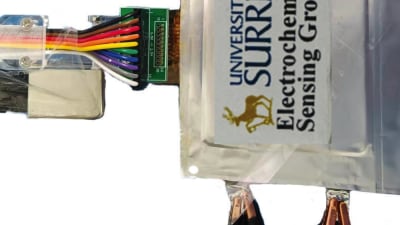
New smart sensors can help detect dangerous internal failures in lithium-ion batteries before they escalate into fires or explosions, say researchers from the University of Surrey. Read on to learn more.
Briefs: Energy
In a major step forward for sustainable energy technology, researchers at Worcester Polytechnic Institute, led by Professor Yan Wang, William B. Smith Professor of Mechanical and Materials Engineering, have developed a new, scalable method to recycle lithium-ion batteries in a way that is both efficient and environmentally friendly. Read on to learn more.

Briefs: Materials
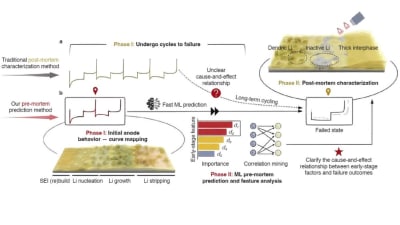
In a groundbreaking study, researchers at Tsinghua Shenzhen International Graduate School and the Shenzhen Institute of Advanced Technology, Chinese Academy of Sciences, have developed a predictive model that uses electrochemical data from the initial cycles of LMBs to forecast potential failures. Read on to learn more.
Briefs: Energy
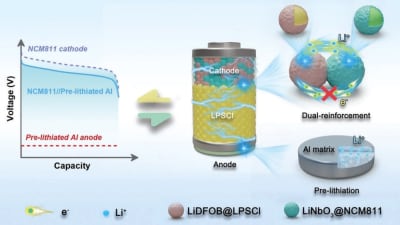
Researchers from Nanjing University, led by Professor Ping He and Professor Shaochun Tang, have published a comprehensive study in Nano-Micro Letters on the development of high-energy, stable all-solid-state lithium batteries using aluminum-based anodes and high-nickel cathodes. Read on to learn more about it.
Briefs: Energy
A team of Rice University researchers led by materials scientist Ming Tang showed that even if the materials used in thick battery electrodes have nearly identical structures, their internal chemistry impacts energy flow — and, hence, performance — differently. This finding goes against conventional wisdom in the field. Read on to learn more.
Briefs: Power
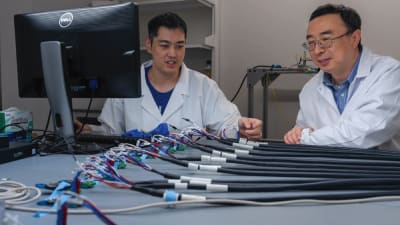
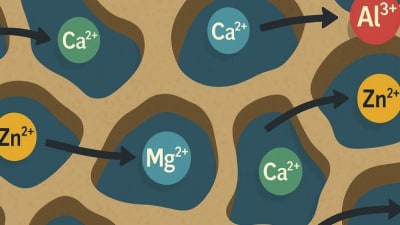
In research published in Cell Reports Physical Science, an NJIT team successfully applied generative AI techniques to rapidly discover new porous materials capable of revolutionizing multivalent-ion batteries. Read on to learn more.
Briefs: Energy
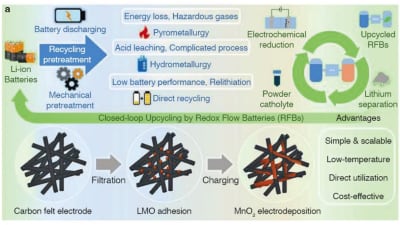
A research team led by Dr. Yosep Han at the Korea Institute of Geoscience and Mineral Resources has successfully developed an eco-friendly electrochemical process to upcycle lithium manganese oxide, a common cathode material in spent lithium-ion batteries. Read on to learn more.
Briefs: Motion Control
Researchers from MIT and NVIDIA Research have developed a novel algorithm that dramatically speeds up a robot’s planning process. Their approach enables a robot to “think ahead” by evaluating thousands of possible solutions in parallel and then refining the best ones to meet the constraints of the robot and its environment. Read on to learn more.

Briefs: Physical Sciences
Animals like bats, whales, and insects have long used acoustic signals for communication and navigation. Now, an international team of scientists have taken a page from nature’s playbook to model micro-sized robots that use sound waves to coordinate into large swarms that exhibit intelligent-like behavior. Read on to learn more.

Briefs: Aerospace
NASA has developed an innovative combination of a Magnetometer, low-powered ElectroMagnets, and Resonant Inductive Coupling (MEMRIC) to create and control relative positioning of nano satellites within a cluster. This is a game-changing approach to enable distributed nanosatellite (nanosat) clusters. Read on to learn more.

Briefs: Software
Northwestern engineers have developed a new system for full-body motion capture — and it doesn’t require specialized rooms, expensive equipment, bulky cameras, or an array of sensors. Instead, it requires a simple mobile device. Read on to learn more.

Briefs: Semiconductors & ICs
Maksym Kovalenko and his team have proposed a novel solution that allows them to utilize every photon of light for color recognition. For nearly a decade, they have been researching perovskite-based image sensors. In a new study published in Nature, they show that their new technology works. Read on to learn more.

Briefs: Sensors/Data Acquisition
KAUST researchers have invented a robust, highly sensitive, low-cost hydrogen sensor that outperforms available commercial detectors, offering a vital safeguard for the burgeoning hydrogen economy. Read on to learn more.

Briefs: Physical Sciences
Plans are underway to create more powerful particle accelerators, whose collisions will unleash large subatomic storms. How will researchers sift through the chaos? Read on to find out.

Briefs: AR/AI
Researchers have provided a new open-source algorithm called Conditional Variational Diffusion Model (CVDM). Based on generative AI, this model improves the quality of images by reconstructing them from randomness. In addition, the CVDM is computationally less expensive than established diffusion models — and it can be easily adapted for a variety of applications. Read on to learn more.

Briefs: Energy
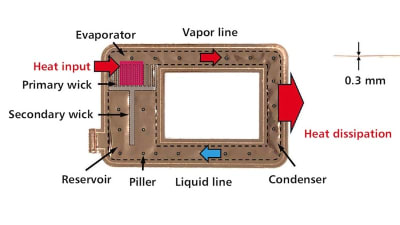
Scientists from Nagoya University in Japan have developed an innovative cooling device — an ultra-thin loop heat pipe — that significantly improves heat control for electronic components in smartphones and tablets. Read on to learn more.
Briefs: Energy
Researchers at North Carolina State University have now identified a “sweet spot” at which the length of a threadlike energy storage technology called a “yarn-shaped supercapacitor” yields the highest and most efficient flow of energy per unit length. Read on to learn more.

Briefs: Power
University of California San Diego and CEA-Leti scientists have developed a ground-breaking piezoelectric-based DC-DC converter that unifies all power switches onto a single chip to increase power density. Read on to learn more about this new power topology, which extends beyond existing topologies and blends the advantages of piezoelectric converters with capacitive-based DC-DC converters.

Briefs: Software
A research team from Japan has fabricated a flexible multimodal wearable sensor patch and developed edge computing software that is capable of detecting arrhythmia, coughs, and falls in volunteers. Read on to learn more about the sensor, which uses a smartphone as the edge computing device.

Briefs: Sensors/Data Acquisition
Engineers at MIT, Nanyang Technological University, and several companies have developed a compact and inexpensive technology for detecting and measuring lead concentrations in water, potentially enabling a significant advance in tackling this persistent global health issue. Read on to learn more.

Briefs: Energy
Buildings are big energy consumers, emitting wasteful carbon, contributing to a warming planet, and accounting for more than 40 percent of the world’s carbon dioxide emissions. Fortunately, a new startup is paving the way for dramatic reductions in carbon from building operations. Lamarr. AI has perfected the process of using drones, thermal imaging, and artificial intelligence (AI) to diagnose the health of building exteriors and roofs. Read on to learn more.

Briefs: Energy
AI systems like ChatGPT are notorious for being power-hungry. To tackle this challenge, a team from the Centre for Optics, Photonics and Lasers has come up with an optical chip that can transfer massive amounts of data at ultra-high speed. As thin as a strand of hair, this technology offers unrivaled energy efficiency. Read on to learn more.
Briefs: Photonics/Optics
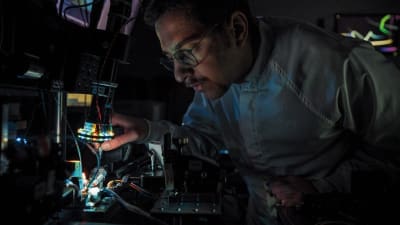
As fast as modern electronics have become, they could be much faster if their operations were based on light, rather than electricity. Fiber optic cables already transport information at the speed of light, but to do computations on that information without translating it back to electric signals will require a host of new optical components. Researchers have now developed such a device. Read on to learn more.

Briefs: Software
Engineers at the University of California San Diego have achieved a long-sought milestone in photonics: creating tiny optical devices that are both highly sensitive and durable — two qualities that have long been considered fundamentally incompatible. Read on to learn more.
Briefs: Semiconductors & ICs
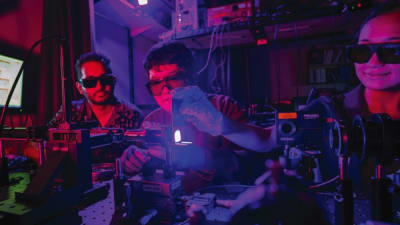
Researchers have invented a new type of tunable semiconductor laser that combines the best attributes of today’s most advanced laser products, demonstrating smooth, reliable, wide-range wavelength tuning in a simple, chip-sized design. Read on to learn more about it.

Top Stories
 Blog: Lighting

A Stretchable OLED that Can Maintain Most of Its Luminescence
 Blog: Energy

Batteries that Can Withstand the Cold
 INSIDER: Energy

Advancing All-Solid-State Batteries
 Blog: Power

My Opinion: We Need More Power Soon — Is Nuclear the Answer?
 Quiz: Power

 Blog: Data Acquisition

Webcasts
 Upcoming Webinars: Test & Measurement

From Spreadsheets to Insights: Fast Data Analysis Without Complex...
 Upcoming Webinars: Defense

Cooling a New Generation of Aerospace and Defense Embedded...
 Upcoming Webinars: AR/AI

Beyond AI-Copy-Paste Engineering: Advanced AI-Integration Success...
 Upcoming Webinars: Automotive

Battery Abuse Testing: Pushing to Failure
 Upcoming Webinars: Connectivity

A FREE Two-Day Event Dedicated to Connected Mobility
 Upcoming Webinars: RF & Microwave Electronics

Choosing the Right N-Port Strategy: Multiport VNAs vs. Switch...